Have you watched Ted Lasso? If you have you might already know what I’m talking about here. In which case, stick with me anyway because who knows, I might say something borderline interesting at some point. If you’ve never heard of it, don’t worry because the theme of it isn’t crucial to what I’m going to talk about anyway. Basically, whomever you are, and whatever your current relationship with Ted Lasso, from superfan to total obliviousness, let’s just agree that you carry on reading and I’ll carry on writing, yeah?
[For those novices, suffice to say that Ted Lasso is a comedy series about a football coach from the USA who comes over to London to manage a fictional club in Richmond. Sounds a bit crap, but it’s absolutely brilliant – less piss-taking about Americans saying “soccer” instead of football and more of a case study in vulnerable leadership. And you don’t need to like football to enjoy it either – my wife is Welsh and hates football and we devoured each series like a pack of children at a party devouring the birthday cake which a loving aunt took ages baking but was only actually on display for about 45 seconds before it was cut into irregular size pieces and put in paper napkins to be squashed in a party bag along with a bouncy ball and an almost unbelievably small fun-size Mars bar]
So, with those somewhat unnecessary and [let’s be honest here] rambling introductory passages behind us, let’s get into the bones of this, shall we?
There’s a point in the second series where the team are in a real slump. They’re playing terribly, and losing, and it seems like all might be lost. It’s at this lowest ebb, where the team are starting to come apart at the seams and individuals are blaming individuals for the failing of the whole, that Ted gives an impassioned talk about his belief in “rom-communism”.
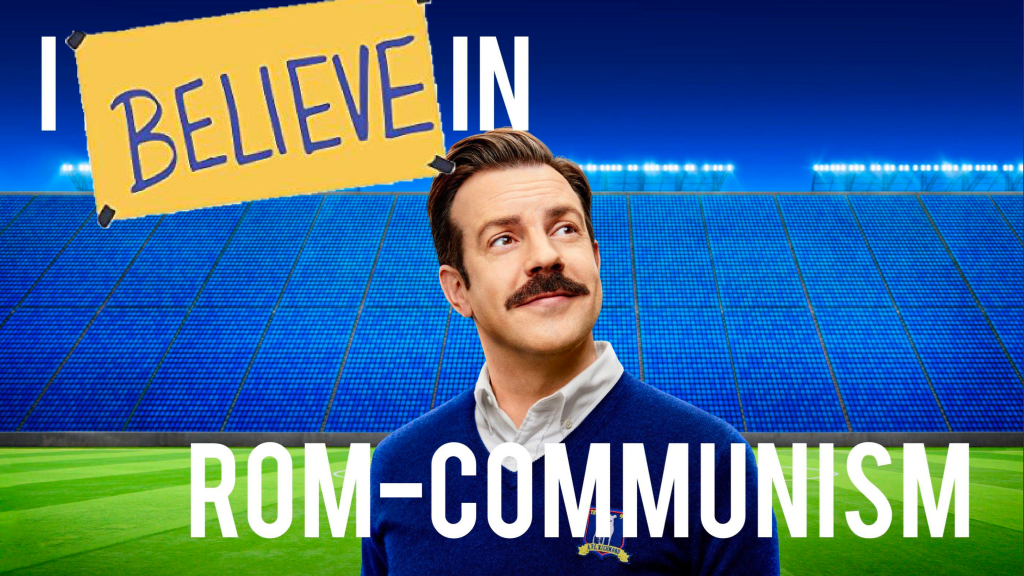
Rom-communism is a concept borrowed from the classic romantic-comedy movie narrative, where in the middle of the film everything is a right old mess and it looks like the two protagonists aren’t actually going to end up together. Yet by the end of the film, everything tends to work out.
So for Ted, a belief in rom-communism is a belief that everything’s going to work out in the end..
Now these next few months might be tricky, but that’s just ’cause we’re going through our dark forest. Fairy tales do not start, nor do they end, in the dark forest. That son of a gun always shows up smack-dab in the middle of a story. But it will all work out.
Now, it may not work out how you think it will, or how you hope it does, but believe me, it will all work out.
Exactly as it’s supposed to.
Our job is to have zero expectations and just let go.
Ted Lasso: Season 2, Episode 5
It’s stuck with me, this scene. I don’t believe in fate: the idea that our lives are somehow pre-ordained and we are destined for something whether we like it or not. I also don’t really believe in luck, whilst we’re on the subject of things somehow bigger and more mysterious than ourselves. It’s not “lucky” that stick wasn’t closer to our younger son Jack’s eye [true story – he’s currently on course to take the title of “World’s Clumsiest Living Human”] any more than it’s lucky when you don’t stab yourself in the face with your fork when you’re eating. And whilst we’re on this particular soapbox, no, it’s not “spooky” when you ring your friend and they answer and say “oh my God I was literally just about to call you!!” any more than it’s spooky that you didn’t ring them all the dozens of other times they were about to call.
So no, I don’t believe things will work out as they were always going to. But I do believe that things tend to work out as they are supposed to…
Through the middle of last year I had a pretty confusing time of things, particularly with what was going on at work. [I lknow, bloody work, eh?]. Having thought things were going to go one way, it became clear that things were going to go a completely different way and there wasn’t a damn thing I could do about it.
Looking back on it, there were things I could have done differently, and there are things I’d do exactly the same, but the bottom line was that it was really disruptive and difficult for loads of reasons, surprisingly few of which are anything to do with me, actually. Some relationships I thought were solid turned out not to be. Others turned out to be stronger than I’d thought. But whilst I was right in the middle of it, forgetting about the second agreement I made with myself to not take anything personally, I took everything personally. Whoops!
[If you’re wondering about the other agreements, or indeed wondering why I’m going around making agreements with myself and thinking that perhaps I should have a nice cup of tea and a sit down, you can find out more about The Four Agreements in a blog I wrote about it all here. It’s good stuff but don’t just take my word for it: you can ask my mate Caroline’s husband, who told me he liked it (hello Aaron mate!) and he really had no reason to lie to me.]
Yes, that’s right: I was going through my deep, dark forest.
And for a while there, I forgot that fairy tales do not begin, nor do they end, in the dark forest. That they always turn up in the middle of a story.
I won’t apologise for that, because… well because I’m not sorry, basically. I lost my way a bit, and weirdly I didn’t actually realise that I’d lost my way until I stumbled out of the darkness of the forest into a clearing, and saw the wide expanse of the sky for the first time in a long time and suddenly became acutely aware that I’d been holding on so tightly to expectations that I’d lost the plot of my own story and, to a degree, lost myself.
Forgive me for taking a short detour here. That idea of “lost myself” is interesting to me. We’ve all felt a version of this at some point and we’ve got lots of ways of talking about it: I was not feeling myself; I was beside myself. I do think it’s all about how we understand our own sense of “self”, and actually it’s when we are furthest from our own values that we feel most disconnected from ourselves, and most lost in the world as a result.
Actually connecting to that disconnection was, for me, the first step in the next part of the journey.
My good friend, and cherished colleague, Sir Olly of Caporn [take a bow, Oliver] and I were chatting recently and he casually and without ceremony said something very profound, as he tends to occasionally:
The story only makes sense when you reach the end.
Like a great whodunnit, or crime drama, or, yes, even a rom-com… when you get to the end of the story, it all makes sense, and then when you look back you can see how it all fits together.
And that’s how I feel now, With a new world of work opening up, with all the possible roads that I could have taken but didn’t now just sub-plots that didn’t happen or didn’t go anywhere, it seems almost daft to think that things could have ended up any way than the way they’ve actually ended up.
I’m not saying this is the end of the story, because of course it’s the start of a completely new one. But it’s the end of that story, and whilst it did not work out how I thought it would, or how, at the time, I hoped it was going to, dammit if it didn’t all work out. Exactly as it was supposed to, I guess.
You may, as you read this, be in your own dark forest. I’m really sorry if you are. I know how much that sucks.
I also know that sometimes, we need to sit down in the forest, and take a moment. To check on our values and on our sense of self, and just take a moment. I’m the last person to tell you to pick yourself up and dust yourself down and carry on struggling through the thick undergrowth and sharp leaves and grabbing vines before you’re good and ready. Because we both know that has to come from you.
But we both know you will have to decide to pick yourself up and dust yourself down at some point.
And when you make that decision, remember that fairy tales do not start, nor do they end, in the dark forest. This isn’t the end of the story. Your job is to have zero expectations, and just let go.
And know that when you get to the end of the story that you’ll be able to look back and understand it all.
You’ll know that, even though it was hard, things worked out, somehow.
You’ll know more about yourself. Your values., Your principles.
And maybe, just maybe, that’s all part of the story, too.

 The Bartlett Bubble
Great piece Phil. This reminds me of something my dear grandad always used to say when he wanted to reassure me about anything. He would say “It will all be ok in the end. And if it’s not ok, it’s not the end”
LikeLike
Love that – someone said something similar to me last year too!
LikeLike
is someone peeling onions? great piece as always.
LikeLike