Wherefore International Men’s Day?

Good question. There is an argument that, in a world created by men and for men, a world where men hold most of the power, every day is “Men’s Day”.  We all know there are more male CEOs than female, but to put that into context the latest data tells us there are more men called John running FTSE 250 companies than there are women. Not women called John, in case you’re wondering. Women. In total. And we all know there are more male heads of government than female, but to follow through and put that into context, just 19 of the 193 member states of the United Nations currently have female head of state. More than two thirds have never had a female head of state in their entire history.

And some of those male heads of state we are subjected to now really are some of the most caricatured examples of toxic masculinity you could ever hope to avoid, building their palaces and breeding their bullshit authoritarianism as a shield to protect their eggshell thin egos. Trump, Putin, Netanyahu, Orban, Jong Un, Milei. And many more like them, or hoping to be. I’m not sure what the question is for this bunch of bullies but the answer is “unresolved childhood trauma”. I can’t make up with my father/mother/teacher/first girlfriend so I’ll build up an armour made up of sycophants and wealth and as much power as I can possibly hold in my little hands.

When I took my first steps into my work on diversity, equity and inclusion, there was a shared belief that things were getting better, particularly around gender equality. The dictionary definition of feminism is the belief that women should have the same rights, opportunity and, yes, “power” as men, and that seemed to be shifting, albeit very slowly. But thanks to this lot, and their acolytes, we’ve taken a few big steps backwards over the last couple of years.

[Yeah, I did drop it in there, didn’t I? The dreaded curse of DEI which is now put forward as the reason why society is a so fractious and divided, conveniently and maliciously ignoring the fact that it all stems from wealth inequality which started with ideological free market economics, wandered through the failed experiment of privatisation, jogged past the systematic deindustrialisation of swathes of countries and communities wearing nothing but a flimsy coat of consumerism, skipped into a garden of easy access to credit and slammed right into the greed-fuelled banking bubble of the 2008 financial crisis.
People have been sold the story that the problem is “woke”, forgetting that they were actually there and saw it happen. Don’t you remember? It was the banks! Billions of your taxes went to bail out a bunch of (overwhelmingly male) bankers that had become gorged on greed. You must remember that? It wasn’t giving more opportunity to those who didn’t have as much in an effort to level the playing field. It was the fucking banks! You were there! REMEMBER?
Hmm, this might be a separate blog now I come to think of it. Where was I? Oh yeah “power”]

It’s not just “power” of course. Data from the World Economic Forum tell us that whilst there has been change in the gender gap in Economic Participation and Opportunity (money, basically) since 2006, if we keep going at the current rate it will take 169 years to close the gender gap completely. [Yeah, I know, that’s such a long time that it almost seems silly counting it doesn’t it?]. A big part of that is because women still do around 60% more unpaid work – cooking, cleaning, childcare, caring – than men, none of which is recognised in the economy but all of which impacts on time and, by extension, the need for more flexible working to fit it all in.

So yeah, it’s a man’s world. Then why on Earth do we need International Men’s Day?

Well, because the day is less about celebrating men in general, and more about recognising the need for positive conversations around manhood and masculinity. And about stripping back some of the baggage, too.

And there is baggage that comes with being a man. I mentioned in these pages a while back a book I’d read called The Mask of Masculinity (you can find it here if you’re interested, it’s very good) by a nice chap called Lewis Howes. In this the empathetic and erudite Mr Howes [no I’m not sure why I’ve suddenly gone all formal and pseudo posh either] explains that there are a whole bunch of masks that men ‘wear’ to function in society.

The Know-It-All Mask where you pretend to know stuff you don’t know because admitting you don’t know shows weakness. Best example of this is me looking at the engine in a car, pretending to understand when the roadside repair man arrives at my broken down vehicle and tells me there’s something wrong with the “crank shaft” or “big end” or something else which, because I’m quite childish sometimes, sounds slightly risqué in a very Carry On film kind of way.
The Joker Mask, which makes light of everything things – particularly things that might be emotionally difficult – to avoid having to deal with them properly. Yeah, I’ve known that one a fair bit.
The Material Mask, where showing off an expensive watch or an expensive car or about an expensive holiday is a demonstration of how successful you are. Money can’t buy me love but it can help me pretend I’m happy and powerful. I’m very fortunate that I’ve never really put this one on. I don’t really care about watches or cars or designer clothes and the idea of ‘conspicuous consumption’ seems kind of pathetic to me. But
The Alpha Mask where you never back down or admit fault, doubling down when challenged and becoming even more Alpha. Think all of those dickhead “leaders” mentioned above. Especially Trump,  
The Stoic Mask, where you pretend everything is okay when it’s really not. Hmm, yeah. That one fits me like an old pair of slippers, perfectly moulded from years of use.

There are others, of course. But it all conflates into one big theme…

Pretending.

Pretending things don’t hurt. Pretending you care about stuff that you don’t care about. Pretending you don’t have emotions. Pretending everything is okay when it’s really, really not.

Boys don’t cry, remember?

When I was a young man we never talked about negative emotions. Ever.

Trouble at home? Worried about school? Disappointed about not getting into the sports team? Heartbroken because the girl you liked and who you thought liked you too has started hanging around with a lad from the year above? Grieving over the death of a beloved pet?

Bury it. Deep.

Don’t show weakness or it will be ruthlessly exploited by your own very best friends, not because they want to hurt you but because that’s what boys do because “it’s just a bit of banter, lads”. No need to take it personally mate. Can’t take a joke?

So if you’re the one on the receiving end, you have precisely two choices: suck it up, or give as good as you get. Stoicism or alpha? Your choice.

That’s what we’re conditioned with, and that’s how a lot of men’s relationships with other men stay for ever. Never really get to anything deep. Pretend everything is going great. Give as good as you get.

Suck it up. Man up. Grow a pair.

Let’s leave all that emotional stuff to the ladies, eh lads arf arf wink wink?

Just because men don’t talk about emotions with each other, doesn’t mean they don’t have the emotions of course. It just means they can’t talk about them, or process them, or get advice, or support, or just plain old filial love. An arm round the shoulder.

And the absence of these necessities is killing us.

Suicide is the biggest killer of men under the age of 45 in the UK. Men make up over three quarters of suicides. There are lots of reasons for this, but many will come back to the way men hide their emotions. From each other, and often from their partners too.

That’s one bloody good reason why International Mens Day is an important time to stop and talk. A moment in a busy year to talk about what modern masculinity should be all about, talking about the expectations society puts on men (and men put on themselves) which can lead to anxiety and depression, and worse. It’s not a celebration. It’s a time to reflect.

I know about this stuff because I’ve been there myself. I’ve not handled all the expectations brilliantly over the years. I’ve worn a lot of the masks mentioned above, some for so long I almost forgot I was wearing them, and thought they were the real me. And I’ve found that constantly pretending to be something you’re not is fucking exhausting, and confusing, and can leave you wracked with anxiety and down from there into depression.

I’m one of the lucky ones, because I’ve never really gone to the darkest of places, but I’ve been close enough that I can have at least a sense of it. Slowly slipping down a muddy bank, scrabbling for a foothold yet picking up speed, then tumbling and clawing and snatching at brambles and branches and bracken that cut the hands to ribbons. A thousand cuts, each of them minor, irrelevant, laughable, as the sky falls away above. Unable to shout for help for the fear that no one will come.

I can’t quite imagine the place that ends up in. Not really. But I know two men who took their own lives in the last couple of years.

One I only knew in passing, but always seemed cheerful and chatty and generally a ‘good bloke’. He’d struggled since leaving the armed forces, as so many do. His wife had no idea he was struggling. Neither did his kids.

The other one I’d known since I was 8 years old, and was one of my best friends for a big chunk of my life. His difficulties were more well known to us all, and horribly complex in a bunch of ways. But in the end he made a decision all on his own.

Most men of my age will know someone who’s gone the same way.

Again, I’m lucky, because along my journey I’ve grown into someone who is a talker. Perhaps that’s because I found my soulmate when I was 20 and she was 19, and so I’ve always had a partner alongside me. Perhaps it’s because I’ve picked up some friends along the way whom I love like family, and who love me too.

As I’ve got older and experienced more of the world and made a million mistakes, I’ve also grown into someone who doesn’t conform to the more “traditional” tropes of masculinity. I’m really open about my emotions and I make a point of talking to my friends, and colleagues [some of whom span those categories, I’m happy to say] and even to relative strangers about my vulnerabilities and struggles, partly because I’m not ashamed of any of it and partly because I want to show that being in a conversation with me is a “safe space” for them. And I’ve found that the more I open up, the more others open up to me. And we all know by now that vulnerability builds trust, right? So my relationships have become much more real and much richer than they would be if I kept my emotions to myself.

So, what’s my message for International Men’s Day? Well, there are a couple.
First, if you’re not a man, please be assured that this isn’t about men just saying how ace men are. It’s much more nuanced than that. In a lot of ways it’s about showing how gender inequality damages everyone, men and women, and that breaking down societal expectations around gender would be good for everyone, too.

It is also a time for empathy, rather than antipathy or even (as sometimes can happen) indignance. Whilst I have no question in my mind that [in a sweepingly simplistic and borderline flippant generalisation] men have it easier than women in a society that was largely created by men, for men, I also know that with all the innumerable pressures and stereotypes and masks and pretending and bottling up, it’s often far from easy being a man in this messy world too.

And if you are a man, then it’s really, really simple. Partly it’s about taking off whatever mask you happen to habitually reach for of course. And then from there I’ll borrow from one of my comic heroes, if I may?

I saw a clip of an interview with Adrian Edmonson (star of The Young Ones, Comic Strip and Bottom) a while back, where he said that whilst he and co-writer and co-star Rik Mayall had showed their love for each other in loads of ways, “the thing we never did was tell each other than we loved each other, and it’s a huge regret”. Regret he can’t do anything about now, as Rik died in 2014 at the tender age of 56. The expressive and eloquent Mr Edmondson [there I go again] then went on to say the following:

“If you’re a man… and you’ve got a best friend: just tell him you love him.”

That’s as good a “call to action” as I’m going to get I think.

Love you mate. Happy International Men’s Day
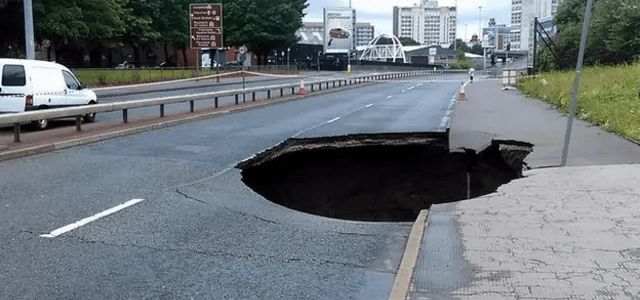
To know, or not to know?

The fact that this is the example given here is also not lost on me. The universe has a funny way of giving you a nudge sometimes, doesn’t it?
Probably best to know about this one?
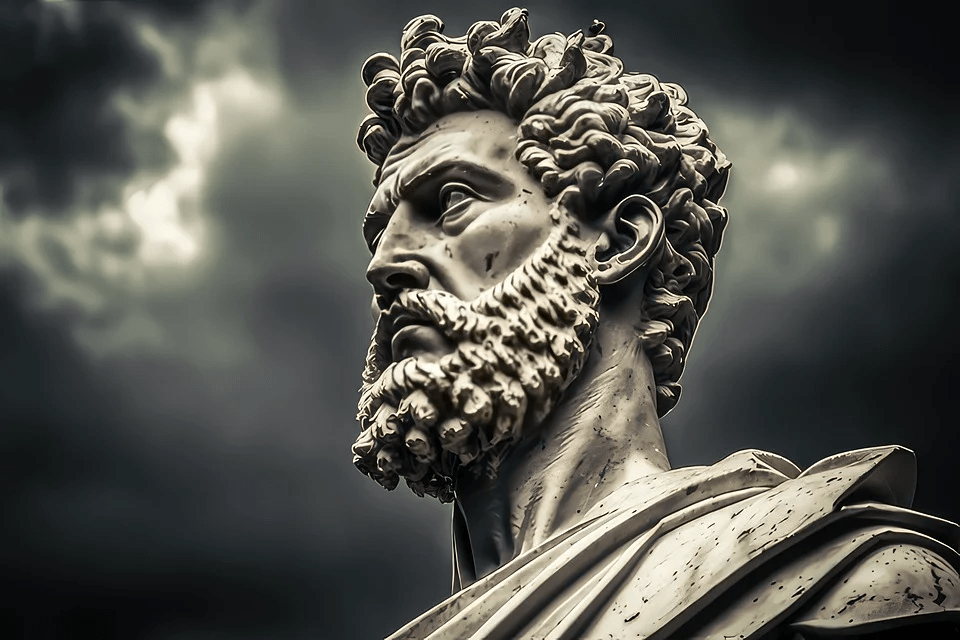
Gen AI Marcus Aurelius demands “MORE LARK’S TONGUES!”

The Oak Tree

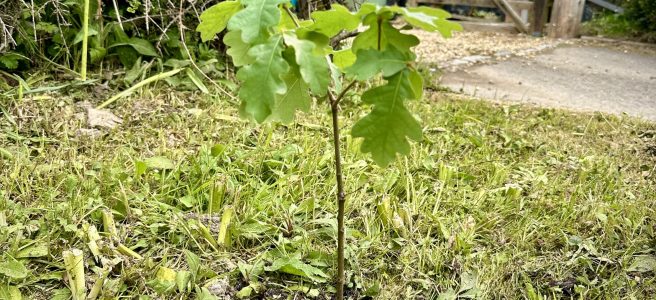
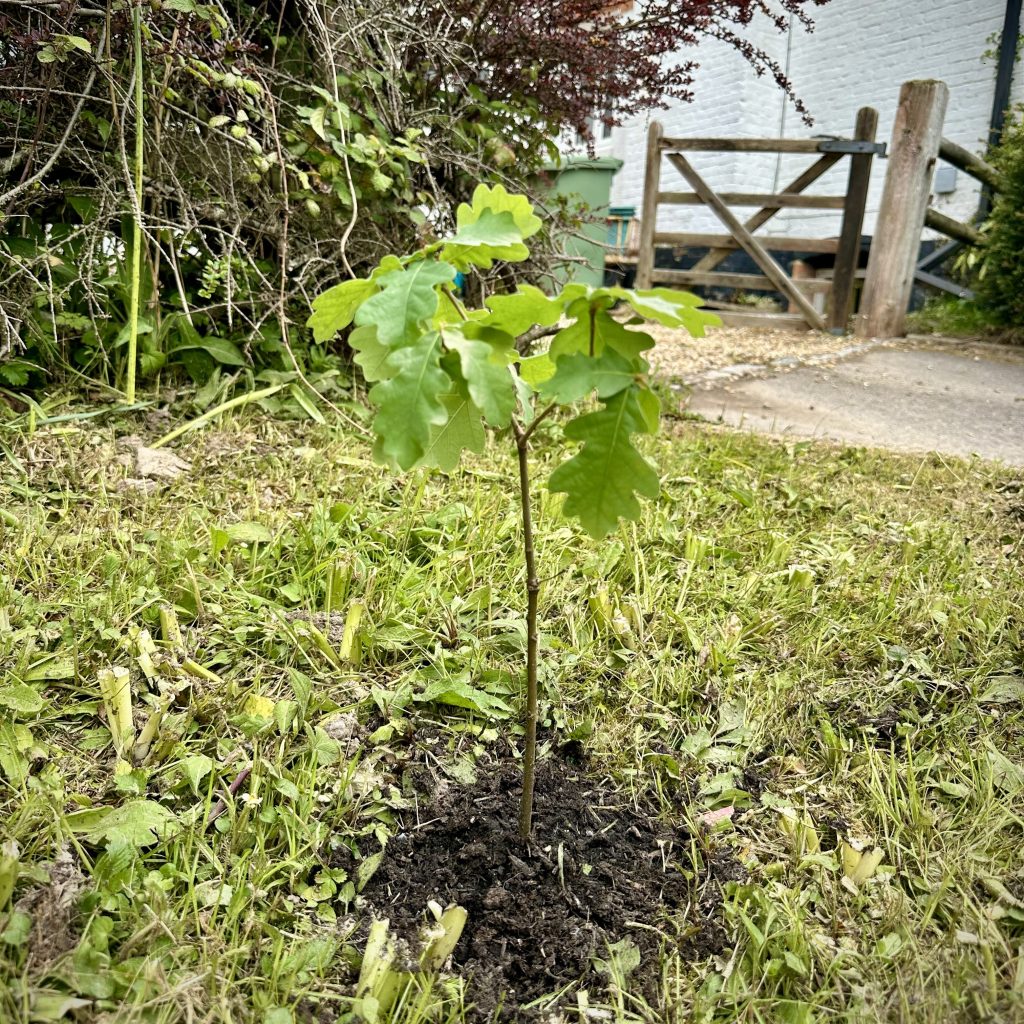
I planted an oak tree a couple of weeks ago. I’ll come on to why I had an oak tree to plant in a bit, but I was surprised how interesting the planting turned out to be. Because quite unexpectedly, the very act of kneeling down out at the front of my house on the edge of a little village in the South East corner of our little country and planting a little 6-inch tree in the soil attracted more attention than usual from the usual stream of passers-by.

To give you a bit of context, I live right on the edge of a big forest, and the path into said forest is right over the road from my front door, and on a sunny Sunday like we had that particular weekend, there are always a fair few people who park up in the village to wander into the woods, perhaps walking their dog, perhaps walking their kids [we all know that kids need the energy running out of them just as much as any dog], or perhaps just walking themselves with their friends, and they all go past the front of my house.

And so when I’m out there of a weekend doing classic middle-aged man things like tidying the hedge or putting stuff in the back of the car to take to the tip [our British word for the local recycling centre, and a mainstay of classic weekend activity for those of you who aren’t Brits and are wondering what I’m on about] or taking Jack [10-year old human male] to football training or Ben [14-year-old human male] to rugby training or Ruby [3-year-old canine female] for a walk [yes, this is the rock-n-roll lifestyle I lead] I often end up in a lot of smalltalk chitchat “lovely weather we’re having” conversations with strangers.

More than I’d ideally like, if I’m honest, because in my heart of hearts I’m not really quite as outgoing and gregarious and social as I might seem. [I’ve discovered over the years that I’m what can be described as an “extroverted introvert”, in that I’ll happily talk to anyone and everyone but I’ll also resent the fact that I have to and will be exhausted from the energy the interaction requires. But that feels like another blog…]

This time, though, it was different.

For a start, virtually everyone who came past felt the urge to point out to me what I was doing, mostly with a mixture of surprise and delight in their voice:

Oh, you’re planting an oak tree!

[Which actually doesn’t happen that often, when you think about it. It’s not often complete strangers totally succumb to the urge to tell you what you’re doing at the time. Imagine how odd the world would be if they did. “You’re walking down the street”. “You’re sitting on a train”. It would end up feeling like you were in some weird kids’ TV show where adults dressed in primary colours point out the blindingly obvious to an audience of tiny, no-nothing humans.]

And then, as a follow-up, virtually everyone would say something about how long it would take to grow, often with a bit of low level comedy in there:

I’ll have to come back in 30 years to see how it’s going.

That’ll look lovely in 100 years!

Quite a few people talked about their own mortality…

I won’t be around to see that fully grown…

Or indeed, about mine:

That’ll be one for your grandchildren to enjoy!

When the first person stopped and pointed out that I was, indeed, planting an oak tree and that yes, it would be a long time until it was fully grown, I said something along the lines of…

“They say that the best time to plant an oak tree is 100 years ago, and the second best time is today!”

…which got a great reaction, and so I basically recycled versions of that same line over and over with everyone who came past, honing my delivery each time, every new set of people blissfully unaware that they had unknowingly wandered into my perfectly curated and planned out set-piece interaction where I knew what they would say and what I would say before anyone said anything, all people playing their parts perfectly, my supporting actors never knowing that they weren’t the first to point out what I was doing, or experience the seemingly off-the-cuff remembering of an old quotation.

I knew I’d picked that line up from somewhere, but because I couldn’t remember where and because the people I was talking to probably wouldn’t know either, by the end I was making out it was a famous quotation which I knew and making up who had said it. Thomas Jefferson sounded realistic, as did Benjamin Franklin [not sure why the American forefathers leapt to mind, but I vaguely remember something about one of them chopping down a tree and then lying about it… or not lying about it… or some such thing; if you’re from that side of the ocean perhaps you can enlighten me!], and Lord Byron, for some reason, and then of course you can always drop in Churchill because all quotations sound like they come from him.

[As it happens, having put an appropriate amount of effort into researching this, it turns out it’s none of them: it’s actually (as far as I can ascertain, anyway) from an old Chinese proverb, and it’s not about an oak tree specifically, it’s about trees in general, and it’s not 100 years, it’s 30 or 20, depending on where you look. But as Mark Twain/Ernest Hemingway/Jonathan Swift/etc might or might not have once said: “Never let the truth get in the way of a good story”.]

And so, as the sky started to bruise and late afternoon made its lazy way towards early evening, I kept myself occupied with making up new attributions for this “quotation” and had a bunch of very small, but very enjoyable and (for me, at least) playful little interactions, all ending with an “enjoy your walk” from me and a variation on “enjoy your tree!” from them.

[I tell a lie: there was one more negative exception which proved the rule: a very prim and proper woman who took the time to point out that because of where I’d planted it, in 50 years time “that tree” would be getting in the way of the electricity and telephone wires criss-crossing above and I should perhaps plant it somewhere else. Knowing me as you do, dear reader, you will be most proud and a little surprised to hear that I didn’t simply say “oh sod off you grumpy old bag”, but instead said that in 50 years the tech would have moved on and there probably wouldn’t be wires above and anyway I’d be long dead by then and it wouldn’t be my problem to worry about. Which, considering she was maybe 25 years older than me, probably gave her a little jolting reminder of her own mortality and, perhaps, made her consider whether being such a naysayer was really how she wanted to spend her Autumn years. But we didn’t get into that next conversation because by that point it was clear we weren’t going to be friends anyway.]

And as I stood back, brushing the soil from my hands and admiring my handiwork – this funny little baby tree in the middle of a patch of grass, containing every piece of genetic information it needed to become a huge oak towering over the house – I had quite a deep feeling of accomplishment, and even a little pride.

I’m someone who plants an oak tree, with the knowledge that I won’t be here to see its majesty. It felt like a pure act of altruism, of outward-looking connection to the future. To people I’d never know, who would never know that I planted this tree, all those years ago.

And there he is!

Perhaps, in 60 or 70 years’ time, my own sons might visit the village in which they grew up, perhaps bringing their own grandchildren, or great-grandchildren even, and say “I remember when my dad planted that tree”. And they could all point out that as it turned out it had really got in the way of all the electricity cables and made a right mess of things, and remember how the great power cut of 2078 that had all been traced back to me planting that very tree back in 2024…

Last Sunday, I have to say, they were both pretty underwhelmed. But they could see I was chuffed to bits with it so they kept their lack of enthusiasm to grunts of “it’s not very big” and “is that it?” and we left it at that.

So why, I hear you cry? Why was I planting an oak tree, of all things?

Good question. Well done you. There are a few reasons, and they probably make the most sense if I explain them in reverse order…

This little oak tree had actually been living in my house for a few weeks by the time it eventually got to experience the wild wonders of the world, but had arrived just before the twentieth day of the third month of this year which I’m sure you will have spotted is indeed my birthday.

If you’re also wondering why it took so long to plant it, well that’s symbolic of how my brain works – an often constant cycle between “I must do that important thing” followed by a gap, followed by a reminder and “shit I forgot to do that important thing” and then a gap and then repeat. A cycle between frustration and guilt and self flaggelation which is only broken by actually just doing the important thing which often doesn’t even take that long once I get down to it.

This is how it was with our oak tree. When it arrived it was just a little twig with roots in a bit of soil in a little plastic bag within a little hessian draw-string bag, and it sat on the windowsill in the kitchen [you know, the one behind the kitchen sink, by the window]. Every time I noticed it again, perhaps once a week or maybe a little more often, I’d go through the cycle of self flagelation above and give it a little drink from the kitchen tap, and think “definitely this weekend”. Then I’d forget all about it until the next time.

But this is an oak tree, remember? These things last for hundreds of years, and a few weeks being forgotten about by some bloke with a fuzzy brain wasn’t going to stand in the way of that.

So it grew leaves anyway. Beautiful, perfect little oak tree leaves like the ones you’d get if you googled “oak tree leaves”. Leaves of life, and determination. Leaves that demonstrated that this was a living thing, demanding to be planted so the roots living in a hessian draw-string bag could dive down deep into the earth to find their own water source.

Putting together all this information, and if you’re not only observant but also somewhat sleuth-like, you may well have worked out that this little oak tree friend of ours was indeed a birthday present.

The next question your inquisitive mind might ask could be “why on earth would someone buy you an oak tree sapling as a birthday present?”

Well, this particular oak tree was a surprise present from the person who’s been coaching me for the last couple of years, another Sarah in my life [alongside my wife and my big sis], who lives on the the other side of the world in Australia. And when she sent me an oak tree, she knew that I would know the meaning behind that gift.

Which takes me right back to the chronological start of this (surprisingly long) tale.

If you’re a regular reader you’ll know that I’ve had my struggles with mental health over the years, and you’ll also know that I’m now thinking that some of those struggles could well be connected to undiagnosed and untreated ADHD, which I had diagnosed and then treated from last year.

So over the years I’ve occasionally found myself right in the middle of the deep dark forest [you can jump into the Ted Lasso story around that idea here if you feel the need], where everything seems tough and scary and you don’t know which way to turn. You know how that feels too, I’m sure. I hope you’re not in there right now.

But as Coach Lasso pointed out, fairy tales do not begin, nor do they end, in the deep dark forest. “That son-of-a-gun always shows up smack-dab in the middle of a story”. Things do get better, and things do work out.

What I’ve found is that it’s not until you start to find your way out, coming out into the open air, seeing the sky and the clouds and the sunlight, that things start to get some context.

I’ve also found that there is a huge temptation, at that point of being able to look back, to curse the forest for all its darkness and danger and discomfort.

And that’s where the oak tree changed things for me, and why it’s become such a theme for me, and why Sarah gave me an oak tree for my birthday, and why planting it meant more to me than it would have if I had planted a beech, or ash, or horse chestnut.

Because the oak tree doesn’t represent the forest. The oak tree isn’t the forest, or part of the forest. The Oak Tree is a poem.

[Listen, if you’re sitting there reading this and thinking “oh for crying out loud, what is he banging on about”, or possibly words with the same meaning but with more expletives, then I get it. I wouldn’t blame you if you decided that you’ve had enough of this story which started with some amateur horticulture and has ended up here, talking poetry. It’s been quite a journey to this point, I grant you. But going through the forest often means you need to take some strange turns along the way, right? So stick with me. It’s worth it, I promise.]

It’s a poem that my yoga teacher, Lucy, read out during one of our yoga therapy sessions just as I was coming out of a deep dark forest of my own. It’s called, simply, The Oak Tree, and it goes like this:

The Oak Tree

A mighty wind blew night and day
It stole the oak tree’s leaves away
Then snapped its boughs and pulled its bark
Until the oak was tired and stark

But still the oak tree held its ground
While other trees fell all around
The weary wind gave up and spoke,
“How can you still be standing Oak?”

The oak tree said, “I know that you
Can break each branch of mine in two,
Carry every leaf away,
Shake my limbs, and make me sway.”

But I have roots stretched in the earth
Growing stronger since my birth
You’ll never touch them, for you see
They are the deepest part of me.

Until today, I wasn’t sure
Of just how much I could endure
But now I have found, with thanks to you
I’m stronger than I ever knew.”

It’s that last verse that got me. The idea that I could look back not with horror of what I’d come through, but with gratitude for what it showed me about myself, was brand new to me.

I’m sure that you, like me, have the tendency to look back at difficult times and revile them. Perhaps you’ve even put a whole calendar year in a box marked “CRAP” and now you talk about it like it something real and evil rather than just the social construct that it was. 2023 sucked, right?

Whatever the situation you experienced [the one you’re thinking about right now, for example], whether it was a difficult friendship, or a toxic work environment, or a bereavement, or a break-up, or just the end of an era, the urge is there to put it in a neat little box and then burn that box in the eternal fires of Hades because the wind was battering you and your branches were breaking and your leaves got carried away and you were swaying all over the place and you just want to forget about it.

But here you are. You made it from then, which seemed so huge and impassable and desperate, to now. And like it or not, you learnt something along the way.

About your values.

About your friends.

About what’s really important to you.

About yourself, and what you can endure.

It feels a bit unfair perhaps, but you don’t get to learn those things when you’re wandering carefree through the meadows. You only get to learn those things when you’re being tested. So whilst you may not feel like it now, perhaps one day you might even look back with a kind of gratitude, for showing you those things.

For showing you just how deep your roots go.

I’m not saying that’s an easy shift. But once made, it’s a shift that can release some of the tension you’ve built up around those more difficult times. It certainly allowed me to shift the way I look at the bad things that happen. Bad things will always happen. Of that there can, I’m sorry to say, be no doubt. But how you look back on them? That, dear reader, is always up to you. You didn’t get to decide what happened. But you do get to decide what place these things occupy in your mind, and what energy you give them. You do have choices now.

Me? I chose to plant an oak tree, to symbolise all these things. Time moving inexorably on from a made-up, one-sided story we tell ourselves about the past, through the reality of right now, towards another fantasy which we call the future. My own mortality within that. Friendship and support. Trials and tribulations. Resilience, and choices. My own roots. Stronger than I ever knew.

Not bad for a 6-inch high twig with a dozen or so leaves.

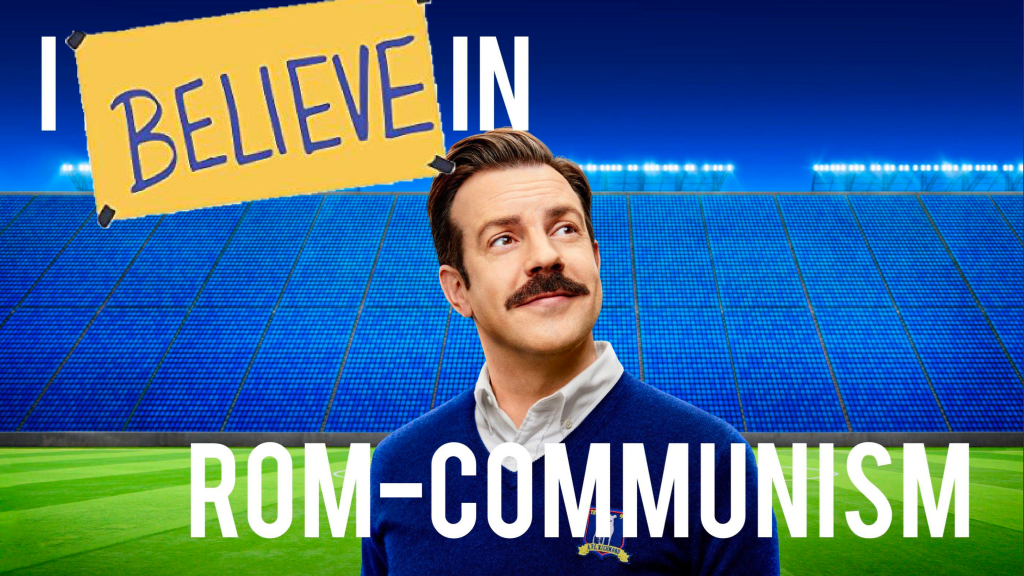
Believing in Rom-Communism

Have you watched Ted Lasso? If you have you might already know what I’m talking about here. In which case, stick with me anyway because who knows, I might say something borderline interesting at some point. If you’ve never heard of it, don’t worry because the theme of it isn’t crucial to what I’m going to talk about anyway. Basically, whomever you are, and whatever your current relationship with Ted Lasso, from superfan to total obliviousness, let’s just agree that you carry on reading and I’ll carry on writing, yeah?

[For those novices, suffice to say that Ted Lasso is a comedy series about a football coach from the USA who comes over to London to manage a fictional club in Richmond. Sounds a bit crap, but it’s absolutely brilliant – less piss-taking about Americans saying “soccer” instead of football and more of a case study in vulnerable leadership. And you don’t need to like football to enjoy it either – my wife is Welsh and hates football and we devoured each series like a pack of children at a party devouring the birthday cake which a loving aunt took ages baking but was only actually on display for about 45 seconds before it was cut into irregular size pieces and put in paper napkins to be squashed in a party bag along with a bouncy ball and an almost unbelievably small fun-size Mars bar]

So, with those somewhat unnecessary and [let’s be honest here] rambling introductory passages behind us, let’s get into the bones of this, shall we?

There’s a point in the second series where the team are in a real slump. They’re playing terribly, and losing, and it seems like all might be lost. It’s at this lowest ebb, where the team are starting to come apart at the seams and individuals are blaming individuals for the failing of the whole, that Ted gives an impassioned talk about his belief in “rom-communism”.

The man himself

Rom-communism is a concept borrowed from the classic romantic-comedy movie narrative, where in the middle of the film everything is a right old mess and it looks like the two protagonists aren’t actually going to end up together. Yet by the end of the film, everything tends to work out.

So for Ted, a belief in rom-communism is a belief that everything’s going to work out in the end..

Now these next few months might be tricky, but that’s just ’cause we’re going through our dark forest. Fairy tales do not start, nor do they end, in the dark forest. That son of a gun always shows up smack-dab in the middle of a story. But it will all work out.

Now, it may not work out how you think it will, or how you hope it does, but believe me, it will all work out.

Exactly as it’s supposed to.

Our job is to have zero expectations and just let go.

Ted Lasso: Season 2, Episode 5

It’s stuck with me, this scene. I don’t believe in fate: the idea that our lives are somehow pre-ordained and we are destined for something whether we like it or not. I also don’t really believe in luck, whilst we’re on the subject of things somehow bigger and more mysterious than ourselves. It’s not “lucky” that stick wasn’t closer to our younger son Jack’s eye [true story – he’s currently on course to take the title of “World’s Clumsiest Living Human”] any more than it’s lucky when you don’t stab yourself in the face with your fork when you’re eating. And whilst we’re on this particular soapbox, no, it’s not “spooky” when you ring your friend and they answer and say “oh my God I was literally just about to call you!!” any more than it’s spooky that you didn’t ring them all the dozens of other times they were about to call.

So no, I don’t believe things will work out as they were always going to. But I do believe that things tend to work out as they are supposed to…

Through the middle of last year I had a pretty confusing time of things, particularly with what was going on at work. [I lknow, bloody work, eh?]. Having thought things were going to go one way, it became clear that things were going to go a completely different way and there wasn’t a damn thing I could do about it.

Looking back on it, there were things I could have done differently, and there are things I’d do exactly the same, but the bottom line was that it was really disruptive and difficult for loads of reasons, surprisingly few of which are anything to do with me, actually. Some relationships I thought were solid turned out not to be. Others turned out to be stronger than I’d thought. But whilst I was right in the middle of it, forgetting about the second agreement I made with myself to not take anything personally, I took everything personally. Whoops!

[If you’re wondering about the other agreements, or indeed wondering why I’m going around making agreements with myself and thinking that perhaps I should have a nice cup of tea and a sit down, you can find out more about The Four Agreements in a blog I wrote about it all here. It’s good stuff but don’t just take my word for it: you can ask my mate Caroline’s husband, who told me he liked it (hello Aaron mate!) and he really had no reason to lie to me.]

Yes, that’s right: I was going through my deep, dark forest.

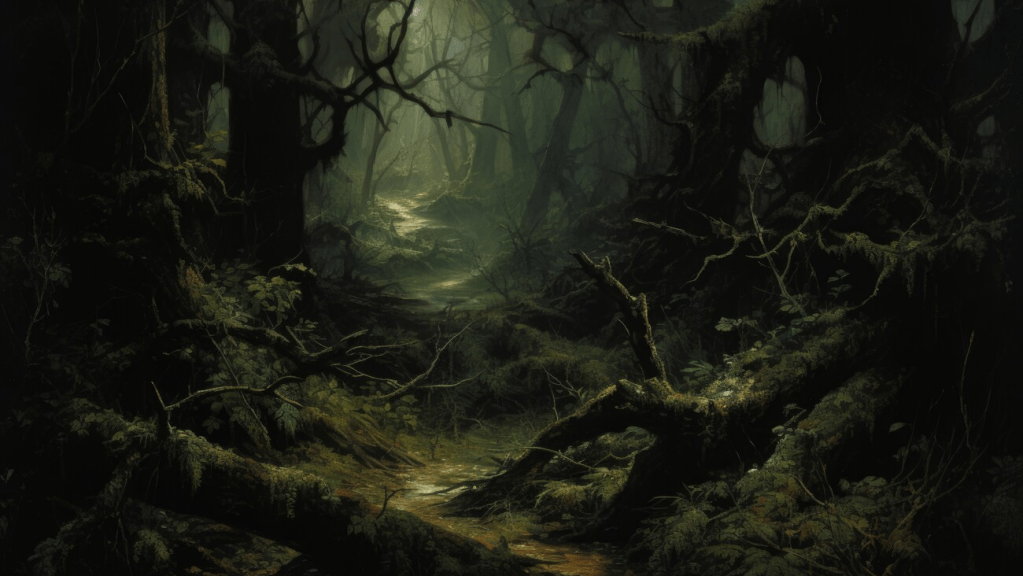
This isn’t actually my forest as such but it’s quite similar

And for a while there, I forgot that fairy tales do not begin, nor do they end, in the dark forest. That they always turn up in the middle of a story.

I won’t apologise for that, because… well because I’m not sorry, basically. I lost my way a bit, and weirdly I didn’t actually realise that I’d lost my way until I stumbled out of the darkness of the forest into a clearing, and saw the wide expanse of the sky for the first time in a long time and suddenly became acutely aware that I’d been holding on so tightly to expectations that I’d lost the plot of my own story and, to a degree, lost myself.

Forgive me for taking a short detour here. That idea of “lost myself” is interesting to me. We’ve all felt a version of this at some point and we’ve got lots of ways of talking about it: I was not feeling myself; I was beside myself. I do think it’s all about how we understand our own sense of “self”, and actually it’s when we are furthest from our own values that we feel most disconnected from ourselves, and most lost in the world as a result.

Actually connecting to that disconnection was, for me, the first step in the next part of the journey.

My good friend, and cherished colleague, Sir Olly of Caporn [take a bow, Oliver] and I were chatting recently and he casually and without ceremony said something very profound, as he tends to occasionally:

The story only makes sense when you reach the end.

Like a great whodunnit, or crime drama, or, yes, even a rom-com… when you get to the end of the story, it all makes sense, and then when you look back you can see how it all fits together.

And that’s how I feel now, With a new world of work opening up, with all the possible roads that I could have taken but didn’t now just sub-plots that didn’t happen or didn’t go anywhere, it seems almost daft to think that things could have ended up any way than the way they’ve actually ended up.

I’m not saying this is the end of the story, because of course it’s the start of a completely new one. But it’s the end of that story, and whilst it did not work out how I thought it would, or how, at the time, I hoped it was going to, dammit if it didn’t all work out. Exactly as it was supposed to, I guess.

You may, as you read this, be in your own dark forest. I’m really sorry if you are. I know how much that sucks.

I also know that sometimes, we need to sit down in the forest, and take a moment. To check on our values and on our sense of self, and just take a moment. I’m the last person to tell you to pick yourself up and dust yourself down and carry on struggling through the thick undergrowth and sharp leaves and grabbing vines before you’re good and ready. Because we both know that has to come from you.

But we both know you will have to decide to pick yourself up and dust yourself down at some point.

And when you make that decision, remember that fairy tales do not start, nor do they end, in the dark forest. This isn’t the end of the story. Your job is to have zero expectations, and just let go.

And know that when you get to the end of the story that you’ll be able to look back and understand it all.

You’ll know that, even though it was hard, things worked out, somehow.

You’ll know more about yourself. Your values., Your principles.

And maybe, just maybe, that’s all part of the story, too.

ADHD and me

As you may or may not know, October is ADHD Awareness Month. Now that I missed the entire month, meaning to write something about it but procrastinating for a bit then forgetting about it for a bit then meaning to get round to it but getting distracted by something or other [is that a Jay I can see out of the window? They really are quite beautiful aren’t they?] I think it’s probably about time I let you, dear reader, into the incredible time of enlightenment and understanding that I’ve experienced in the last few months.

In a nutshell, I have ADHD.

If you know me even at all well, that revelation will likely illicit the response “no shit, Sherlock” [please feel free to replace this wonderfully idiosyncratic British term with anything you might prefer which shows a total lack of surprise at something you probably assumed anyway] because it’s kind of obvious really in the way I act and interact, the way and, I suppose, in the way I write as well [I mean, what kind of person has all these parenthesised ‘by the way’ bits throughout everything they write? Yes, that’s right, someone whose brain flits off in different directions like a hummingbird seeking out the finest, sweetest droplets of nectar from the flowers in the forest. Someone with ADHD, basically].

Certainly my father [hi Dad – hope you’re enjoying your holiday] wasn’t exactly surprised. “It does explain all your school reports I suppose” was his reaction to my telling him about my diagnosis. And he’s right: my memory of those reports was littered with talk of my “potential”, “easily distracted” and of course “distracting”, talkative, . And the times where I really got into proper “trouble” it was never malicious: more often than not it was just something that happened on the spur of the moment where I impulsively did something daft to make people laugh and it all went wrong somehow.

So yeah, I’ve got ADHD. No massive surprise to lots of people. And actually, not really a surprise for me, either, which needs a little explanation. If I’ve suspected it for a while, why bother getting assessed and diagnosed? What difference does it make?

For quite a long time I’ve had the thought in my head [which is where most of my thoughts tend to wander, in case you were wondering] that, had ADHD been a ‘thing’ when I was a kid, I would have been diagnosed. I’ve even said that to people. After all, I left school in 1993 [I know, you’re shocked because I look so youthful, right?] and ADHD wasn’t recognised as a valid condition in the UK until 2000 when the National Institute of Clinical Excellence (the organisation who decide about conditions and treatments – they’re the ones who you hear about in news reports referred to as NICE) brought out their first report on the condition. I hadn’t heard of it until after I’d long gone from the school room, and to be honest, I thought ADHD was just a childhood thing anyway: more about behaviour and self-discipline than anything else. So I thought I might have had it. But adults can’t have it, and I am an adult so I must have grown out of it.

I can’t remember when I first heard about Adult ADHD. “A while back” is about as accurate as I’m going to get on that one. But I do remember still getting hooked up on the H bit of it.

The H of ADHD stands for hyperactivity of course, and whilst yeah, I fidget a bit and jig my leg when I’m sitting down and I sometimes stand up whilst I’m in a meeting because I need to stretch my legs and I’m always fiddling with whatever’s on the table in front of me… (!!) I’ve always thought that hyperactivity is about not being able to sit down and constantly jumping all over the place and running around and that ain’t me. I’m really pretty good at sitting in one place for ages when I’m doing something I’m into, like playing the piano or reading or writing something like this…

That’s another thing. I’ve always had the sense that if I concentrate on something I can be absolutely prolific. Especially if there’s a deadline coming. I’ve always had this belief that I can get things done really, really quickly when I need to. I’ve never, ever been phased by a deadline. In fact, I’ve found that I work better under pressure. I’ve even said, to close friends or colleagues in the past, that I’ve got this belief that I can smash through 4 or 5 days’ work in a couple of days, but I know that after I’ll be exhausted so if I’ve got a weeks’ work to do I’ll do it in 2 or 3 days and then coast a bit for a couple of days.

I’ve always felt that my brain worked differently from other people’s brains.

But what got me thinking that I should get a diagnosis in the first place, it in the first place and what I’ve learnt since? That’s been surprising, and enlightening, and actually life-changing. Let’s start at the beginning.

As regular readers of these pages will know, I’ve had my fair share of struggles with anxiety over the last few years. In fact, I think I’ve always struggled with it, really. I’ve always felt that if I could just turn my brain off, just for a bit, then I’d be able to relax more. I’ve always thought that I overthink things. I’ve always had a really uneasy sense of self – of who I really am. Sometimes I’m the joker, who’s irreverent and somewhat rebellious and makes people laugh and is good fun to be around, and yet in my heart of hearts I’m actually very thoughtful and introspective and sensitive and actually quite an introvert… all wrapped up in a very (sometimes excessively) extroverted package. Which one is the “real me”? Does anyone really know me at all?

I’ve always felt that it’s exhausting, being me.

[Yes, I know that using the phrase “psychodrama” underplays the emotional strain of that time and that making light of things can be counterproductive and reinforce the outdated notion that emotions and feelings are somehow not appropriate, particularly for men who find themselves, as we all do, constrained by the shackles of expectations that come with the tropes of masculinity. But if I want to make light of things for comedic effect as a way of avoiding having to get into things from time to time then by great Zeus’ mighty beard I shall do precisely that and there’s nothing you can do about it.]

If I’m honest, the end of the year once I’d come back wasn’t great either. I was pretending to be okay most of the time, whilst trying to convince myself that I was okay too. Whilst very much not being okay. Some of the pressures that had built up had dissipated but I can tell you from experience that if you ever get to the point where you feel you need to take a month off, you probably need to take more than a month off.

Anyway, I made it through with a few bumps and bruises along the way. Other things I picked up along the way included a rediscovered love of poetry, mostly via my new yoga teacher [hi Lucy – see you Friday!] which I also picked up and now can’t imagine my life without. I also learned to meditate and started journaling. Basically, all the good things that I always thought I should do but never really got round to because… well, because I have ADHD and actually getting round to things is actually quite difficult with my brain.

And perhaps the most important thing I stumbled across this year is the diagnosis itself.

That came about through a colleague who became a friend. Nice when that happens, isn’t it. [And hello to you Farhat – looking forward to eventually sorting out that date for lunch!]. This woman is probably more open and honest and direct than anyone I’ve ever met, yet kind and thoughtful with it. Deeply committed to driving change in all aspects of diversity and inclusivity, she pushes me to consider my own perspective on lots of things. I find myself questioning my beliefs in anticipation that I might need to have a friendly and vulnerable toe-to-toe debate with her, and that forces me to challenge my own thinking along the way which always ends up with a clearer perspective, more considered and more rounded than when I started. Sounds good, right?

Perhaps part of the reason for her directness, and something she was disarmingly open about from our first meeting, was that she knew she was neurodiverse, and had recently been diagnosed with autism. I have both friends and family who are “on the spectrum” and there’s a clarity of thought that can result from a neurodiverse mind that I always find fascinating to be honest.

So when she told me that she’d also been previously diagnosed with adult ADHD, I was intrigued. I knew that Adult ADHD was a thing, but I’d always had that thing about the H bit that I didn’t connect with. But my friend isn’t physically hyperactive either, really. I was keen to hear more.

She talked about how she had had to learn about how to use her energy to allow for, or indeed take advantage of, her ADHD. She told me that she was able to “hyperfocus” on a subject that interested her, but would then be exhausted afterwards…

Hmm.

She told me that sometimes she struggled to focus on things, and would jump from one thing to another and back again. I always thought I was good at multi-tasking, but she pointed out that really I was just jumping from one thing to another and back again…

Hmm.

We talked a lot about her ADHD as I was keen to learn how to make sure she felt included and that she belonged, and also so I could make sure I knew how to get the best out of her. Because the level of work that she was able to produce through harnessing that hyperfocus was just off-the-chart incredible.

The more she told me about what she had learned about her ADHD, the more I found myself sitting there thinking “That’s me”. Eventually, I asked her how she started her assessment, and she smiled and said “I do see a lot of me in you”.

That’s where the ADHD part of the story started for me. I did an assessment and I ticked virtually every box. I then did the full clinical assessment and got my diagnosis.

So, what’s changed?

Honestly, pretty much everything.

For years I’d been suffering under a cloud of anxiety, and in the end it drove me right to the edge of breakdown and depression. Yet now I felt I could reframe that anxiety as the result of undiagnosed and untreated ADHD, and now I’m being treated for the ADHD, I don’t have the anxiety in the same way at all.

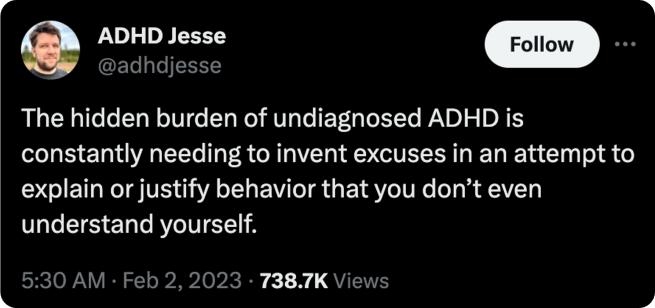
As I was just starting to explore the idea of Adult ADHD I saw this tweet, and it really summed up not just my childhood but large swathes of my adult life too:

In another nutshell, this is me.

The way I’ve come to describe ADHD is that it’s your mind, and then immediately afterwards your body, overreacting to outside stimuli. The mind sees fun, or threat, or danger, or excitement and primes the body to deal with it. I’ve never been able to stop myself from making a joke, even when it’s probably not the right time. I’ve never been good at taking criticism in the moment.

ADHD doesn’t define me. But damn, it sure explains a hell of a lot.

ADHD often comes with a lower ability to regulate emotions, so it’s hard to put the breaks on when emotions start off. It’s why I’ve always worried about being very ‘up and down’ emotionally and the impact that has on the people I care about and who care about me.

The name of it really doesn’t help. ADHD isn’t a lack of attention: it causes us to pay too much attention, to everything, most of the time. Not being able to stop reacting to outside stimuli. A lack of filter.

And the hyperactivity sounds like something physical, but in fact:

The vast majority of adults with an adhd nervous system are not overtly hyperactive. They are hyperactive internally

Dr William Dodson, M.D., LF-APA

A hyperactive mind. A mind that doesn’t stop. No wonder I’ve always felt like it’s exhausting being me.

What I’ve learnt about my ADHD is just as important as getting the right treatment for it. As much as the new meds have made a big difference, just understanding myself (and my self) has allowed me to reassess how I can manage things differently in the future. In my view, it’s about pills and skills, not either/or.

Last year I was worried that my mental health problems would overwhelm me. I don’t worry about that any more. I’ve got lots more to learn, but whilst I don’t subscribe to the “ADHD is my superpower” idea I’ve seen a lot of on social media, I also don’t think it’s a burden that will drag me down either.

I was sitting up after watching the Rugby World Cup Final with an old school friend of mine last weekend [hello Nobby – hope the whisky hangover has completely gone by now] and he pointed out that whilst the ADHD might have made things difficult sometimes, on balance I’ve also had a shitload of fun along the way, and it’s probably made me good fun to be around too. He’s a wise man, my friend.

Now that I understand it better, I’m better able to understand how to harness the benefits and manage the difficulties. Now I understand it better, I can see that whilst it’s caused me problems, my ADHD has also been part of my successes too.

Now that I understand it better, I’m not sure I’d want to get rid of it even if I could.

ADHD awareness month has come and gone, but for me the awareness of my own, personal experience of ADHD has only just begun. I’m going to learn more as I go, and as I learn I’ll fill you in on anything that I think you’ll find interesting if that’s cool?

Until then, I’m just off to change a lightbulb which will end up with me having to fix my car. To find out what the hell I’m talking about – and to see the most perfect example of an ADHD day that I’ve ever come across, have a look at this little clip.

Speak again soon. Love and peace x

The Four Agreements

I don’t know about you, but whenever I give someone a book, particularly one very specific to them, I write a little note in the front along with the date. I do it partly because I really appreciate it when someone does it for me, and also perhaps partly because I like the idea of marking the moment in time so that in the future it’ll pop up again.

Perhaps it’ll be read by the person to whom I gave the book, a single tear of reminiscence rolling involuntarily down their face as they recall the thoughtful gesture and how lovely I was. Or perhaps it’ll be read by someone decades from now who’s picked up the book for next to nothing at a charity shop and will never know how lovely I was except to know I’m the kind of person who writes a note in the front of a book. And maybe, just maybe, they will decide that is something they will do from that point on… thereby making the world a slightly better place, forever and ever into the future.

Yes, I do overthink things sometimes, I’ll give you that.

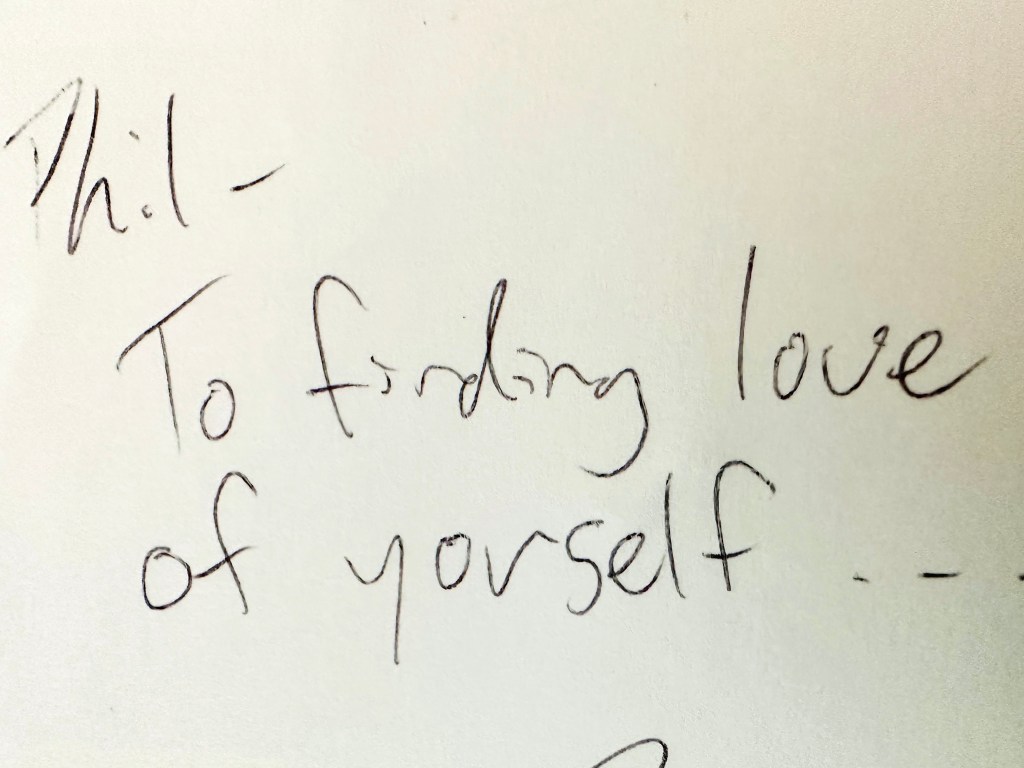
Anyway, it just so happens that in the middle of last year, right in the middle of a very challenging time for me personally (which, if you’re interested in such things, you can read about here), someone I didn’t really know very well came up to me holding a book, and then handed me that book. Their personal copy of a book they carried with them at all times, a book wherein they had highlighted passages, and made the odd note. Handed over now to me, for me toread and to keep.

And yes, they had written inside:

Underneath, they’d written their name, and their personal contact details

First off, it struck me then and still does today as an incredibly kind, thoughtful, open gesture. Let me give you something that’s helped me, in the hope that it may help you too.

But just as much as that, I was fascinated as to what the book might be. What is the kind of book that someone carries with them, at all times, and highlights passages and makes little notes in pencil in the margin, and is then moved to inscribe and hand to someone else? It must be a book with such wisdom, such guidance, to drive someone to feel they simply must pass on to someone else in their time of need.

What book holds that kind of potential impact?

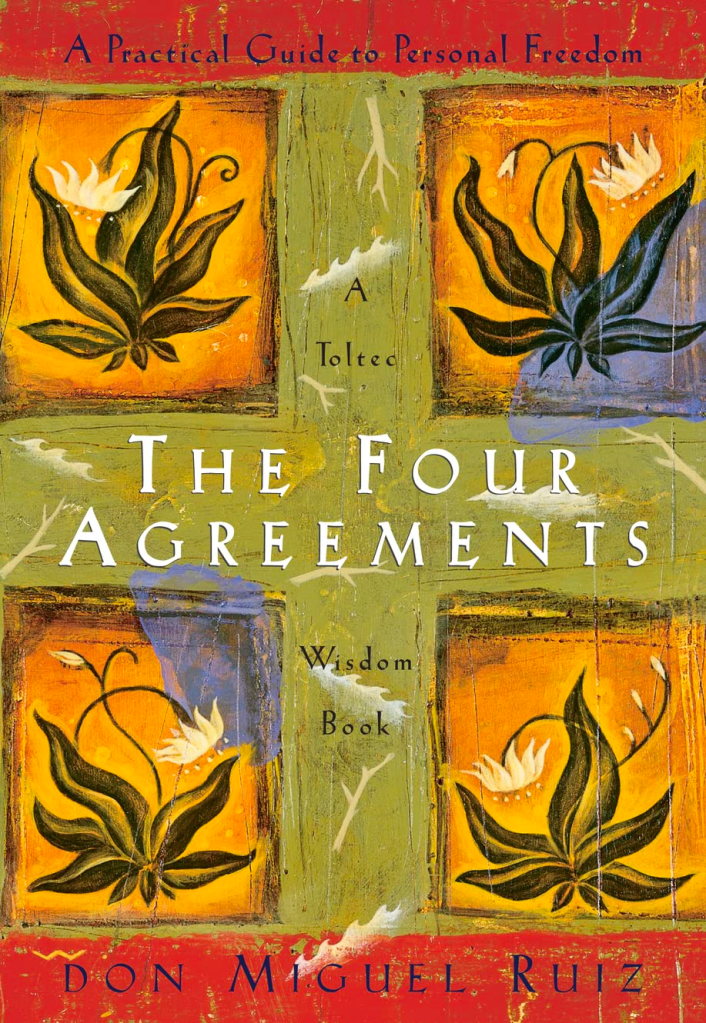
The book in question is called The Four Agreements, written by a chap by the name of Don Miguel Ruiz. I’ll be honest, the first time I started into it I liked the thinking but struggled a little with the way it’s written. That’s because Don Miguel Ruiz is a shamanic teacher and healer, and he writes in a very unconventional, conversational style about teachings from the ancient Toltec culture in central Mexico. It’s not written like a classic business or “self-help*” book because it’s not written by a classic business or “self-help” author, and as you can see below it’s not either of those things anyway, it’s a much more than that: a Practical Guide To Personal Freedom. So you have to get into the way it’s written, or you have to get past the way it’s written. But you can’t ignore the way it’s written.

[I hate that I feel the need to put “self-help” in “” but I do so because it’s been hijacked to be used pejoratively by people who think that “self-help” is the sort of thing that those awful woke snowflake Remoaner lefties need and which any hard-working normal person knows is a load of bloody nonsense and anyway who needs introspection when you can just judge other people from a position of blithe, dismissive self-ignorance? From being a positive, it’s become a negative, despite the fact that every single thing I’ve read with the intention of helping myself has, in some way, actually helped my actual self. But anyway, it’s in “” so we can leave it there and crack on…]

Whether you get into or get past, the idea of a Practical Guide to Personal Freedom is immediately something that appeals, right?. I mean, who doesn’t want Personal Freedom, and what better than a Practical Guide to get there? I’ve been following the Massively Impractical Guide to Personal Angst in my own brain for years and that’s been a bit of a chore at times, to say the least.

And once you’re in, the simplicity of The Four Agreements sing out as a sort of rulebook for a life which doesn’t fall into all the pitfalls we all fall into, all the bloody time. So simple that it’s a bit annoying no one mentioned them before, really.

So to avoid you having to find all this stuff out yourself, I’ll outline them here, with my take on what they’re all about, and you can save yourself a lot of future angst. Sounds like a plan, right? Great, let’s roll.

This is the front cover. You can’t miss it.

1) Be impeccable with your word

Don’t talk shit, basically. Don’t lie, don’t make stuff up, don’t brag, gossip, don’t collude, don’t say unkind things, don’t talk about people behind their backs. Actually, don’t say any of that shit to yourself either. Tell the truth to yourself and to others. As good ole’ Brené Brown would say “Clear is kind, unclear is unkind”.

Am I good at this? Only in parts. I’m not one for collusion and I don’t brag, but I do gossip sometimes and on a bad day I can be quite cutting about people, particularly when I feel I’ve been “wronged” in some way. I can also talk shit about myself, to myself. So this is one I have to come back to, and remind myself of, to keep it fresh and real. This much I do know: nothing good comes of speaking ill.

2) Don’t take anything personally.

Self-explanatory this one. But damn – how can you not take things personally when you are about you? If something happens to you, or someone does something to you, it’s you, right? It’s personal to me because it’s happening to me!

Except, of course, it really isn’t. This is one I’ve kept really close to me since I first read it – the idea that whatever someone does or says, howsoever it may affect you… it’s not about you. It’s about them.

It’s about how they see the world, and themselves in the world; about the pressures they have put on them and the pressures they put on themselves. It may affect you in horrible ways, but even then, it’s not personal. It’s not about you, it’s about them.

If someone treats you badly, it’s because in their mind they are under pressure or under attack somehow. If someone puts you down, it’s because of how they experience themselves when they are with you. If they really, really seem to just hate you for no reason you can work out, then don’t bother trying to work it out because the answer to “what have I done?” is quite possibly “nothing”. Because they don’t actually hate you – the you that you know and know to be fundementally good – they have negative feelings towards the “you” they have created in their mind because of their own issues. It really isn’t about you.

I know this is difficult. Believe me when I say that even with this agreement not to take anything personally sitting happily in your head in all its logical, sensible splendour, it’s still really, really difficult. I’m not saying you should just brush it off or, even worse, get thick-skinned to protect yourself. Those people who claim not to give a fuck about anything people say or do to them are lying to you and to themselves. I’m not saying you can’t be upset. Be upset. Just don’t take it personally. Because it’s not about you, it’s about them.

Oh and by the way, unfortunately, it works both ways. So it’s also true that If someone talks you up or lauds your every minute action and deed, it’s really not about you, it’s about what they think or hope for or need in the relationship. I know you’re brilliant, but just don’t take it personally.

Trust me: this one is a keeper. Don’t take anything personally. It’s not about you, it’s about them.

3) Don’t make assumptions

You know what they say: “Assume” makes an ass out of u and me. That trite little saying doesn’t stop us from doing it though, does it?

We make assumptions because we’re trying to make sense of the world without all the information to hand. Our brains don’t like stories without an ending. We seek reasons and endings, and so without a reason or an ending we just go and make up our own.

Assumptions are the basis of pretty much every conflict you’ve ever had – the story you’ve made up in your head about what someone else is thinking, which you then judge them for without them even knowing. They become the loser in a game they didn’t know they were playing. And let’s be honest, we don’t often cast ourselves as the villains in the piece.

Assumptions leave you wide open to be disappointed, or surprised, or shocked and appalled when things don’t turn out as we guessed they would. Assume it’s in the bag and you’ll find that someone who assumed otherwise put in more effort than you and walked away with the prize. Assume they won’t want to talk to you and you’ll never know what might have been. Assume there’s no point in applying for that job, and I promise you that you 100% will not get that job.

This is my biggest Achilles Heel. I love a good story, and I can’t help telling myself all the stories I’ve created about my assumptions. I know that this is how my brain works, though, so I’m trying to be disciplined in checking those stories as I go and removing the assumptions that may be driving action, inaction, or reaction.

4) Always do your best.

I love this. So simple. The kind of thing we were told as kids and now tell our kids because that’s what you tell kids… without really listening to what we’re saying and taking our own instruction.

If you always, always simply do your very, very best, you can end the day knowing that you couldn’t have done anything more. It’s the drive to get up in the morning and the solace to sleep soundly through the night. Just do your best. Personal to you, and only you know what your best is. Don’t worry about what other people are doing. Don’t cut corners.

And be okay with the idea that your best varies, too. Your best when you’ve had the elusive straight eight hours of uninterrupted sleep and woken to the birdsong and the sun is coming up and the day ahead looks challenging but manageable isn’t the same as your best when you’ve been awake through the night with your mind racing because you know you’ve got that difficult conversation you have to have later and there’s no milk for your morning cuppa and the dog just slobbered on your black jeans so it looks like you’ve had a giant snail crawling. up your leg. But just do your best, no more and no less, every time, in everything, and you simply cannot go far wrong. It’s actually quite freeing.

So there you have it. The Four Agreements, which I was given by a very kind man who felt I needed them at a difficult time in my life. Again, what a lovely gesture.

And what simple agreements they are. I can’t tell you that I stick to them all the time, but I can tell you that whenever I lose my way, it’s because I’ve not done one or more of these.

Maybe just make a note of them somewhere and consider in all honesty, where you’re strongest. on these and where you’re not. Perhaps consider that difficult thing that’s on your mind at the moment and see if there’s a chance that one of these agreements might have avoided it – or might even get you out of it. Be impeccable with your word. Don’t take anything personally. Don’t make assumptions.

And whatever you do today, just do your best. No more, no less. I reckon that’ll be more than enough for whatever today has in store for you,

[If you’re interested in getting a copy of said book for yourself, then you can find it here or at all good remaining physical book shops. I’d give you mine but I’m not quite ready to give it up yet.]

Despair, and Courage

I’ve always been interested in words – where they come from, how they develop and change over time, and how we use them. I love the way that the English language is this crazy melting pot made of Old English, Danish, Norse, French, Latin, Greek, Chinese, Hindi, Japanese, Dutch and Spanish, and a bunch of others in various amounts and we all just use it like it ain’t no thing.

 [For your information, our vocabulary includes words from around 350 other languages according to the Encyclopaedia Brittanica. I know, I thought that was an unrealistically large number too, but apparently, there are 7,117 distinct languages spoken in the world today… although 23 of those cover more than half the world’s population. You’re welcome].

I love how we play with language and how language plays with us, too. The alluring alignment of alliteration. The way words like “imagine” trigger the imagination parts of the brain whether you like it or not. The way that we know that there are rules around how we use our language that we all know but don’t even know that we know…

So when I say that we have a cute little old yellow French wooden ladder in our kitchen, it sounds perfectly fine… but if I said we have a French cute wooden old yellow little ladder, you’d think I had lost my mind.

That’s because there’s an unwritten rule that we do adjectives in a certain order to make it sound right, which [as I know you’re wondering] goes, in order: Opinion; Size; Age; Shape; Colour; Origin; Material; Purpose.

[Don’t take my word for it – there’s a whole book about this and other pleasing peculiarities you can find here]

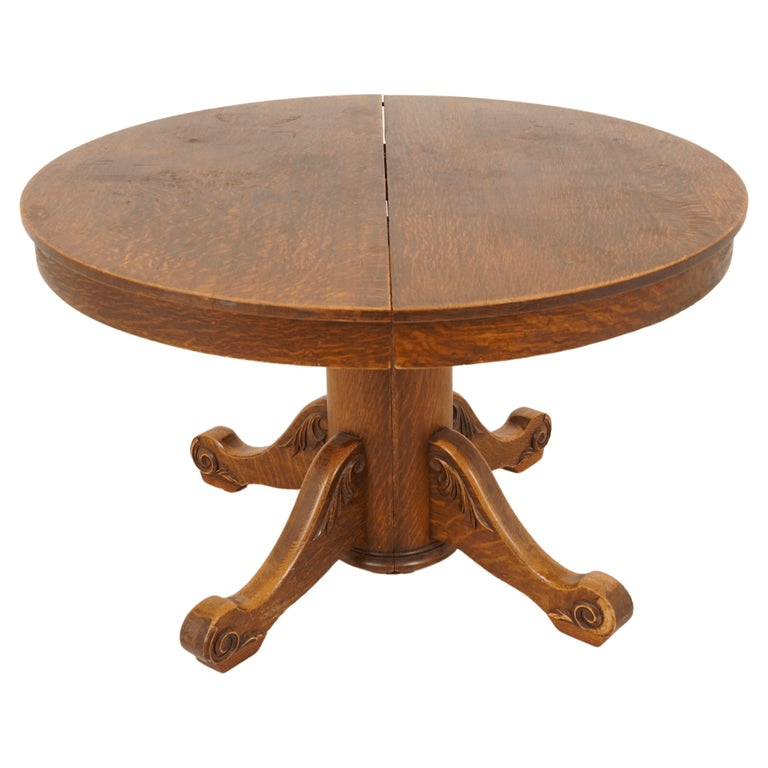
I didn’t even add in the shape in my ladder example above. But you know that an old round wooden table sounds right, whereas a wooden round old table sounds odd.

A wooden round old table

[If you’re reading this as a non-native English speaker this may all sound like nonsense of course, but it’s stuff like this that makes the language such fun to learn, I’m sure! Idiosyncrasies that we wouldn’t be able to tell you, but will know if you get wrong. If it makes you feel better it even happens between English-speaking countries – so as Brits, we would happily say “hello mate” to an individual, but when our American cousins greet a group of us with “hello, mates!” we quietly smirk into our cup of tea.]

So yeah, I’m fascinated by words. They’re interesting.

Oh yeah, and I guess they can be incredibly powerful too. In case you thought this was going to be a lazy wander around our language. We’re going in hot, folks. Hold on tight.

Words can bring comfort, give direction, even show a way towards freedom. And they can close us in too, forcing division and leaving marks on our souls.

[Remember that old kids’ rhyme “sticks and stones may break my bones, but words will never hurt me? Bull, and I can’t stress this enough, shit. I’ve broken a few bones over the years and they heal over time, but the phrase “crushingly dismissive” from some anonymous 360 feedback about a decade back will stay with me until my dying day, believe me.]

Understanding how we use words now versus how they were intended originally can sometimes change the way you think about them too – and here’s this whimsical pootle through the highways and byways of my mind turns onto the slipway and accelerates onto the main carriageway of this little story…

I stumbled across the word despair recently whilst reading a book [an actual book with pages made of wood pulp – remember those??] and once I’d dusted myself down I looked at the word again and did a bit of a think in my head (which is where most of my thinks happen, I find).

As you’ll know if you’ve read these pages over the last couple of years, I’ve had some dalliances with the darkness of despair in my time – never quite giving in to it, but sometimes viewing it carefully from a safe distance, knowing not to go too close. So for me, despair is a word that conjures up a world that is very gloomy and quite final: something hard to come back from. When all hope is gone…

Which is where a tiny little bell somewhere in the back of my mind gave a tiny little ring…

With the knowledge that English is an amalgamation of all those different languages that have come together, I know that there’s a fair bit of French knocking around for all to see. And as it happens, I remember enough A-Level French to know that “I hope” is “j’espère”. And we all get that ‘de-’ basically means the opposite of what follows it – deconstruct, deodorant – or, more classically, the idea of “away from”.

So there we have it: despair is the lack of hope. Or, even more meaningfully: moving away from hope.

But hope is something within us. All hope cannot simply be “lost” if we created it in the first place. Of course, nobody chooses despair. But is there a moment when we decide to move away from hope and into despair?

And if that’s the case, then surely there’s a decision we can make to do the opposite? To refuse to let hope move away. To hold on to hope and bring it closer, especially at our most difficult times.

What do we need to make that decision? Great question. And like any rhetorical question, you’ll be pleased to know I have the answer:

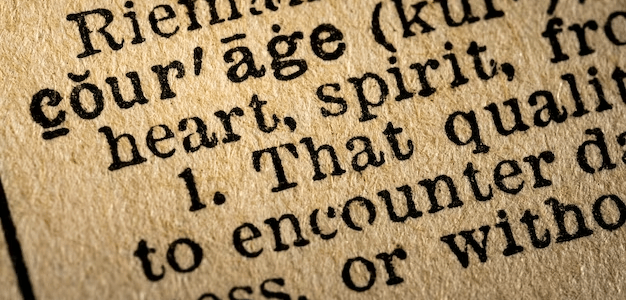
Courage.

Let’s be clear here: courage isn’t bravery – at least not in the ‘running into a burning building’ kind of bravery that my Dad did once, or my little bit of it you can read about here – and it isn’t about just pretending everything is fine and persevering when actually it isn’t. It’s a word with much more to it than daring and valour. The Cowardly Lion from The Wizard Of Oz was lacking bravery; courage is broader than that.

Again I find myself back in A-Level French lessons and recall that “cœur” is the French for ‘heart’. A quick trip down an internet rabbit hole and I find that cœur comes from the Latin word for heart, cor, which connects to the second part of the word which comes from the Latin word ‘agere’, meaning ‘to be’… or ‘to lead’.

So…

Courage isn’t about being bold or daring. Courage is leading from the heart. Putting the head to one side and just letting the heart lead the way.

This, my friends, is where the magic lies. Courage is how we do the thing that logic tells us is impossible. Courage is a decision

Courage is choosing to forgive.

Courage is being the first to say “I love you”.

Courage is holding on to hope.

And here’s where I question whether we create our language or our language somehow guides us through. Because whether or not you already knew that despair means that you actively go away from hope, you definitely will have had the feeling that despair was at the end of the line. When all hope is gone.

And perhaps now you may consider that there’s another choice; another decision: that when all rational hope is gone, it’s time for the emotional hope to endure. To choose courage. To lead with the heart. To know that whatever you are going through, you are still going, and today, that’s enough.

Courage doesn’t need to turn up with a sword and a shield; to smash the door in. Sometimes courage is just picking yourself up and dusting yourself down, and making the decision to go again, even when you know that you may fall once again; the heart taking the lead, because the head is weary.

Whatever happens, however difficult or uncomfortable or unfair you think it may be, however hurt or lonely or lost you may feel, remember you always, always get to decide how you handle it. As the Zen Taxi Driver I once met noted: don’t be so keen to give up control of your mood or feelings to whatever’s happening. No matter how hard things are, or how close you may be to despair, you get to decide what you will allow to affect you and what you will not. I know it’s not easy, but believe me: you are not at the mercy of external influences. You get to choose.

So just take a moment. Let go of whatever expectations you might have about what might happen, because last time I checked you’ve never actually that good at reading the future anyway, right?

And choose courage. Go again. You’ve got this.

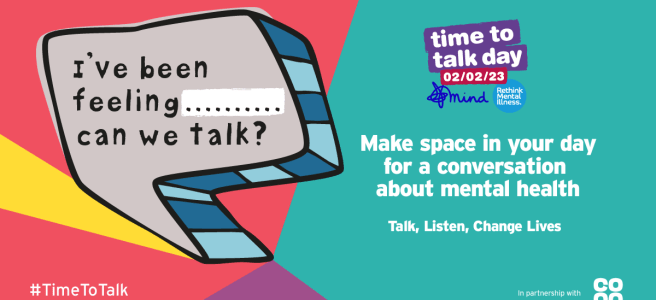
Time To Talk Day – my “little episode”

I’d been feeling a bit lost for a few weeks. Maybe a few months even, I’m not too sure. A while, anyway. Not completely without purpose, but lacking a little… something. “Not feeling it” as they say. It’d been a time of introspection, not all of it particularly useful, coupled with a fair bit of time wishing I weren’t so introspective. It can all get quite meta when I’m thinking about how I feel. And how I feel about how I feel. You get the idea.

I get like that sometimes. It’s kind of exhausting, to be honest. I get into my own head and get stuck there for a bit. Outwardly I’m fine – perhaps a little skittish or distracted – but inside I’m spinning.

When I’ve been like this in the past, there’s always the internal monologue that just says I need to snap out of it. To follow the good old masculine trope and for fuck’s sake just MAN UP.

But of course, I know that bit of me doesn’t solve anything. Rejecting how I’m feeling, pretending it’s not real, or (even worse) beating myself up for even having these silly, selfish, weak things called emotions is a road I’ve been down before, and it’s always ended up at a dead end. [If you’re interested in one of those roads – perhaps the first dead end I found, actually – then you can find my story about my anxiety here.]

Unfortunately knowing all this in your more calm and more rational moments doesn’t necessarily help when you’re in the middle of it, because when you’re in the middle of the forest you can’t see the wood for the trees. And I was right in the middle of the forest.

Allow me to explain…

A long time ago I decided that if I was going to be leading people, in any way, big or small, I’d do that in a way that felt genuine and authentic to me. I’ve always known that the best way to bring people together was to try to connect with them – and to connect them to each other – with shared passion and values and purpose and all that good stuff. I don’t need to tell you that you only build trust through vulnerability, and that’s what I’ve done, for years.

This philosophy requires me to be emotionally open, genuinely caring, and empathetic not just to the individuals but to the group that individual is a part of too. If I’m not all of those things, all the time, then the connection doesn’t work in the same way. I’ve doubled down on vulnerability, time and again, because that’s what I believe in. There’s no question that it’s made my working life richer than I could have hoped for, but I can’t pretend there aren’t times when I’ve wished I could shut off the emotional side because it does take a hell of a lot of energy. You can’t reverse back out once you’ve started with an open, honest, vulnerable relationship because if you were to do so, the trust you’d built up would break into a thousand pieces, never to be put together in quite the same way again. Once you’re in, you’re in. And I’ve always been all in.

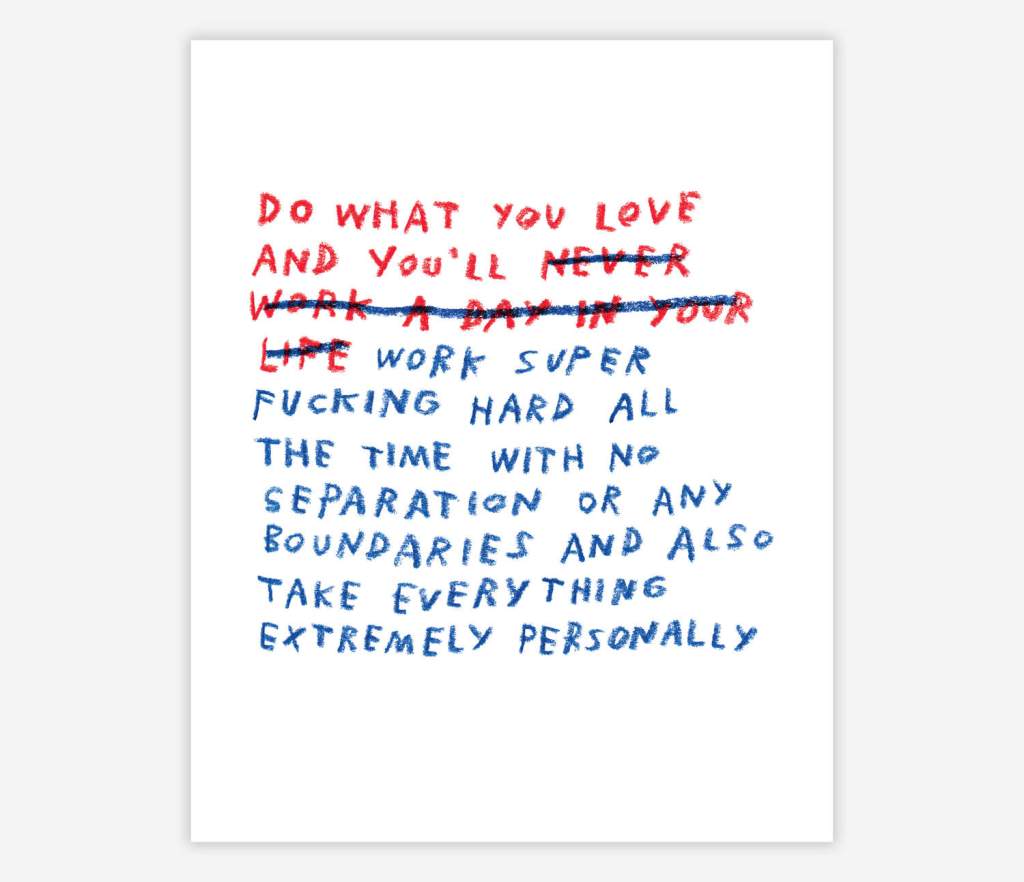
The result of that can be neatly summed up by this little gem from the visual artist Adam JK (you can learn more about him here if you like), who put it thus:

And that, mes amis, is the life of an ‘all-in’ leader, especially in the strange razor-edge world of running an advertising agency, where every success means people are working too hard and burning out and freaking out and you can see that they’re struggling and you wish you could do something… and every little failure means you might have to send someone home without a job. Someone you know, and care about. Someone you really, really like. Whose family you’ve met.

It’s always been personal for me. And the last couple of years only heightened that.

Authentic, vulnerable leadership is hard at the best of times, but leading through two years of global pandemic, where people’s expectations of their employer changed overnight and never changed back, has taken its toll on leaders the world over. I’m no exception to that. Overnight I felt responsible not just for the agency I run or the jobs of the people who work in that agency, but for the people themselves, too. We were the de facto community that people were missing. Work was, for many, the only human contact people had.

And so through two years of sustained growth in lockdown, I knew people were allowing their commute time to be subsumed by work, and working longer hours than ever. To help with that we were trying to hire people so quickly that there was no way we could be doing a decent job of embedding them into the group and setting them up for success. I could feel that we were cashing in all the “emotional currency” we’d been banking through the previous years.

Emotional currency is an idea I’ve talked about for a good few years now, and it’s simple enough – when things are going well and work feels good and morale is good and the mood is good then all that good stuff gets banked in people’s minds but more importantly in their hearts. The more the good continues, the more you bank. And then when things aren’t so good for a while for whatever reason, you have some good in the collective emotional bank which means you get some leeway – some time to get things good again. But here’s the rub – it’s not fair. You might have two years of good in the bank, but once you start withdrawing it’ll be gone in six months.

I could feel that the bank was getting empty. Not in the red, but not snow angels in the banknotes either.

And then as the shared experience of lockdown and Covid became smaller in the rearview mirror, everything happened. All at once.

Work got messy. The razor edge was sharp and painful. We were under pressure and I was out on a limb, fighting for what I thought was the right thing to do time and time again, holding on so tight that I couldn’t release, and in my own head so much that I started to question my instincts on things. And I’ve always trusted my instincts. Always.

Life got messy. An old friend took his own life, which rocked me in ways I still don’t really understand. Family members were in and out of hospital for operations which of course were always going to be fine but of course there’s always that bit of your mind which likes fucking with you in the middle of the night because WHAT IF..?

My head got messy. Losing sleep. Losing perspective. Losing myself.

It all came to a head on an otherwise unremarkable Wednesday morning at the end of June. My wife told me that she was going away with my sons for a few days in the summer holidays and I’d be at home for about 10 days on my own. My reaction wasn’t “sounds great, I’ll sit around eating pizza in my pants and get the lads round to play poker”. It was “I’ll go fucking crazy here on my own”.

The way I’ve described it since is by using the analogy of holding a mental tray. You’ve always got a decent amount of stuff on your personal tray, and most of it you put on there yourself so it’s all balanced in a way that you can handle. But if you keep on putting more and more things on it, then eventually you’re going to struggle. And then if other people stick some stuff on it as well, and aren’t as careful balancing…

I just about managed to put the tray down before I dropped it. Just.

I spoke to my team at work and agreed that I’d take some time off in the summer.

Which I did. A month away. Time to get some more stuff in my toolbox. Started some coaching and some yoga and meditation. Started going to the gym, too.

I can’t say the return to work was gentle, though. If anything it was worse than before the break: intense and toxic and kind of disgusting really. If you ever want a case study on how not to handle the return to work of a leader who’s been suffering with their mental health, give me a shout.

When, like me, you’ve spent your entire adult life ‘showing up’ as self-confident and full of energy, it’s actually pretty easy to fake it. To turn it on and turn up and get through and get out. So I tried to be what I thought people needed me to be. No one needs a leader who can’t trust his instincts. Who can’t trust himself at all, really. I was so wrapped up in my own stuff that I couldn’t really be the support that people needed, but I couldn’t tell them either because that would be putting more on them and they were already covering for me. I thought I was doing okay because the time off had given me a chance to get my nose just above the flood waters so I could breathe, but I was still only one slip from going under again.

I had a panic attack one morning before going into the office. I called my wife and she talked me down and I went into M&S and got some fruit and went into our offices and up in the lift and sat down and didn’t say a word about it to anyone.

I couldn’t take more time away because people needed me. Or at least that’s what I thought. But looking back, I wasn’t completely there anyway. By the time I started getting cluster headaches [read about the delight of those here if you fancy it. TLDR – they are horrible] towards the end of the year I was just limping towards the alluring finish line where 2022 would finally be consigned to history as the shittiest year of my life. Beating the year my mum died takes some doing.

BUT…

Lovely word, right? “But” makes everything that comes before it irrelevant. It turns the story.

But that was last year.

Yeah, I know that nothing magical actually happens at the end of December 31st, and that the whole idea of a “New Year” is just yet another construct that we’ve created – a story we’ve all decided to believe. But I needed to go with the romance of a new beginning. The turning of a page.

And as I sit here today, I do feel like I’ve turned the page.

Over the last six months since what I’ve euphemistically been referring to as my “little episode”, I’ve put a lot of time and energy into getting more things in my self-care toolbox that I can pick out as and when I need them. I’ve been going to the gym with a couple of friends who also could do with reshaping the dad bod [which considering I’ve been “Gym Free Since ’93” is quite a shift for me]. I’ve been doing a 1-2-1 yoga class every week since July. I’ve had some professional coaching which has helped me to get a better sense of my own values and what I need to be fulfilled. I’ve had a sprinkling of therapy along the way. Then just before the break in December, I learnt to meditate and now I’m doing that once or twice every day,. Last year I changed my meds and then this year got some advice and changed the dose which has helped. Hell, I even spent last weekend at a yoga retreat where as well as doing more yoga than I’ve ever done I also opened up to a load of complete strangers and chanted around a fire with a couple of shamen women for crying out loud [don’t worry I’m not converting – I just love a fire]. And perhaps above all, I’ve got my wife, and my two boys, and my dog, and the huge oak tree in the woods over the road.

I’m coming into this year feeling more centred and more solid than I have in a long time. Maybe ever.

At the same time, I’m also very conscious that all this is part of a journey and I can’t let myself be either complacent that somehow I’m magically “fixed” or concerned that “it’s only a matter of time before I crash again”. I just have to be whatever I am right now and be okay with that. I’m okay today. Tomorrow is tomorrow.

So why the hell am I telling you all this?

Well, there are a few reasons, actually.

The first one is then when I’m writing this, you’re not here. So I’m kind of talking to myself really – starting with the man in the mirror and asking him to change his ways [yes that is a Michael Jackson lyric – I couldn’t help myself and it’s lightened the mood a bit hasn’t it?]. It helps me to organise my thoughts, and as a result it’s kind of cathartic.

I’m also telling you because there’s a massive stigma around talking about mental health, especially in men, and if I can talk about it then at least I’m doing something to break down that stigma in some way. For me it’s just health -I’m not ashamed of my mental health problems any more than I’m ashamed of the fact that I need glasses or got diagnosed with gout at the age of 30 [a family disease for the Bartletts]. I take my pills for my brain at the same time as I take the ones for my liver. I take vitamins too. Sometimes I take something for allergies. It’s all the same. Talking breaks down barriers and stigmas and I have a lot of privileges in life so if I can’t talk openly about all this shit, who can?

If you’re a regular visitor to these pages, you may also have gathered that I’m a talker anyway, so this isn’t new news for a whole load of people. My immediate family know, and some of my extended family do too. A decent amount of the friends I’ve spoken to in the last 6 months know, because it would feel horribly inauthentic if they were to say “how have you been” and I were to say “yeah, fine thanks”, so I’ve tended to ditch the small talk and go for the big talk. And at work, I started off telling my immediate team, then thought it felt right to tell the whole agency about it because it’s real and I want them to know that it’s okay to not be okay. And then somehow I found myself in a really open and honest conversation with the new big boss in New York and I took a punt that he would get it and told him and he did get it and that felt good. So now a lot of people know I guess. Everyone, without exception, was kind and considerate and caring.

And now you know.

Which leads me to the last reason, which is actually all about you, dear reader

You see, the reason I overthink things and then write about it here is so that you can learn from my mistakes and avoid them (whilst, of course, making a whole set of completely different ones). Call it a friendly nudge, or wake-up call, or even a kind of non-specific remote intervention, but if you’re carrying your own tray and you’re wobbling, then please trust me, it’s not just going to magically fix itself. Yes, there may be light at the end of the tunnel but it’s no fun living in a tunnel on your own either and maybe, just maybe, a nudge around TIME TO TALK DAY might be the right time to maybe talk to someone about what you’re going through. It will help, I promise, and they will care, just like you would if the tables were turned. The truth is, they probably know already.

And on this day of all days, if you’re actually doing pretty well, actually, then you can make the world a better place by making a point of being emotionally available for the people around you who seem like they’re probably fine but actually might not be…

The colleague who always seems like they’re a step or two behind where they think they should be.

The family member who’s gone a bit quiet recently.

The friend who hasn’t made it the last few times you all got together.

Maybe they are fine, and you just have a nice chat and a catch-up and perhaps arrange a time to spend a bit of time together because it’s been too long, hasn’t it? But maybe they’re not, and you’re exactly the person they needed to talk to but just didn’t realise it. Either way, you get to talk to someone you care about.

Hey, don’t let me keep you. I’ve got a call to make anyway.

What have I done?

Though it was still early in the morning, it was already becoming hot in the Jornado de Muerto desert, about 35 miles southeast of Socorro, New Mexico. On this day, the sixteenth day of July, 1945, the world was about to change forever.

At 05:29, the United States Army detonated the first ever nuclear weapon. As huge sunlight flash subsided and the mushroom cloud rose into the air, amongst the 425 people in attendance was the director of the Los Alamos Laboratory where the bomb had been designed, Dr J Robert Oppenheimer. He later said that the sight of the explosion brought to mind words from the Hindu scripture the Bhagavad Gita:

“Now I am become Death, the destroyer of worlds.”

June 16th, 1945.

Developing the technology behind such a device had been his life’s work, and within days of that morning in the desert the dropping of bombs on Hiroshima and Nagasaki, on August the 6th and 9th respectively, effectively ended the Second World War. The only nuclear bombs to have been used in combat, they killed between 90,000 and 146,000 people in Hiroshima and 39,000 and 80,000 people in Nagasaki, with roughly half of those dying on the first day. 95% of those who died were civilians.

There’s no knowing how long the war might have continued without those bombs of course, or at what cost in terms of lives. History changed course at that point, leaving those stark figures as the epitaph to the largest war the world has ever known.

Oppenheimer’s moral conscience about his place in this history as “the Father of the Atom Bomb” was complex and nuanced. Two years after the bombs had extinguished both life and war at the same time, he would tell his peers that they had “dramatised so mercilessly the inhumanity and evil of modern war”, and connected science to the idea of sin like never before.

Yet when asked to reflect later in his life, he claimed to carry “no weight on my conscience”, seeing the scientist’s role as distinct and detached from the governments who decided to use their work. Scientists do science. Governments do war.

I’m not sure I could disconnect myself from the responsibility for my actions quite like that. But then I’ve never been indirectly responsible for the deaths of thousands of people in a flash. Perhaps that would be the only way to live with it.

And here we are, a month under 67 years later, and the mere threat of those same bombs that Dr Oppenheimer came up with allows a country to invade another and no one can do anything to stop them, just in case.

Oppenheimer never could have imagined. At the very first, it was all about the science. As Jeff Goldblum’s character memorably says in the first Jurassic Park movie:

Your scientists were so preoccupied with whether or not they could, they didn’t stop to think if they should.

It makes me wonder about all the other people who started out with good or decent intentions, and ended up making the world worse.

The people behind Twitter is an obvious one. Created as a way to connect people all over the world, it’s ended up being a place where the positive connections and sharing and love is vastly outnumbered by the division and demarcation and disunion. Where people can anonymously shout and threaten without consequence, and conflicting interested parties can choose to create and curate hatred and vitriol.

Google was set up to “democratise information’. Now they sell our personal data to whomever wants it so they can convince us to buy shit we don’t need, with money we don’t have. They could, and didn’t stop to think if they should.

Facebook was set up by pretty grim people for pretty grim original reasons, and then morphed into something that was nice for a bit but now is as bad if not worse as Twitter. For every local community group, there are ten more sowing dangerous lies, giving legitimacy to lies which in times gone by would have died on the edges of society. Connect enough crackpots and they’ll convince each other they’re all right.

[There’s no question this extreme online discourse has leaked into society as a whole. If you haven’t seen David Baddiel’s excellent documentary on the BBC then check it out in iPlayer here.]

There’s an old cliché that “the road to Hell is paved with good intentions”, but it’s a cliché because it’s true, of course. And on much smaller levels we all have it in our own lives.

As I say, I’ve never invented an atomic bomb, but I have been so desparate to avoid having to make people redundant that I ended up making things worse in the long run. I have allowed loyalty and hope to cloud my judgment. I have had times when the utopian working environment I was aiming for looked more like a sweatshop. I have tried to make someone laugh with a joke that actually made them cry. I have tried to hold everyhing together for everyone else and ended up forgetting myself. It”s no bomb, but I can learn from my “what have I done?” moments anyway.

You’re not Dr Oppenheimer either. But imagine for a second that you could undo the thing you did that’s put you in the situation you never planned for and don’t want to be in right now. Compare that to inventing the atomic bomb. One thing can’t be undone, but I wonder if the thing you’re thinking of can?

If it can, fix it. It doesn’t matter how, although I can give you some tips on a good sorry I wrote earlier here.

If you can’t, then don’t push it away and deny it, like the good doctor. But don’t carry it with you either like a stone in your shoe. We all make mistakes, even when the intentions are good. Instead just acknowledge, learn, and move forward.

It’s not about what you’ve done. Because there isn’t a damn thing you can do about that. It’s about what you’re going to do next which makes things better.

So go. Do that.

Routine, in every sense.

Our little habits and routines are crucial parts of our lives. Once we’ve done something the same way a few times, our brains create a kind of short-cut, low-energy running mode which means we can do things whilst only using the minimum of our internal working brain. Brushing your teeth, making a cup of tea, packing the dishwasher. It’s all done on your brain’s equivalent of standby mode.

This can even kick in when we’re doing quite complicated things, too. I’m sure you’ve experienced driving a route you know well “on autopilot” and arriving at the station or your Mum’s house or wherever and thinking “I didn’t really concentrate through any of that” and wondering how it all just happened.

But just happened it did. We’re actually bloody good at it, and it’s really useful, because if we had to think about everything all the time our overworked little ape brains would, without any shadow of a doubt, explode within 30-45 minutes, maximum.

30-45 minutes later…

That routine, that habit, just doing something without thinking – that does more than just save our brain power. It’s that same sense of being on ‘autopilot’ which can bring an element of stability to our lives. The familiarity of getting a coffee at the station every morning, standing in the same place on the platform, walking the same route to the office: yes it’s because “who wants to think about that stuff”, but it’s also familiar, and comfortable. We like that, us humans. We’re simple animals, and we like things to be the same. Same is simple. Same is known. Same is safe.

Ooh, hang on. SAFE. That’s quite a big word, isn’t it? [And I don’t mean just because I put it in ALL CAPS, although I concede that does indeed make it bigger, well done if you spotted that, you get a cash prize of 10p please contact me on MySpace for details].

Feeling safe is really basic to us as animals. Right down towards the bottom of good old Maslow’s Hierarchy of Needs, it’s a foundation of the pyramid, something we need before we can start to think about more lofty ideas. So much so, that once we have that safety, the idea of giving it up can actually make us feel very uncomfortable, very unsure.

Perhaps, when the world is so uncertain, it’s even more important? Because when the world is uncertain that means nothing is the same and won’t be the same again. And if same is safe and the world will never be the same again then that means…

Especially when the world – that place out there, full of masked strangers and signage and arrows and rules and fear – is actually full on proper actually scary in its own right.

So we close in. Our new routines, our new habits, become our new safe. Get it right and it can actually get quite comfortable really. At a stretch you could even convince yourself that it was your decision somehow. A smaller life, more constricted. Habits that keep you safe when the world cannot.

And so we lower our expectations, to the point when the only expectation is to make it through the day, the week. To cope, somehow. To get to the weekend… where we do the same things, in the same places. We stop living and we exist from day to day, week to week. We drink too much, or stop drinking completely because we worry about drinking too much. We wait for something new on Netflix but and we feel the grief of TV bereavement when we finish something we like because that was a habit for a bit and habits make us feel safe.

We didn’t get any snow last week. Not a fucking flake. My social media feeds were full of bloody snowmen and sledges and sublime scenery and we got drizzle, for two days. I was livid. Not because I’m desperate to throw a snowball which by chance hits my younger son Jack right in the face so he starts crying immediately and we have to go home and everyone hates me for the rest of the day (true story) but because it would have been different. A break from the norm. A break from coping, getting by, managing.

Oh brilliant, snow selfie is it mate? Yeah yeah whatever

But then, the same day that every other bugger in the whole country got the snow, we had a power cut. A proper, old fashioned, 1980s power cut!! I was genuinely giddy with excitement! The strange “oh my God where are the candles??” excitement of a power cut! What would we do? Maybe read by candlelight or play a board game? Is it out all over the village – yes look it is, not a light anywhere, I wonder what’s happened…

And then, in the time it’d taken me to find a match and light the first candles, it all came back on. The TV hummed into life; the lights all over the house [All together now: “It’s like Blackpool bloody illuminations in here!”]. Like a cruel joke, the house lights of normality chased the dramatic darkness of difference into the corners and away under the chairs.

And there we all were again, all the people in the village, suddenly right back where we started. In the old routines.

Coping. Getting by. Managing.

Is this life in 2021?

I say this is not good enough.

I say we deserve more than just coping.

I say that the habits we have built may keep us safe but they limit our expectations of life.

If we let our routines become our lives then we let our lives become… routine.

But make the choice to break your habits, to bend your routine, and that life can rush back in. Because it’s always there, ready for you. Life’s dependable like that.

If you’re a regular reader [what, nothing better to do with your time than read the latest emanation from my fragile psyche? You’re very kind, thank you I do appreciate it.], you’ll know that last week I went for a walk in the woods with my friend Joe. Well since then I’ve walked most mornings – this morning with the good doctor once again [hi Joe!].

I don’t go every morning, partly because sometimes it’s pissing it down and I’m not a total maniac, and partly because it’s the lack of routine to it that makes it so refreshing. As well as filling my lungs and getting my blood pumping around my increasingly corpulent carcass first thing [still proudly “Gym Free Since ’93”], it allows me to see the world at a different time of day, in a different light, with different smells and sounds. It makes me want to paint a picture or write a poem [neither of which I can do, but a boy can dream, right?]. It’s pulled me out of my routine, and made things less routine.

And in case you’re wondering, I haven’t done the same route twice.

Listen, I can’t tell you how to live your life. What I can tell you is that those new routines, and habits – the ones that aren’t just about keeping your brain free but more about keeping your soul safe – they will need to be challenged at some point. Because whatever comes next [and trust me when I tell you that although everything seems uncertain, this too shall pass] we both know it will need you to let go of some of those new things… just like the situation we’re all in at the moment forced us to let go of all the old things, in a single moment.

We didn’t have a choice before. And we didn’t have the chance to prepare.

Now we do have a choice, and we do have the chance.

So, tell me: what’s today going to be like?

[As a small post script, I just want to say how much I fucking love our crazy language. That one word – “routine” – can as a noun mean those commonplace things we regularly do, and as an adjective means dull, conventional and unremarkable is fascinating and joyous to me. I love the idea that our language is so furtile and full that we can push it around and play with it, like a cat toys with a ball of string, lost in a world of simple pleasures. Sorry if I lost you in the double meaning anywhere – I couldn’t help myself.]