Sorry

No, really. I’m really sorry. I know I was wrong and I take full responsibility for the impact this has had. I can probably have a go at trying to explain to you why I acted the way I did, but I am not trying to make excuses and appreciate that, whatever my intention, the actual impact is something for which I must take responsibility.

I’m sorry.

Elton was right – sometimes sorry does seem to be the hardest word.

But bloody hell, isn’t it powerful?

Sorry takes the wind out of the sails of any argument, any conflict. In seconds, it lays the foundation on which reconciliation can be built.

It has to be sincere of course. An insincere apology can be worse than no apology at all. And ‘The Power of But’ is more dangerous here than anywhere else. “I’m sorry, but…” means that actually I’m not really sorry at all.

[In case ‘The Power of But’ is  a new one on you, the word “but” has the power to make anything that came before irrelevant. “I think we’re going to make it but it’s going to be incredibly difficult” makes you think how difficult it’s going to be; “It’s going to be incredibly difficult, but I think we’re going to make it” fills you full of hope and and motivation. Tread ye carefully, for The Power of But can wreak havoc in the wrong place in a sentence.]

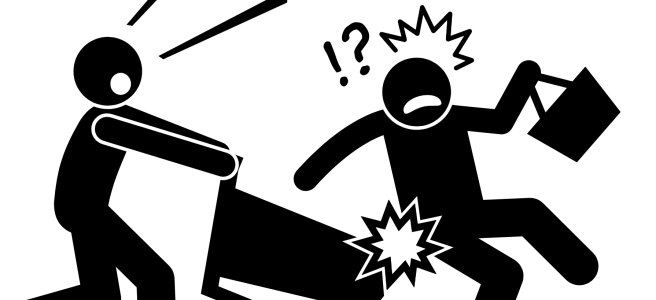
I’m not talking about the “sorry” that every British person says when someone bumps into them and it’s not their fault but they’re very British and that’s just what we do. The German stand-up comedian Henning When once said something along the lines that that the way to know someone’s nationality is to take a run up and deliberately ram into them with a shopping trolley. If they turn round and say sorry to you, they’re British.

“Sorry”

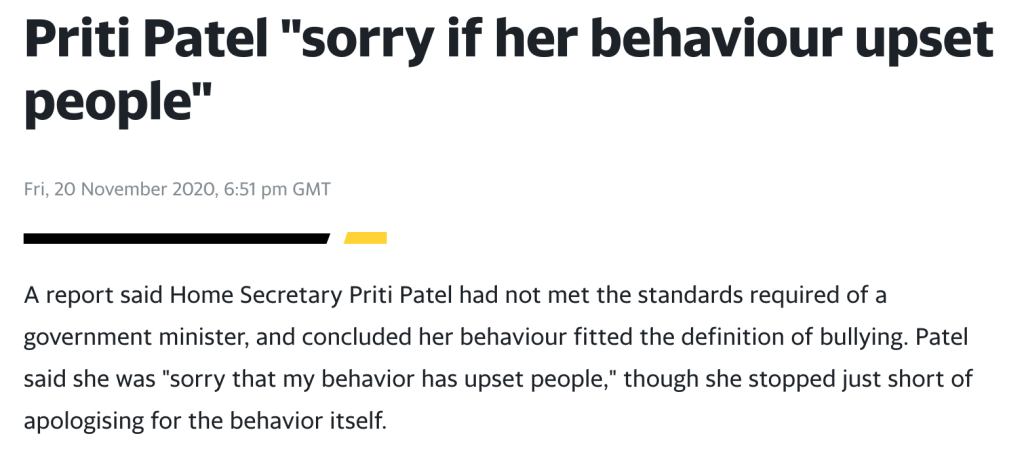
And I’m really not talking about the sly and sneaky non- apology politicians and other kinds of sociopaths and egotists tend to use, which usually goes something like “I’m sorry if you were upset by my actions”. This actually puts the blame on you for your stupid and unnecessary feelings rather than taking the blame for the actions. “I’m sorry you feel that way” fits into that same weaselly passive aggressive bucket. Ugh, and just in case that’s not enough disgust, may I also add UGH.

Ugh

No, I am sorry. I am very sorry.

Sorry says that you accept your part of the conflict, and want the conflict to end. You take responsibility for your own actions.

The best thing about sorry is that it doesn’t mean that you weren’t wronged in some way yourself. There are nearly always two sides to any conflict, with each person sure, in the moment at least, of their own position. But the magic is that it doesn’t matter if you can say sorry. And you always have that simple word with you, ready to drop into the middle of a storm and watch as the wind dies in a second, sails empty and flapping in the memory of the gales that threatened to destroy just a few moments ago.

There’s a powerful phrase I heard a few weeks back which has stuck with me. For the life of me I can’t remember where I heard it, and Google can’t help me which makes me think I actually might have misheard it, but as it exists in my memory it’s perfect….

Leaving aside the wrongdoings of others, we ask ourselves “how was I at fault?”

Clearly it has its roots in counselling or therapy of some kind, because even the phrasing of it is beautifully inclusive: “we ask ourselves” not “you must ask yourself”.

And the simplicity of it really gets me. Yes other people may have done the wrong thing. Yes they need to take responsibility and consider how their words or actions may have affected you or exacerbated an already difficult situation. No one is denying any of that.

But let’s put those things to one side for a moment, take a breath, and consider the idea that we weren’t perfect. That we were at fault in some way – how we phrased something, how we reacted… how we were perceived as a result (because, lest we forget, perception is reality of course).

Find your own fault. And then apologise, sincerely and without expectation or hope of reciprocity.

It’s truthful, and disarming, and vulnerable [that word again, right?] and incredibly, uniquely powerful. It’s the start of the rebuilding process. The first step towards a brighter place.

Give it a try. You know that your mistake was just that – a mistake. It doesn’t mean you’re a bad person, just that (leaving aside the wrongdoings of others, remember?) you’ve examined where you were at fault.

Admit you were wrong, Maybe have a bit of a plan for how you might start to fix things. Ask for forgiveness.

Start with sorry, and you’re making a start.

And if it doesn’t go the way you hope…

I’m really, truly sorry.

Fighting fires

When I was a kid, I watched my father [hi Dad!] walk into a burning building. I was maybe 8 I guess? Our house backed onto a farm and (so the tale goes) some local kids had been smoking in the barn in the evening and it caught fire. Next to the barn was a little cottage where an old lady lived, with a load of cats – like a dozen or something – and she had refused to leave the cottage before all of them were found and she couldn’t find one and “what if it’s still in the house??!!”…

My dad wouldn’t claim to be “brave”, I don’t think. I imagine he’d consider himself much too sensible for daft ideas like that [he reads The Times, for crying out loud] but on that evening [probably with an “oh for fuck’s sake” under his breath if I know him] he walked into the burning cottage to ‘convince’ the lady she really should think about making her way out of the building sometime soon if turning into a roast old lady wasn’t in her immediate life plans.

Anyway, you’ll be pleased to hear that he came out, jostling the old lady in front of him. You’ll be delighted to know that all the cats had, of course, left the cottage some time before, because as we all know cats only care about themselves. My old man [who, come to think of it, would have been younger then then I am now: what a mind fuck that is!] was coughing and his face was black from the smoke and soot and my mum was really cross with him which at the time I thought seemed a bit unfair, because, you know, he was a bloody hero and all that.

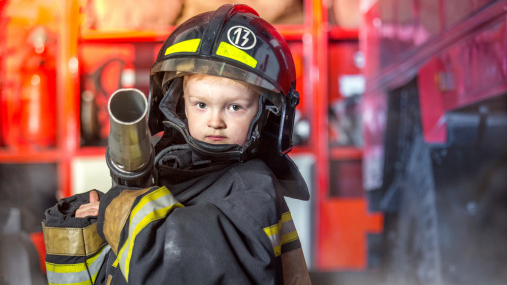
And then the fire brigade turned up and we got to watch them putting the fire out, and it was very late and very exciting and I think I got to wear a fireman’s hat [although I might have imagined that because I’ve watched too much TV in my life and that’s the kind of thing that happens in a montage at the end of a TV program about a fire isn’t it?].

My fake memory

Up to now, I haven’t had the opportunity to save an old lady from a burning building [although I did have my bravery tested once – perhaps one for another time!] but that doesn’t mean that I haven’t had fires to put out in my own way over the years. Oh no!

Because that’s what leaders have to do, right? Solving problems, making things better, fixing things. Filling gaps, plugging holes, and “putting out fires” [See what I did there?].

To be honest, I’ve never really liked the phrase “fire-fighting” when talking about work problems. It feels too reactive to me, like you’re forced to jump from the hottest, most urgent thing to the next, constantly on edge, constantly turning to find something else threatening to burn out of control. And so I think the phrase actually makes things worse, somehow.  But I do get the association of course.

Because we know that, left unattended, problems are more likely get bigger and less easy to deal with, just like a fire, until they’re totally unmanageable. And because we know deep within us, through thousands of years of generations upon generations from our earliest times on our planet, that fire has huge power and fearsome energy. Not just in what it does – how it destroys all in its path – but in what it does to us as people.

Just like our ancestors before us, we’re drawn towards fire. It’s deep within us to fan it or fight it, and so all too often we find ourselves simply gazing into it, transfixed, lost in its dancing light.

Nature’s cimena

And just like fire jumping from tree to tree and house to house, the closest possible proximity in which we’re forced to work in our overstuffed offices mean than even the smallest spark can catch, and grow and draw people in to fan or fight or stand and gaze once again.

But as much as we are mesmerised by fire, no matter how wondrous and fearful we find it, what we tend to forget is that the following day the ashes hold only a memory of the fire that once was, and hold no one’s interest for more than a fleeting moment before the winds of time disperse them.  Every fire that ever was ended up as ash in the wind.

And so perhaps one positive thing that I’ve experienced through the maelstrom of Bloody 2020™ is that the forced virtual nature of work has meant that when problems do arise there’s more space for consideration.

I don’t mean there’s more time, of course; not when the line between home and work has completely blurred to the point that it’s not actually visible any more, and I’m working earlier and later than I have in many years because it’s not like I’m going anywhere, and yes it’s getting physically and emotionally exhausting, as the stark sharp split between the imitation intimacy of a video call and the silence when it ends is jarring in a way that as simple, social animals we were never designed to be able to comprehend so we feel somehow empty in the moment, like we’re mourning the human connection that felt so real just a few moments before… [shit, sorry, where was I?]

No, I mean that there’s more physical and emotional space between us – space between the trees, if you like, so fires don’t spread so inexorably. With a watchful eye, some even die out all on their own.

Because with that space, people can consider their actions and consider what they might have done differently. The shared experience of lockdown and everything that’s gone with it means there’s more space for considering what someone else might be going through as well.

And so it seems people find it harder to hold a grudge from afar. People realise that they miss each other, individually and as the office buzz in the background as they work.

Starved of the oxygen of incidental interaction, disagreements become distant, irritations become irrelevant, niggles become nothing. And thus the flames of conflict are dampened, free to fizzle out naturally, quietly, simply.

There’s a lovely quotation I saw recently from a French writer/Aristocrat which goes:

L’absence est à l’amour ce qu’est au feu le vent. Il éteint le petit, il allume le grand.

Roger de Bussy-Rabutin

Which (as I’m sure you know) means:

Absence is to love what the wind is to fire: it extinguishes the small, it inflames the big.

I think that’s true, not just of romantic love but also of the companionship we all miss from our working relationships. The wind of absence has made the ones that were important to us before even more important now.

But perhaps the very same wind can blow out a lot of little fires of little inconsequential problems, too.

All without a fire-fighter to be seen…

A post-office world?

When my wife [hi Sarah!] and I made the decision to move out of South East London [big up big up Crystal Palace massive] three years back, I planned to work from home for “at least” a day a week. I was going from a 45-minute commute to one which would take an hour and a half, and anyway it’s not like I actually need to be physically ‘in the office’ every day…

Needless to say, that didn’t happen. Most weeks I was in every day, with perhaps a day working from home every couple of weeks. And when I did, I made it very clear what I would be working on…

Because tradition states that work is something that was done… well… at work. And everyone knows that all this newfangled “working from home” nonsense really just means dossing around doing nothing. No way that someone could be as productive from home, or that they could really be trusted to do their work instead of drifting off and playing computer games or watching daytime TV.

“Oh yeah right working from home mate yeah? Like nice one yeah?!”

Of course I knew that wasn’t the case: if anything I tended to work longer hours, with less distractions, fewer interruptions and less breaks than I did at the office. Without my friendly neighbourhood Finance Director [hi Jonny!] sitting next to me ready to wander off and grab a coffee, I was smashing through my to-do-list at quite a pace.

In fact, if I had organised a bunch of things to put on my WHF to-do-list which might have taken me a whole day to get done in the office, I might even find that I was through it by early afternoon and freeing up time to get to some of the important stuff that often got bumped by the urgent stuff.

But I always felt I had to check in with people too to prove I wasn’t off doing what I thought people might think I was doing instead of work. Call it “virtual presenteeism” if you like – an email, a text, just to say “I am still here, and I am still working”.

And I was also conscious that it was all very well for me to be working from home, because I’m in the privileged position of being the boss of the agency and thus a) largely setting my own work timetable and b) having no one to tell me what to do or where to be (in London, anyway!). Not so easy if you’re the Account Manager with the client on the phone all day, or the Planner with a creative team to brief…

Within a matter of days, lockdown meant that “WFH” was the norm. And soon everyone showed that they can work just as hard, just as effectively, just as productively from wherever their laptop was set up.

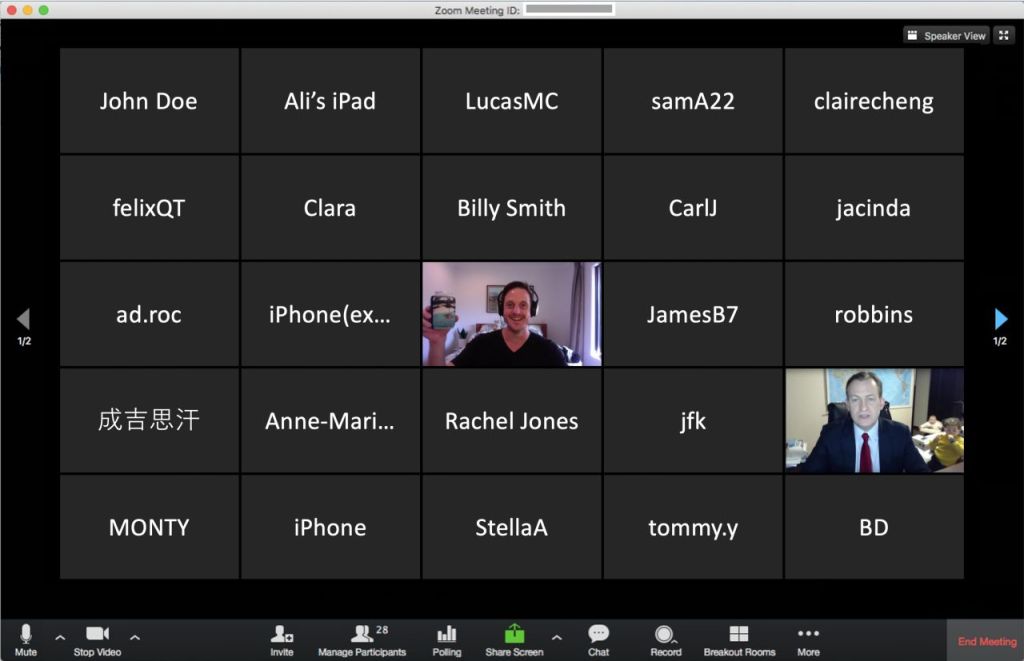
We’ve still had some issues – of course we have. The blurring of lines between work space and home space has meant that hours become blurred too; sometimes too much. I still have the occasional twitch which pushes me into digital presenteeism… now using Teams or WhatsApp as much as the other channels I used to use. “Video calls” where instead of a load of faces it’s just a sea of initials or avatars made everything feel very cold and unnatural [luckily we’ve pulled ourselves up on this and have made a real effort over recent weeks – it’s made a massive difference].

Stolen from my cousin Nick’s post [hi mate!]

And I’ve written recently about the lack of opportunity for ad hoc, in person, informal learning from colleagues and co-workers which I found so valuable in my formative years.

So there’s stuff to fix, but surely the stigma around working from home will have been the one victim of this virus that we can be positive about?

Hmm. I’m not sure.

When our office spaces are back to something like normality, will the assumption return that work is done “at work”? If we don’t need to work from home, wouldn’t it just be better if most of the people were in one place most of the time?

I think there are various truths about this whole thing that we’re going to need to reconsider, and possibly reconcile, over the coming weeks and months…

  1. There is no substitute for personal, face-to-face interaction. None.
  2. I would not have the relationships that I have with the people with whom I work had I not spent a lot of time with them in the same place [specifically “the office”, in case you’re wondering].
  3. Building an organisational culture without being physically together as a group would be really, really difficult. Not impossible, but tough.
  4. A strong organisational culture makes a company more resilient to a crisis, with shared values acting as the strongest foundation for honest, genuine working relationships.
  5. Some people have been more productive working virtually, with associated benefits in their mental wellbeing and emotional and physical energy
  6. Some people have found working virtually incredibly difficult, with the blurred lines between work and home feeling both draining and isolating at the same time.
  7. Some people will work like a dog no matter where you put them.
  8. Some people will do as little as possible no matter how much faith you put in them.
  9. Virtual hugs are not as good as actual hugs. Especially from me, as I am a world-class hugger [N.B. this is not my personal opinion – I have a full trophy room to prove it].
  10. It’s all about trust.

Yeah I know, I funnelled you into that last one. But it really is.

And so before you do anything else, assume positive intent. I know it’s obvious, and I know it’s not always easy. But it’s also surprisingly uplifting.

Assume that people are trustworthy. That they care about their work and their colleagues. That they want to do a good job, every day.

That they trust you to do the same.

Let’s all assume that we’re all doing our best, unless specifically proven otherwise, and a lot of this “new normal” [aaaarrrrgggghhh that phrase again] planning will be a lot easier. Start with trust and we can crack on making a new kind of totally flexible working – flexible around you as an individual with specific requirements and specific responsibilities, in all parts of your life, like never before – really work. For all of us.