The Oak Tree

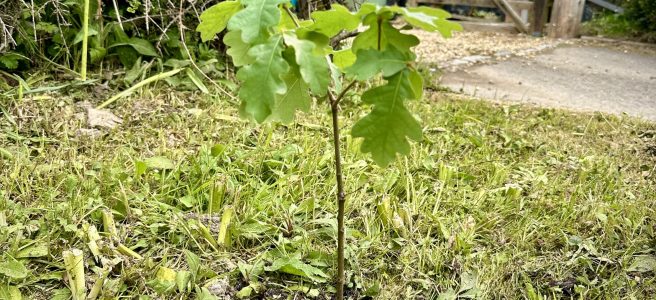
I planted an oak tree a couple of weeks ago. I’ll come on to why I had an oak tree to plant in a bit, but I was surprised how interesting the planting turned out to be. Because quite unexpectedly, the very act of kneeling down out at the front of my house on the edge of a little village in the South East corner of our little country and planting a little 6-inch tree in the soil attracted more attention than usual from the usual stream of passers-by.

To give you a bit of context, I live right on the edge of a big forest, and the path into said forest is right over the road from my front door, and on a sunny Sunday like we had that particular weekend, there are always a fair few people who park up in the village to wander into the woods, perhaps walking their dog, perhaps walking their kids [we all know that kids need the energy running out of them just as much as any dog], or perhaps just walking themselves with their friends, and they all go past the front of my house.

And so when I’m out there of a weekend doing classic middle-aged man things like tidying the hedge or putting stuff in the back of the car to take to the tip [our British word for the local recycling centre, and a mainstay of classic weekend activity for those of you who aren’t Brits and are wondering what I’m on about] or taking Jack [10-year old human male] to football training or Ben [14-year-old human male] to rugby training or Ruby [3-year-old canine female] for a walk [yes, this is the rock-n-roll lifestyle I lead] I often end up in a lot of smalltalk chitchat “lovely weather we’re having” conversations with strangers.

More than I’d ideally like, if I’m honest, because in my heart of hearts I’m not really quite as outgoing and gregarious and social as I might seem. [I’ve discovered over the years that I’m what can be described as an “extroverted introvert”, in that I’ll happily talk to anyone and everyone but I’ll also resent the fact that I have to and will be exhausted from the energy the interaction requires. But that feels like another blog…]

This time, though, it was different.

For a start, virtually everyone who came past felt the urge to point out to me what I was doing, mostly with a mixture of surprise and delight in their voice:

Oh, you’re planting an oak tree!

[Which actually doesn’t happen that often, when you think about it. It’s not often complete strangers totally succumb to the urge to tell you what you’re doing at the time. Imagine how odd the world would be if they did. “You’re walking down the street”. “You’re sitting on a train”. It would end up feeling like you were in some weird kids’ TV show where adults dressed in primary colours point out the blindingly obvious to an audience of tiny, no-nothing humans.]

And then, as a follow-up, virtually everyone would say something about how long it would take to grow, often with a bit of low level comedy in there:

I’ll have to come back in 30 years to see how it’s going.

That’ll look lovely in 100 years!

Quite a few people talked about their own mortality…

I won’t be around to see that fully grown…

Or indeed, about mine:

That’ll be one for your grandchildren to enjoy!

When the first person stopped and pointed out that I was, indeed, planting an oak tree and that yes, it would be a long time until it was fully grown, I said something along the lines of…

“They say that the best time to plant an oak tree is 100 years ago, and the second best time is today!”

…which got a great reaction, and so I basically recycled versions of that same line over and over with everyone who came past, honing my delivery each time, every new set of people blissfully unaware that they had unknowingly wandered into my perfectly curated and planned out set-piece interaction where I knew what they would say and what I would say before anyone said anything, all people playing their parts perfectly, my supporting actors never knowing that they weren’t the first to point out what I was doing, or experience the seemingly off-the-cuff remembering of an old quotation.

I knew I’d picked that line up from somewhere, but because I couldn’t remember where and because the people I was talking to probably wouldn’t know either, by the end I was making out it was a famous quotation which I knew and making up who had said it. Thomas Jefferson sounded realistic, as did Benjamin Franklin [not sure why the American forefathers leapt to mind, but I vaguely remember something about one of them chopping down a tree and then lying about it… or not lying about it… or some such thing; if you’re from that side of the ocean perhaps you can enlighten me!], and Lord Byron, for some reason, and then of course you can always drop in Churchill because all quotations sound like they come from him.

[As it happens, having put an appropriate amount of effort into researching this, it turns out it’s none of them: it’s actually (as far as I can ascertain, anyway) from an old Chinese proverb, and it’s not about an oak tree specifically, it’s about trees in general, and it’s not 100 years, it’s 30 or 20, depending on where you look. But as Mark Twain/Ernest Hemingway/Jonathan Swift/etc might or might not have once said: “Never let the truth get in the way of a good story”.]

And so, as the sky started to bruise and late afternoon made its lazy way towards early evening, I kept myself occupied with making up new attributions for this “quotation” and had a bunch of very small, but very enjoyable and (for me, at least) playful little interactions, all ending with an “enjoy your walk” from me and a variation on “enjoy your tree!” from them.

[I tell a lie: there was one more negative exception which proved the rule: a very prim and proper woman who took the time to point out that because of where I’d planted it, in 50 years time “that tree” would be getting in the way of the electricity and telephone wires criss-crossing above and I should perhaps plant it somewhere else. Knowing me as you do, dear reader, you will be most proud and a little surprised to hear that I didn’t simply say “oh sod off you grumpy old bag”, but instead said that in 50 years the tech would have moved on and there probably wouldn’t be wires above and anyway I’d be long dead by then and it wouldn’t be my problem to worry about. Which, considering she was maybe 25 years older than me, probably gave her a little jolting reminder of her own mortality and, perhaps, made her consider whether being such a naysayer was really how she wanted to spend her Autumn years. But we didn’t get into that next conversation because by that point it was clear we weren’t going to be friends anyway.]

And as I stood back, brushing the soil from my hands and admiring my handiwork – this funny little baby tree in the middle of a patch of grass, containing every piece of genetic information it needed to become a huge oak towering over the house – I had quite a deep feeling of accomplishment, and even a little pride.

I’m someone who plants an oak tree, with the knowledge that I won’t be here to see its majesty. It felt like a pure act of altruism, of outward-looking connection to the future. To people I’d never know, who would never know that I planted this tree, all those years ago.
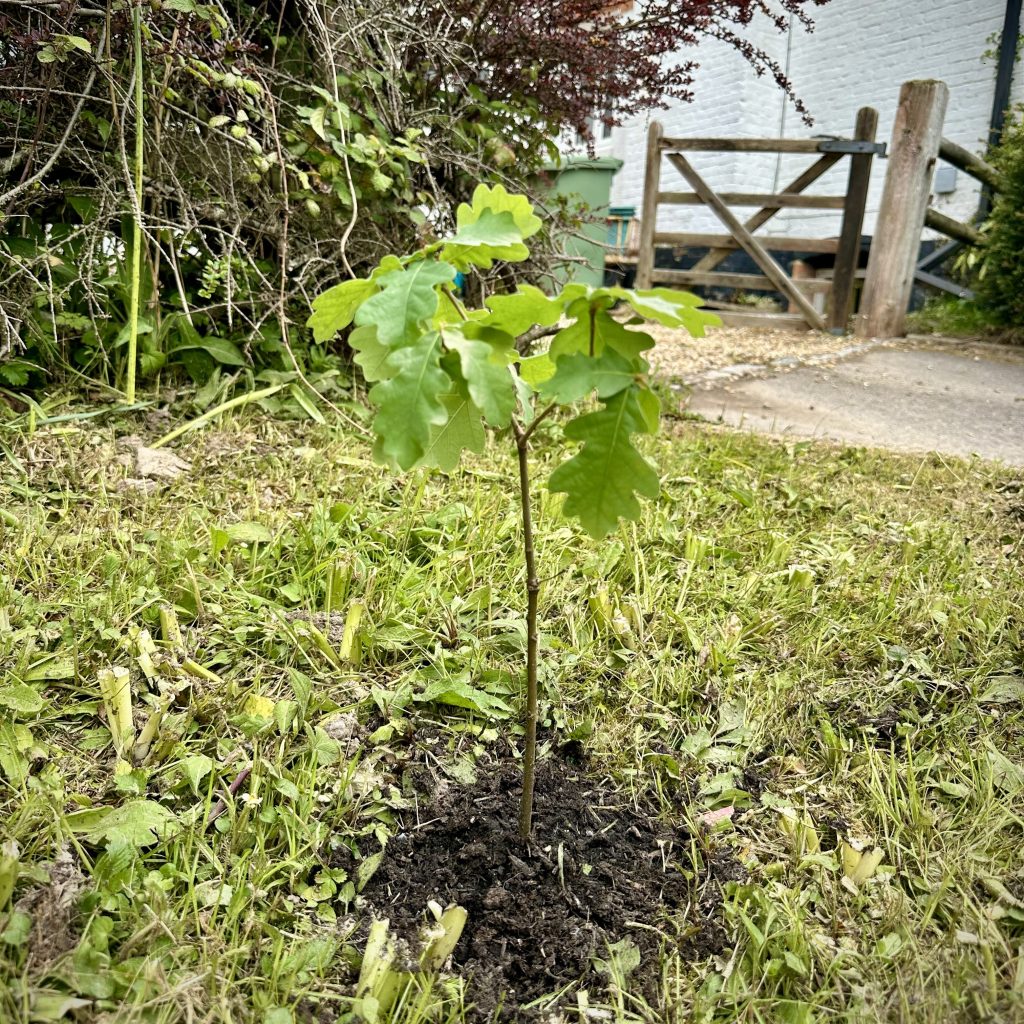
And there he is!

Perhaps, in 60 or 70 years’ time, my own sons might visit the village in which they grew up, perhaps bringing their own grandchildren, or great-grandchildren even, and say “I remember when my dad planted that tree”. And they could all point out that as it turned out it had really got in the way of all the electricity cables and made a right mess of things, and remember how the great power cut of 2078 that had all been traced back to me planting that very tree back in 2024…

Last Sunday, I have to say, they were both pretty underwhelmed. But they could see I was chuffed to bits with it so they kept their lack of enthusiasm to grunts of “it’s not very big” and “is that it?” and we left it at that.

So why, I hear you cry? Why was I planting an oak tree, of all things?

Good question. Well done you. There are a few reasons, and they probably make the most sense if I explain them in reverse order…

This little oak tree had actually been living in my house for a few weeks by the time it eventually got to experience the wild wonders of the world, but had arrived just before the twentieth day of the third month of this year which I’m sure you will have spotted is indeed my birthday.

If you’re also wondering why it took so long to plant it, well that’s symbolic of how my brain works – an often constant cycle between “I must do that important thing” followed by a gap, followed by a reminder and “shit I forgot to do that important thing” and then a gap and then repeat. A cycle between frustration and guilt and self flaggelation which is only broken by actually just doing the important thing which often doesn’t even take that long once I get down to it.

This is how it was with our oak tree. When it arrived it was just a little twig with roots in a bit of soil in a little plastic bag within a little hessian draw-string bag, and it sat on the windowsill in the kitchen [you know, the one behind the kitchen sink, by the window]. Every time I noticed it again, perhaps once a week or maybe a little more often, I’d go through the cycle of self flagelation above and give it a little drink from the kitchen tap, and think “definitely this weekend”. Then I’d forget all about it until the next time.

But this is an oak tree, remember? These things last for hundreds of years, and a few weeks being forgotten about by some bloke with a fuzzy brain wasn’t going to stand in the way of that.

So it grew leaves anyway. Beautiful, perfect little oak tree leaves like the ones you’d get if you googled “oak tree leaves”. Leaves of life, and determination. Leaves that demonstrated that this was a living thing, demanding to be planted so the roots living in a hessian draw-string bag could dive down deep into the earth to find their own water source.

Putting together all this information, and if you’re not only observant but also somewhat sleuth-like, you may well have worked out that this little oak tree friend of ours was indeed a birthday present.

The next question your inquisitive mind might ask could be “why on earth would someone buy you an oak tree sapling as a birthday present?”

Well, this particular oak tree was a surprise present from the person who’s been coaching me for the last couple of years, another Sarah in my life [alongside my wife and my big sis], who lives on the the other side of the world in Australia. And when she sent me an oak tree, she knew that I would know the meaning behind that gift.

Which takes me right back to the chronological start of this (surprisingly long) tale.

If you’re a regular reader you’ll know that I’ve had my struggles with mental health over the years, and you’ll also know that I’m now thinking that some of those struggles could well be connected to undiagnosed and untreated ADHD, which I had diagnosed and then treated from last year.

So over the years I’ve occasionally found myself right in the middle of the deep dark forest [you can jump into the Ted Lasso story around that idea here if you feel the need], where everything seems tough and scary and you don’t know which way to turn. You know how that feels too, I’m sure. I hope you’re not in there right now.

But as Coach Lasso pointed out, fairy tales do not begin, nor do they end, in the deep dark forest. “That son-of-a-gun always shows up smack-dab in the middle of a story”. Things do get better, and things do work out.

What I’ve found is that it’s not until you start to find your way out, coming out into the open air, seeing the sky and the clouds and the sunlight, that things start to get some context.

I’ve also found that there is a huge temptation, at that point of being able to look back, to curse the forest for all its darkness and danger and discomfort.

And that’s where the oak tree changed things for me, and why it’s become such a theme for me, and why Sarah gave me an oak tree for my birthday, and why planting it meant more to me than it would have if I had planted a beech, or ash, or horse chestnut.

Because the oak tree doesn’t represent the forest. The oak tree isn’t the forest, or part of the forest. The Oak Tree is a poem.

[Listen, if you’re sitting there reading this and thinking “oh for crying out loud, what is he banging on about”, or possibly words with the same meaning but with more expletives, then I get it. I wouldn’t blame you if you decided that you’ve had enough of this story which started with some amateur horticulture and has ended up here, talking poetry. It’s been quite a journey to this point, I grant you. But going through the forest often means you need to take some strange turns along the way, right? So stick with me. It’s worth it, I promise.]

It’s a poem that my yoga teacher, Lucy, read out during one of our yoga therapy sessions just as I was coming out of a deep dark forest of my own. It’s called, simply, The Oak Tree, and it goes like this:

The Oak Tree

A mighty wind blew night and day
It stole the oak tree’s leaves away
Then snapped its boughs and pulled its bark
Until the oak was tired and stark

But still the oak tree held its ground
While other trees fell all around
The weary wind gave up and spoke,
“How can you still be standing Oak?”

The oak tree said, “I know that you
Can break each branch of mine in two,
Carry every leaf away,
Shake my limbs, and make me sway.”

But I have roots stretched in the earth
Growing stronger since my birth
You’ll never touch them, for you see
They are the deepest part of me.

Until today, I wasn’t sure
Of just how much I could endure
But now I have found, with thanks to you
I’m stronger than I ever knew.”

It’s that last verse that got me. The idea that I could look back not with horror of what I’d come through, but with gratitude for what it showed me about myself, was brand new to me.

I’m sure that you, like me, have the tendency to look back at difficult times and revile them. Perhaps you’ve even put a whole calendar year in a box marked “CRAP” and now you talk about it like it something real and evil rather than just the social construct that it was. 2023 sucked, right?

Whatever the situation you experienced [the one you’re thinking about right now, for example], whether it was a difficult friendship, or a toxic work environment, or a bereavement, or a break-up, or just the end of an era, the urge is there to put it in a neat little box and then burn that box in the eternal fires of Hades because the wind was battering you and your branches were breaking and your leaves got carried away and you were swaying all over the place and you just want to forget about it.

But here you are. You made it from then, which seemed so huge and impassable and desperate, to now. And like it or not, you learnt something along the way.

About your values.

About your friends.

About what’s really important to you.

About yourself, and what you can endure.

It feels a bit unfair perhaps, but you don’t get to learn those things when you’re wandering carefree through the meadows. You only get to learn those things when you’re being tested. So whilst you may not feel like it now, perhaps one day you might even look back with a kind of gratitude, for showing you those things.

For showing you just how deep your roots go.

I’m not saying that’s an easy shift. But once made, it’s a shift that can release some of the tension you’ve built up around those more difficult times. It certainly allowed me to shift the way I look at the bad things that happen. Bad things will always happen. Of that there can, I’m sorry to say, be no doubt. But how you look back on them? That, dear reader, is always up to you. You didn’t get to decide what happened. But you do get to decide what place these things occupy in your mind, and what energy you give them. You do have choices now.

Me? I chose to plant an oak tree, to symbolise all these things. Time moving inexorably on from a made-up, one-sided story we tell ourselves about the past, through the reality of right now, towards another fantasy which we call the future. My own mortality within that. Friendship and support. Trials and tribulations. Resilience, and choices. My own roots. Stronger than I ever knew.

Not bad for a 6-inch high twig with a dozen or so leaves.
Life saver

In Spring of last year, on the 28th of May, in fact [the significance of which we’ll come to], I happened to save someone’s life, and I’ve only ever told a couple of people about it. It’s a bit of a hard one to slip into a conversation if I’m honest, certainly without a great deal of tangential segueing anyway. And the longer ago it gets, day by day by day, the less relevant it seems to bring up, or the less likely I would be to get away with bringing it up with at least a passing glance at nonchalance.

And also, it seems like such a weird experience – so heightened, so very vivid and memorable, yet at the same time so ephemeral and unbelievable and isolated from the rest of my life – that now it almost feel like a dream I once had.

The couple of times that I did bring it up, it felt weird too. I knew once I started I would have to get to the end, but I also knew that it did all seem like a dream and there are few things more boring in life than listening to someone else’s dream [I always have an overwhelming urge to interrupt and scream “NONE OF THIS HAPPENED IN REAL LIFE” at the top of my voice] but of course this wasn’t a dream and I know because I was there.

So let’s get to it shall we? I’ll give you a run down of what happened and then I’ll tell you what it’s left me with.

I will warn you at this stage that a lot happened in a short space of time so if you think I’m going to “cut to the chase” you’re in for a disappointment. This is the director’s cut. So if you were also thinking of reading this then making a nice cup of tea, I’d suggest making the tea before you start.

Right, we ready? Lovely.

Now come with me, if you will, back to the end of May.

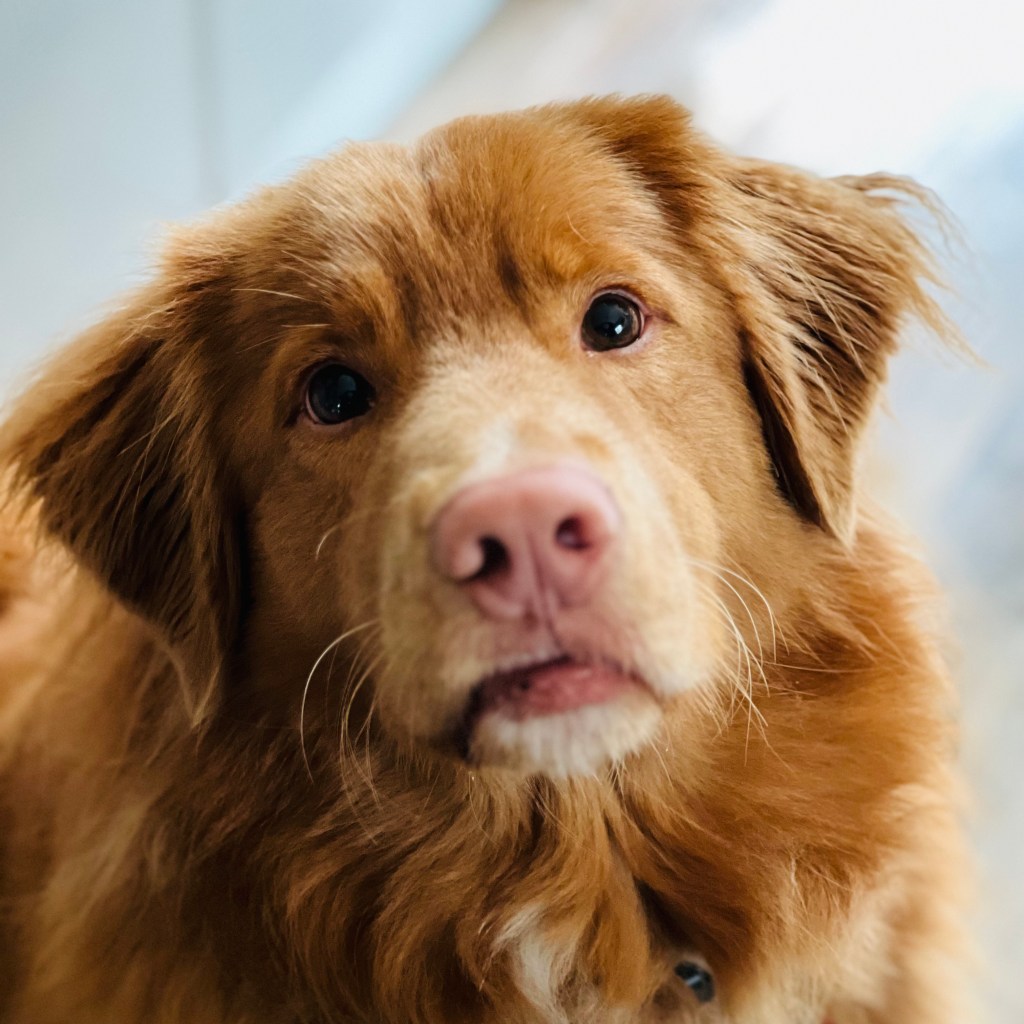
It’s a lovely sunny Saturday, and we have my wife’s cousin and his family visiting us in Kent from their home in Cardiff in South Wales. Cousin, wife, ridiculously cute baby of almost exactly 18 months, and a big shaggy dog [a Canadian Duck Tolling Retriever, for the caninophiles amongst you] all descend and because it’s a lovely day and we have a dog too we decide to head down to the seaside in Rye, East Sussex, which is just down the road.

This is the actual dog mentioned above. He’s called Dougie.

We decide to go to Rye Harbour Nature Reserve, and once there, after stopping to get an ice-cream for the kids, we head off along the path towards the beach.

This walk takes us alongside the River Rother which has wound its merry way for 35 miles through Sussex and Kent and is now looking forward to fulfilling its destiny of spilling out into the English Channel.

Who knows, in a few weeks the water herein could be enjoying a nice weekend as waves lapping against the beach of Boulogne-sur-Mer on the French coast, closer to where we are walking than London as the crow flies. Or any bird actually. But for the moment it is trapped in by high brick walls on either side, designed to stop the tides completely flooding the unspoilt salt marshes of the nature reserve on one side and totally spoilt members of Rye Golf Club on the other.

About halfway towards the beach, my younger son (8 years old at the time) decides he has a stone in his shoe. I say “decides” because he doesn’t have a stone in his shoe at all: he’s just a bit tired and being a bit of a pain in the arse. I love him with all my heart, but he does have “pain in the arse” in his locker and trust me, he will pull it out whenever he feels the need.

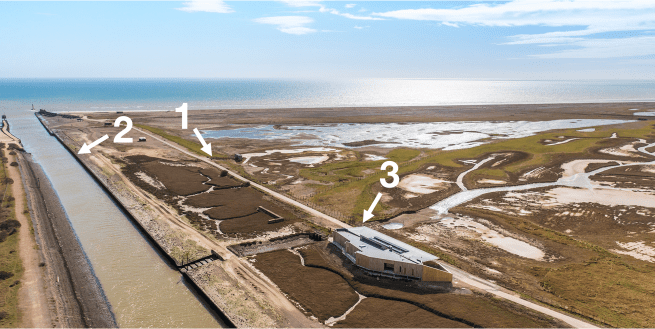
So there I am, sitting on a bench, taking his shoe off for the third time and considering whether I can get away with just leaving him here forever. My wife and elder son have carried on walking with our dog and the visiting Welsh folk. If you look at the pic below, I’m at point 1. [Yes that’s correct, dear reader: I have done a bloody diagram. You are most welcome.]

Then there is a commotion. Something is going down. This is a quiet, peaceful place, and yet someone is shouting. A ruckus! I’m instantly titillated. This has potential for drama, and who doesn’t like a bit of drama, eh? So I’m half listening to my son’s whining and half trying to work out what’s happening when I hear a woman shout out with the unmistakable timbre of fear in her voice.:

Somebody help, please!

I’m not sure what happens in my mind at this point, but before I know what I’m doing, I’m ushering my youngster to run over to mum and I’m running towards the lady and her two young kids, and over towards where she’s pointing. Another shout as I come towards her:

My dog has fallen into the river

I’ll be honest, at this point I’m a little less urgent all of a sudden. I mean, I have a dog, and I love dogs, but surely the dog just swims to the edge and gets out, right?

When I get to the edge, I realise that isn’t going to happen.

The woman’s husband is lying face down on the ground, right on the edge of the river [point 2 on our diagram]. The tide is going out so it’s a good four feet down to the water, and he can’t reach the small black dog, who’s desperately swimming against the river flowing out through the narrow channel, the tide pulling it along towards its French holiday destination.

The current is really, really strong. The dog is getting tired. The kids are crying, and the woman is shouting at the man:

He’s getting tired. You’ll have to jump in and get him

To which the man shouts back:

If I go in there I’ll fucking drown.

I’m glad he says that, because I think he’s right. This is like one of those news reports you hear on the radio where someone has gone into a river or a lake or the sea to save their dog or climbed onto the roof to save their cat and they end up dead and the animal ends up fine. Let’s not do that, eh mate?

But the woman is right, too. The little dog is getting very tired.

At this point the woman runs off back towards the café which has just opened [point 3 on the diagram which you’re now glad you were supplied] to “call for help”. As she does this I’m wondering what kind of help that might be. No one is going to send a chopper out for a little dog.

And the little dog is getting very, very tired.

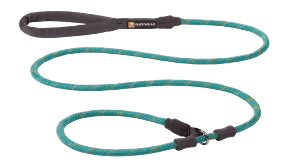
I shout to one of our group to hand me my dog’s lead, and for a few extremely unsuccessful seconds the man tries to lasso the little dog’s head with the lead. We both then try to encourage the little dog to bite onto the end of the lead. But the little dog doesn’t understand what we’re shouting at him to do because he speaks dog and we’re shouting at him in English. A couple of times he drifts downstream a few inches and pushes himself to swim back to us.

The little dog is really fucking tired now.

The man looks at me and says:

I’m going to have to go in.

I’ve never met this bloke before but it’s very clear I’m in this with him now. If he’s going to have to go in, I’m going to have to help him get out.

I have the dog’s lead in my hand and in the split second I have to think, I tell him to hold one end and I’ll hold onto the other and help him out.

I’ve got you mate. I won’t let you go.

So he quickly takes off his jacket and shoes, holds onto the other end of the lead to the one that I’m holding, and jumps into the dark, fast-flowing water.

He goes completely under for a moment, and when he comes up I can see the panic in his eyes. The water is so cold it’s taken his breath away completely. And the current is stronger than either of us could tell, and immediately I’m straining to hold him where he is. That little dog’s done bloody well against this unrelenting flow.

In another moment, the man catches his breath, grabs his dog and shoves it upwards out of the water, where a set of hands snatch it up. The little dog has been saved. But as I think you’ll probably have guessed, that isn’t the life I’m talking about,

So what next? A grown man is in a fast-flowing tidal current, four feet below the ground. I’m holding on to him but I’m starting to slip in the mud at the edge.

I start to pull him up but as I pull, the back of his hands, gripping the rope of the dog lead, are getting cut to ribbons against the barnacles on the side of the brick wall designed to hold the sea tides at bay. It’s too painful to continue.

I’m slipping more and more. I grab onto a rusty metal pole that is sticking out of the ground to steady myself.

It’s now that I realise I’ve got the end of the dog lead which has a slip on it, designed to stop the dog pulling. What it’s doing now is pulling tighter and tighter and cutting into my wrist and pulling my shoulder. I’m attached to this man and I’m the only thing that’s stopping him from floating off into the sea. And we all know how that news story ends, right?

Don’t get the bottom bit stuck around your wrist

I’m not going to be able to pull him out. I can’t let him go even if I wanted to, and in any case I don’t want to. I decide that I’m going to take him along the edge of the river wall towards the sea and just hope, hope that something comes up which means I don’t end up in the water with the man.

It’s the only option. And it’s just hope. And whilst we all know that hope is not a strategy, right now I don’t have anything else.

But as I let go of the pole and start walking along, I’m slipping more and more. My cherished Adidas Nite Joggers [other cool-ass trainers are available] are great for wandering along a path but they’re not great for trying to grip in a grey mixture of sea mud and sand. A couple of times I slip forward, leaning back so my body weight holds me until my Adidas get a grip.

At this point I’m kind of thinking I’m going to end up in the water unless something happens pretty soon, and then both me and this bloke are in trouble. In deep water, you may say.

I shout for help, and my wife’s cousin (who up to this point had his toddler strapped to his chest) runs down the beach and grabs onto my hand. Another, older man turns up and suddenly it’s not just me and the man, and now I think we’re going to be okay.

And then the universe decides that we need a break here, and out of nowhere there’s a set of steps cut into the wall a few yards away. I keep hold of the man and kind of lead him along to the steps, pulling him through the water like I’m trying to land a massive fish. At the steps, I and the other people help him out.

The next bits are quite strange as the world that was always all around comes back into focus. I see my wife looking after the man’s small children who are both crying. Her cousin’s wife has the tiny, shivering little dog wrapped up in her jacket to warm it up. My younger son is crying because he’s been watching the whole thing and has been scared for my safety.

And the man is more embarrassed than anything. He’s trying to say everything’s fine and thanks for your help and is the dog okay and where’s my wife, and everyone is telling him to just take a minute, and helping him on with his jacket.

He’s bleeding quite a lot from where his hands scraped on the wall and he’s shivering a lot too. I ask him to hold on while I gently clean the blood off his hands with a spare tissue I got from the ice cream van [ONLY ABOUT FOUR MINUTES AGO] and see that his cuts aren’t too bad. I tell him I’m a first -aider and then hear myself say:

I don’t think you need any further medical attention

Which sounds weird as it comes out as it’s not a phrase I’ve used before or probably will ever use again. How very formal.

We walk up across the rough ground and pebbles towards the path, and I see my elder son running back down the path from the café. I later found out that he was told to run to the café but when he got there wasn’t sure what he was supposed to do, or say, or get, so just ran back.

The man is telling his kids that he’s fine and the dog is fine and when we get to the path we see the woman running back down from the café too, and we all wave and say everything’s fine. She runs up and thanks everyone and gets the dog and holds it to her chest under her coat and tells the kids that everything is fine. All fine.

And I hug both my sons, and my wife. I’ve cut my leg and my hand and they’re wet so the blood is running a bit and makes everything look worse than it is, and my wrist has a nasty rope burn on it. But I tell them everything is fine, because in the grand scheme of things, it really is.

As the metaphorical dust settles, my wife and I offer to help the man, the woman, the little dog and the two kids back to the car park. It seems necessary because there’s a lot happened and the man is almost certainly in shock. So we say we’ll catch up with our own family and we’re walking just in front carrying a bag and a kids tricycle and telling the people no honestly it’s no trouble.

It’s only at this point that the woman asks the man why he’s so wet and I realise she doesn’t even know he went in the water because she was up at the café the whole time. So he tells her he went in the water and she asks how he got out, and he gestures at me and says:

That man saved my life.

Which is not something you ever expect to hear someone saying about you.

A few yards on and now the man and the woman have calmed a bit and around about the same time it starts to seem a bit odd to all of us that my wife and I are just carrying their stuff for no clear reason, so they say they will be fine from here and we say are you sure and they say yes.

The man and I face each other for the first time properly, and he notices that I’m wearing a Nike sweatshirt where instead of NIKE it says YNWA in big letters, denoting “You’ll Never Walk Alone”: the anthem of Liverpool Football Club, who are playing in the European Champions League Final that very evening. Which of course is how I know the date.

The man asks me if I’m a Liverpool fan, and I tell him I am, and he says that he is too. And I say:

You’ll never walk alone, mate

Which felt a little cheesy at the time and still does in retrospect but it was an emotional moment so I’ll let myself off.

And then we hug each other with real meaning, knowing we would, in all probability, never see each other again, but that for a few moments on this Saturday lunchtime we were connected in a way that neither of us will ever forget.

Then the woman says that they are on holiday and they ended up in hospital the day before because the little boy had hurt himself, and then this today, and “bad things always come in threes” and we all laugh and say we hope not and we all go our separate ways.

And unbeknown to either of us, she will be proved right when our beloved Liverpool lose 1-0 to Real Madrid just a few hours later.

And as we walk away my wife holds my hand and squeezes it and says:

Are you okay?

And, of course, I start to cry because I am okay but also that was about as hectic as things get and all a bit overwhelming and I could do with a hug. Which, of course, I duly get.

And that’s it. Every tiny detail of something that lasted maybe 5 minutes in total from start to finish.

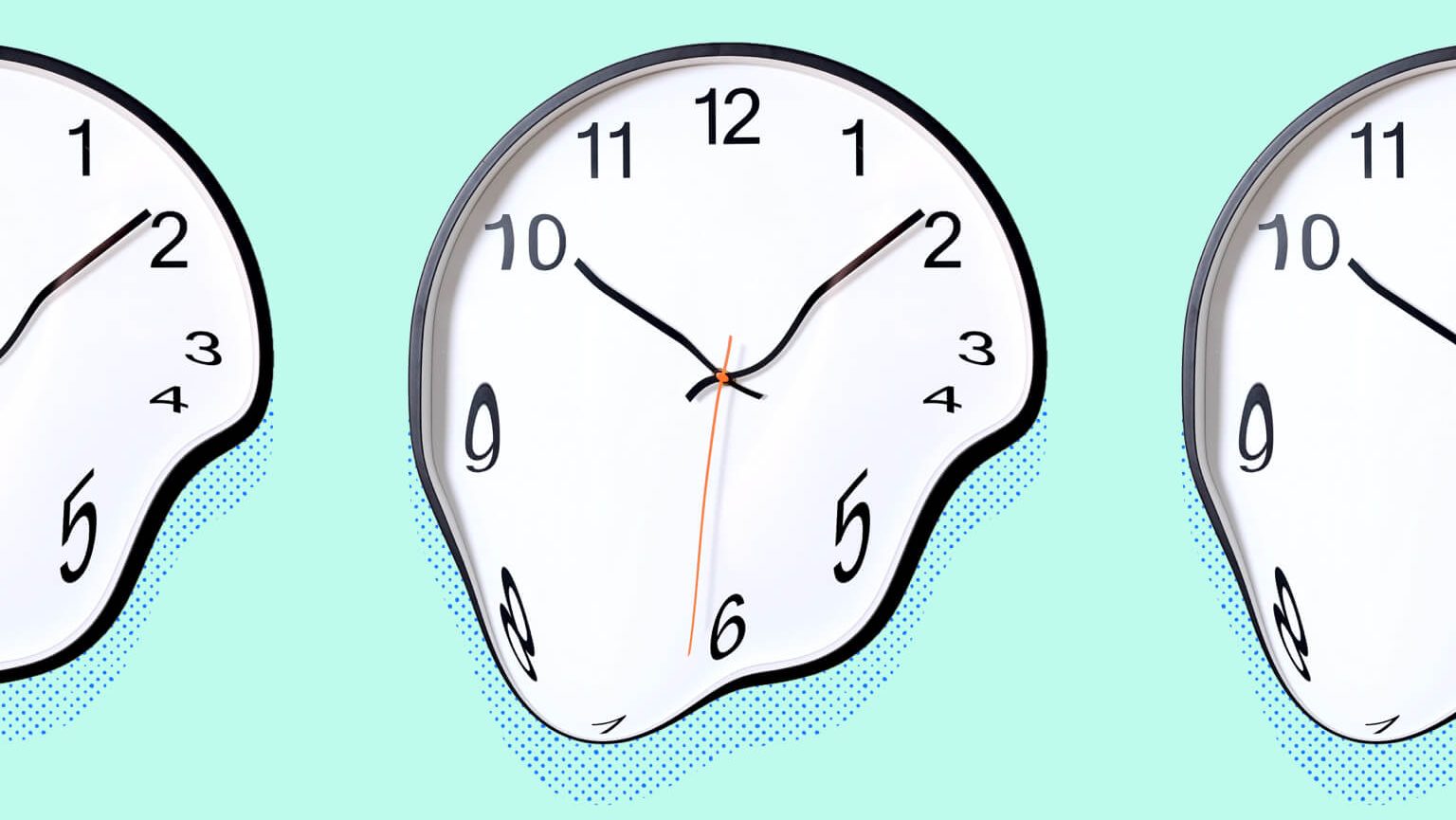
And, of course, that’s the first thing that intrigues me about this: a reaffirmation of my belief that time just has to be relative [as mentioned in these pages before here] to your own personal experience. This was 5 minutes of my life which felt like so much more, with time to take in the detail of every single moment like I was rewinding it and watching it again and again.

Details burnt into my brain. The look in the man’s eyes as he came up from under the water. My foot slipping forward through the mud and catching on a brick at the top of the wall. The little black dog shivering as he was shoved up out of the river. “Time stood still”, as of course it would.

The next thing is about my instinctive reaction.

If you’d asked me beforehand if I were the type of person who runs towards a commotion and then puts himself in danger in order to help, I think I would have said ‘no’. But as it turns out, I am. I’m not sure what you call that? Brave or brainless? Courageous or crazy? Heroic or hasty? Probably a bit of all of these. But an interesting thing to learn about oneself, that’s for sure.

There’s also a “what if” element to it all too. What if we hadn’t stopped for an ice cream? What if my son hadn’t started complaining of a stone in his shoe? We would have been up the path by the beach. So many things aligned to make all this happen. I don’t believe in fate any more than I believe in luck. But I do like considering the magic of coincidence in our life experiences.

And the last thing that sticks with me about this is [it’s me, so of course it’s going to be…] all about how people connect.

Author and speaker Brené Brown [yes you’re right I do mention her quite a bit] has done more research into vulnerability than probably anyone in the world, and her work has come to the conclusion that vulnerability is made of three things: uncertainty, a degree of risk, and emotional exposure. You don’t know how things are going to go. There’s a chance that things might go wrong. This could be emotionally difficult. But you do it anyway. That’s vulnerability.

I can’t think of any better description of what the man and I experienced together. Uncertainty, risk and emotional exposure. And because you know this stuff, you don’t need me to tell you that vulnerability is the irreplaceable, elemental, catalytic basis of human connection.

I will never, ever, forget the man I met that day. Never. And he won’t ever forget me, either. What we experienced, together, was so intense, so short-lived but so unforgettable, and so totally, totally vulnerable that we’re connected forever.

If I could change one thing – just one part of the whole experience – it’s that he could have had another bit of bad luck in the afternoon (nothing big: a seagull pooing on his head or something) to satisfy the “bad things happen in threes” rule. Then the man and I could have been further connected by the shared enjoyment of winning the footy that evening…

YNWA friends. Go safely… and keep your dog on the lead near water yeah?

P.S. Apologies for such a long post – in the words of French mathematician and philosopher Blaise Pascal in his 1657 work “Lettres Provinciales”: Je n’ai fait celle-ci plus longue que parce que je n’ai pas eu le loisir de la faire plus courte”, or as you or I might have it: “I have made this longer than usual because I have not had time to make it shorter.” Except of course I did have time, I just decided to spend it elsewhere.

Time waits for no man – part two

A good while back* I talked in these pages about my first trip into London since before all this happened. How the familiar felt so alien, and how whilst so much had changed, so much other stuff was just as it always had been.

And the thing that I really can’t stop thinking about, which keeps on popping back into my mind, is the thing that felt like it hadn’t changed at all. And that’s the homeless guy I mentioned, sitting in the place he always sits, just along from London Bridge station, next to the back entrance to Guy’s Hospital.

His stop is by the building on the right, and he’s only there until mid-morning.

Every day for as long as I’d made the trip to our office near the Tate Modern, this guy had been there. Always sitting on the floor, surrounded by old copies of the Big Issue in plastic covers, talking to himself a bit and occasionally saying hello to the regular people who walked by. Sometimes people would stop and squat next to him to talk, but more often than not he was there on his own. Every day.

And there he was when I went into London for the first time… and there he’s been on every day I’ve been since. sitting as he always has, like nothing has changed, still asking passers-by for if they can spare some change for him.

He’d been there every day for years, so why was it so surprising to me that he was there again on the day that I decided to come back into London for the first time in 14 months? Just because I hadn’t been there, why wouldn’t he? Yet it did surprise me, because whilst the whole experience was so very different for me his presence was so very familiar, like the gap from then to now simply didn’t happen. Like Covid was some kind of dystopian daydream I’d had on the train.

And now, it’s become less surprising and is becoming more and more an expected part of my journey to our office. I think I’d be more surprised if he weren’t there. But I’ll never forget the surprise of that first time for as long as I live.

I’ve talked in these pages before about the way that your time and mine aren’t necessarily the same – that perhaps we experience time differently to each other, and even our own experience of time changes depending on what we’re doing. You think this cricket match is fascinating, I think it’s taking longer than the whole of history. This day doing something I love has flown by… this day doing something I find dull will seemingly never end.

On a micro level, that’s self-evident to me – objectively something we all experience.

But this was different. Time was playing with me here, surely. How could time fly and stand still at the same time? Make it feel like yesterday, but with the knowledge that the last time I stood here I was two birthdays younger.

And how did the last year feel to him? Did time drag or did it fly? Did it feel any different to any of the other years he’s had?

Time flies. Yet some people have time to spare, but never any spare change.

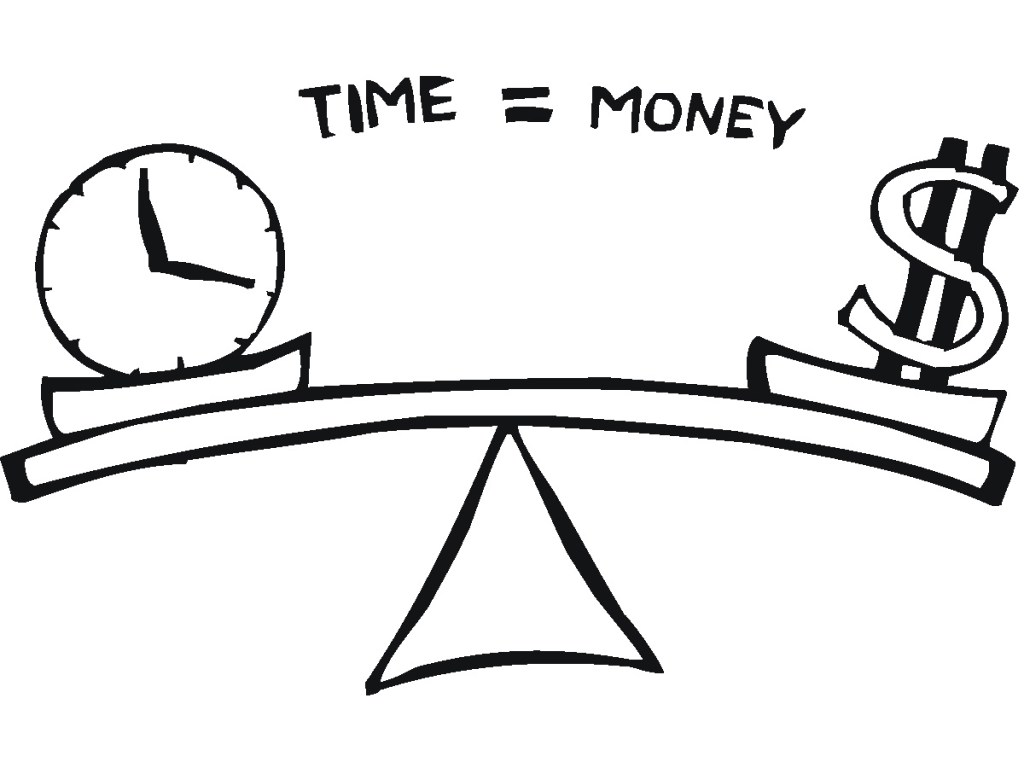
We have time and we spend time. We waste time, and we save time. It’s the same language that we use for money – hell, “time is money” remember? Precious time. We recognise its importance.

And you can tell from the phrases we use that unconsciously we understand our one-sided relationship with time too – our reliance on it but lack of control over it. Time flies. Time waits for no man. We’re on borrowed time, and ultimately only time will tell.

It would be conceited and condescending for me to begin to suppose anything about this man’s life, or about his experience of the last 20 months. Like so many of us I’ve worked out my recent history based on lockdowns – how far I could go from my house; what places I could visit or shop in; whom I could see or hug, how many could be where at any time – and all of those denote privileges and freedoms that this man does not have. For all my insignificant worries, I know where I am sleeping tonight. I know who will hug me in the morning.

What I do know about this man is that it’s doubtful that the few quid he might get from the throngs who pass by will change anything other than the few hours ahead.

Even more than that, I know he doesn’t need my pity, or the thousands of embarrassed half shrugs which mean “sorry I don’t have any change” he gets every day. I know that every time I catch his eye I give him a nod and a smile, and he does the same back, and every time I feel like I should do something more fucking useful, but besides giving him money every day I have no idea what that might be. Maybe the smile is that thing?

Lastly, I know that if there’s a better demonstration of how you might consider someone else’s experience of the world and measure it against your own to see an impossible myriad of differences then I haven’t come across it before, and I’m not sure I ever will.

Perhaps to give myself a purpose from this whole thing – to give it context, beyond just contemplation – I’ll commit to consider other people’s experience of the world even more than I have. Because there’s no question that however they experience the world, it’s unlikely to be anything like the world of which I’m in the middle.

*With noting that yeah it’s been a long while since my last post. If you’re a regular reader then I hope you haven’t missed out too much. If you’re new to the show, then I feel like there might be lots to come in the coming weeks so stay tuned!

Three lessons from a Zen Taxi Driver.

Driving in London isn’t fun. Sometimes it’s bearable, but most of the time it’s crap. Too many cars, too many vans, too many bikes, too many humans. Unending lines of traffic, all trying to get from A to B, perhaps via C and D; all in their own heads and all wishing all the other people would just disappear and leave the roads to them and them alone.

In one of the opening scenes of Danny Boyle’s 2002 zombie classic 28 Days Later, the main character walks across a deserted Westminster Bridge and around a London without a single vehicle. It’s meant to seem like some unreal and eerie waking dystopian nightmare, but for anyone who’s driven or worked around London much it’s an exquisite daydream.

Looks bloody perfect

I drove the streets of London myself for a while in the late 1990s, working as a medical sales rep. Every day I would hammer around the North West of the city trying to speak to doctors about some drug or other. They gave me five minutes of their time; I’d give them some branded tissues, or a car-care kit, or a pen.

I hated it, to be honest. I wasn’t very good at it for a start, because the whole thing – for me at least – seemed so fake. I pretended to be cheerful and chirpy [I know, not really my vibe] to the receptionists who pretended (sometimes) not to hate everything I stood for, hoping eventually that I might be allowed a few moments with doctors who were only after the branded foldable halogen desk lamp. Sometimes they pretended that they would try the drug I was talking about if they got the chance, and I’d pretend to believe them. I was talking to people all day, but not one conversation was authentic. I don’t think I’ve ever been so lonely in my life, and it ended up being quite depressing really – ironic as I had a load of sample anti-depressants in the boot of the Vauxhall Vectra 1.8 16v LS [that’s correct, I had the wheels to match the vibe]

Oh yeah, and the traffic.

On top of everything else, I had to pick my way around Kilburn and Camden, Neasden and North Farm, Holloway and Hampstead, Edgeware and Islington. Traffic everywhere. Every main road blocked, every back road full of people like me, desparately trying to balance a map on their knee as they checked the road signs. For this was a time before Sat Nav or GPS – I had a paper copy of the London A to Z, thumbed to death, covered in the fluff from Wotsits mixed with my own hot, despairing tears.

Okay the late 1990s wasn’t that long ago but this was the same tech

And I guess for a long time I carried that frustration with me whenever I drove around London, the tension I held in my shoulders and chest making my neck ache and my head pound. And I assumed everyone else did too.

And then, one evening, I met a man who changed all that. I met the Zen Taxi Driver.

It was a few years back now, not long after I’d joined CDM. After a long day of authentic and open leadership, I got a taxi back from the office – a car company taxi rather than a black cab – and struck up a conversation with the driver that has stuck with me ever since.

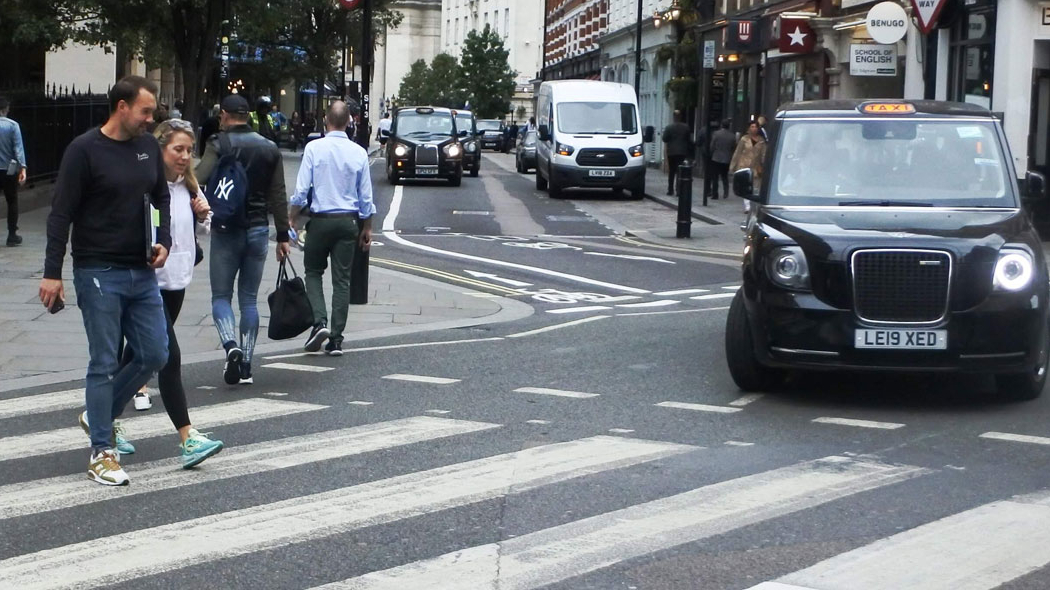
It started when he stopped for a young couple at a zebra crossing, and they moved like aged tortoises actually getting across the road, without acknowledging or even seeming to notice the fact that he had stopped to wait for them. I remarked that this kind of thing must be frustrating for someone driving all day, and rather than giving me the (probably expected) low energy agreement, he disagreed, for three very clear reasons. You may even consider them lessons, if you like…

This is a zebra crossing

The first lesson the driver talked of was about empathy, and honestly I felt a bit embarrassed that he had to point out the very obvious to me: that I had no idea what was going on in the lives of that couple, or the driver who was desperately trying to overtake in those one way, two lane roads through Hammersmith, the lady dithering about whether to turn right, or anyone else you could mention.

Maybe the couple had just had bad news about someone in their family.
Maybe the guy in a hurry was trying to get to his wife who’d gone into labour.
Maybe the lady was trying to remember the road where she had lived during the war.

Or maybe none of those big things. Maybe they just weren’t having the best few minutes, or hour, or day.

Whatever it was, none of them even realised that for that fleeting moment your lives intersected, and you were never relevant to any of them, any more than they should really be relevant to you. You have no right to judge them, nor should you feel the need to do so.

Which led on to the next lesson. My guide had hundreds, perhaps thousands of these micro-meetings every day… ephemeral encounters between people who may well never, ever cross paths again. And his philosophy on this was simple – that none of these people should willingly be given the power to influence your mood or feelings. You have it in yourself to decide what you will allow to affect you and what you will not. So have some respect for yourself, and don’t be so keen to give every passing person access to your emotions and the ability to affect your day. They have no right to affect you, any more than you have any right to judge them.

The third lesson that our teacher talked to me about was the individual experience of time. The way he put it was simplicity itself: “everyone walks to a different beat”. Some people’s internal metronome runs really fast – you’ve seen them doing a walk-jog-walk-jog thing down the pavement just to be half an hour early to work; you’ve seen them frustrated when things are ‘derailed’ or not going fast enough for them. And other people move at a much slower pace. Strolling rather than marching; always time for a ‘by the way’. Everyone has their own pace, one no better or worse than the other: just… different. Except for you, of course: just perfect in the middle, right? Hmm. Perhaps the truth is that to some people you seem incredibly impatient, and to others you’re glacially slow?

Empathy, and acceptance. People walk to a different beat. It’s not for you to judge.

By the time I got back home, I’d had one of the most in depth, introspective and interesting conversations I’d ever had. There was nothing I didn’t already know, as such, but damn if it didn’t make me consider how I was moving through the world.

I won’t say it was an epiphany, because there were so many other things happening in my life at that time which had such a profound effect on me too – new job, new baby, newly without a mum, to name but three [those and many others are in some of the blogs here too, somewhere, if you care to have a look around].

But here I am, probably seven years on, and I’ve decided to sit and write about that man, and the zen-like wisdom that he patiently and clearly articulated like it was all so very simple.

Lessons of self-control, self-respect. Of acceptance, of humility, of empathy. Crucial lessons for a life lived well, and I don’t know about you but I’ll take those with sincere gratitude from wherever I can get them.

In that spirit, I’ll leave you with a couple of thoughts which I’ve carried with me from that moment and likely will continue to carry with me for as long as I wander (and wonder) around this planet of ours.

First, I still have to catch myself sometimes, so I let myself off about that. We are all in our own minds, our own worlds, and so it’s human nature (literally and figuratively) to be wrapped up in what we’re doing and where we are going. We are all the lead actors in our own biopic, and those people whose paths we cross are the extras [and given special effects techonology nowadays they could actually all be CGI and you probably wouldn’t notice]. But still, I make the effort to catch myself; to remind myself that they are in their own world too, that their fleeting actions shouldn’t influence my emotions, and that my beat (at that moment) is different to theirs.

And it’s a simple, kind of daft thing… but since that day, I’ve never said that “I’m in traffic”. Because I’m not in traffic, I am traffic. Okay, it’s not life-changing. But I promise you, it does change one’s attitude to all the other cars around. They’re not deliberately in your way, making you late, any more than you are deliberately in theirs. You’re together, at this moment, just trying to get somewhere.

And here’s the [probably quite obvious to you, dear reader] next bit… none of this is really just about traffic. I don’t think I got that at first, so I make no apologies for holding your hand through it.

Because the truth is that we are all traffic, of course. Human traffic, thrown together into lives that we often don’t really understand and certainly aren’t evolved to be able to manage. But together, fellow travellers, all just trying to get somewhere. Along the way you try to surround yourself with the people and situations that help you along and give you energy, and avoid those which drain you or bring you down. And thus you make your own way, making it up as you go sometimes, but hopefully with some broad idea of where you’re heading, and you criss-cross with other people doing the same. We are all traffic.

Who knows, we might need to ask one another for directions one day. In the meantime, safe travels. Make sure you text me when you get there, okay?

Time waits for no man – part one

So there I am. Poised, ready. Coiled like a leopard ready to leap out onto an unsuspecting prey, every muscle tightened in anticipation. I know I’ve planned everything just perfectly, nothing left to chance after weeks – months even – of analysis and adjustment. And as the moment approaches, I can see the people around me shifting uncomfortably, the realisation dawning on them as slowly yet inexorably as the sun rises, that I am the one whose preparation has paid off; who will, today at least, be triumphant. And almost like it was written in the stars, inch by inch the world seems to shift around us all until the inevitable happens.

For in that moment, I am the man who is standing on the exact spot directly where the train door opens. I need not take a single step to my left nor to my right, but simply step forward and in and find the double seat (the golden ticket!!) that my diligence and meticulousness have earned.

Just a few more metres…

And if you’re thinking that is any train door then bless you, dear reader, but you are naïvely mistaken. For that is the train door which, on the other side of the train, will also be the train door nearest to the escalator when I arrive at my destination station.

Prized seconds have been saved ladies and gentlemen! Perhaps even as many as 30 seconds! That’s half a minute!

Until the world stopped last year, this was only one tiny part of my daily military operation.

Every single second accounted for.

If I leave the house at this time and take this route, I can make the station car park in around 16 minutes (depending on traffic, with 14 minutes as my personal best), then park here rather than there because whilst it’s a little further away from the entrance there’s more space to park quickly so it’s actually quicker. Then, if I have 90 seconds or more before the train is scheduled to arrive, that’s just enough grab a coffee from the coffee shop because the guy recognises me and starts making my “flat white, two sweeteners” as I walk towards him and then I tap and go and still make ‘my spot’ on the platform, this time walking up as the train slows to a halt and almost nonchalantly hit my mark so it looks like it’s coincidence (ha!) but you know, dear reader, that this is anything but.

From the train station to the office I pick the route with the least potential for human traffic, and my pass is in the pocket of my rucksack that I can reach without breaking stride and I’m through the revolving door, quick hello to the security guard and through the gate thing and before I press the button for the lift I see if I can check to see if one of the lifts has my floor illuminated so I can just jump in at the last minute.

Another 40 seconds saved! Hallelujah and praise be to the master of time!

All this in order to get to our office space about 45 minutes before the start of the official working day. Nice to be one of the first in, to say hi to the early morning crew and get myself settled in before the rush of the day to come.

And on the way home, I do it all in reverse.

I know that from the time I come out through the doors I can be on a train (not at the station, actually on the train) if I have 13 minutes. Any less than that and I’m into a weird walk-jog-walk-jog thing which I’m not fond of but will resort to if needed because the next train isn’t for twenty minutes or something monstrous like that and time waits for no man and time flies and yes of course time is money people time is money.

(Yeah, but is it?)

The week before last, I went into our offices in Central London for the first time since the 9th of March last year. Exactly 1.2 years since I’d done the trip which used to be my daily grind. Something that felt so familiar and so alien at the same time.

To be honest I’d forgotten some of the timings, and I didn’t know how long it would take to get a ticket at the station (season ticket having run out last year of course) so this time I left myself a bit longer.

I drove the same route, but without one eye on the clock.

I parked closer to the entrance because the car park was pretty empty. No need to do my weird walk-jog-walk-jog thing anyway, because I had a bit more time.

It was the same guy at the coffee shop as it had been 14 months and 12 days previously, but as I had more than 90 seconds we had time to chat about how long it had been and laugh about how he’d forgotten everyone’s “regular” because no one came in regularly any more.

I didn’t bother walking to “my spot” on the platform.

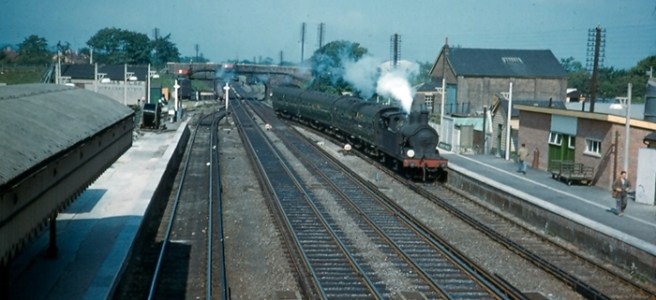
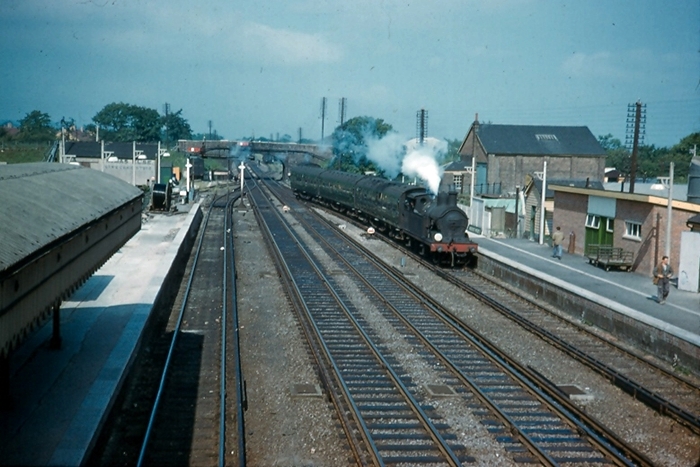
My home station on May 18th, 1961 – exactly 60 years and 2 days before my most recent trip on May 20th this year. Honestly hasn’t changed that much really.

The train ride itself was somewhat dystopian but then it was always going to be wasn’t it? The weirdest bit was coming into London and seeing all the landmarks which in times past would have told me precisely where I was and when I needed to get up to get to the doors at the right time, but not really being sure of the order of them. And it didn’t really matter anyway, because the train was empty of course.

Then from the station to the office, it was like nothing had changed.

That massive building still not finished – not that anyone is going to want Central London office space anyway nowadays…
That human traffic zigzagging across the road and pavement, magically avoiding each other like it was a film and we’d all rehearsed our marks and movements to avoid being within the magical (coincidental or conditioned?) 2 metres of each other…
That homeless guy re-selling copies of the Big Issue. In the same place as he ever was. Wait, has he been there every one of those 438 days…?

[Can that be right? That the world stopped for so many, but for so many others it just… didn’t? I think I’ll come back to that one another time…]

My experience of 10 days back brought something sharply to mind, which I’ve been thinking about a lot since. It’s probably obvious to you, of course

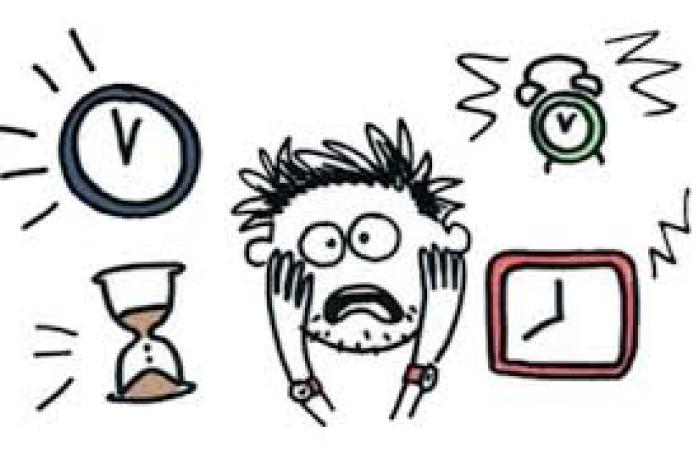
What the hell was I thinking, putting so much self-inflicted time-related stress into my life? So much unnecessary tension thinking so intently about the seconds here and there? So much pressure to get it all so tight that the smallest distraction, diversion or delay would scupper the whole thing?

The car driving too slow on my route, the kids taking my spot on the platform by fluke not by hard graft and painstaking preparation; the tourist with the rolling suitcase going across the flow of human traffic. All purposefully messing with my time.

Turning me into the walking tension headache that needed 45 minutes in the office before work started just to unwind, right?

I’m embarrassed at my own stupidity. I know that anxiety can take hold of me sometimes, yet I created this perfect recipe for stress and gobbled it down willingly every day. I guess it took 1.2 years of not doing it to make me realise that I’d been doing it, in some way or another, for the previous 20 years.

Joni Mitchell once sang that

Don’t it always seem to go, that you don’t know what you’ve got till it’s gone?

Joni Mitchell – Big Yellow Taxi

Too true Joni, too true. And once in a while you notice that the thing that’s gone shouldn’t have been something you were holding onto so tightly in the first place.

So from here I’m going to take the pressure out of my own relationship with time. Less saving and making up, and more ensuring I have a some to spare, so if I lose a little here and there I’ll still have enough.

They say that time waits for no man, but it’s waited 20 years to work that out I probably have as much as I need, and more than I gave myself. I’d love it if you could learn from my mistakes a little quicker than that.