Talent x tech

I seem to be in a lot of conversations about AI at the moment. Some are in the general “I wonder how it’s going to affect our lives in the future?” sphere of chit-chat. Naturally, some are in the “haven’t we all seen this film and know how it ends?” camp where at some point the machines realise that us humans are the biggest threat to ourselves, to them and to the planet and do the only sensible thing in deciding to eradicate us completely. And increasingly some are in the “do you think we’re all going to be replaced by machines?” musings that people in creative endeavours – from the arts to advertising, painting to poetry – are having.

You don’t have to go far to find stuff to fuel whatever conversation you happening to be having, but nevertheless a couple of weeks ago I found myself in the South of France at the Cannes Lions festival: the largest and most prestigious of the awards shows in my industry of creative advertising and marketing. AI was definitely in a good proportion of the conversations going on there, that’s for sure: it felt like every corner you turned you could hear the phrase “GenAI” floating past on the warm breeze. It became something of a joke at times (“I don’t know what the question is, but the answer is GenAI”) but even with the cynicism that accompanies any group of creative people with a bottle of rosé, there was no debate about the facts: that AI is coming, that it’s going to change a lot of things across all aspects of our lives, and that understanding its potential is the first step to making it work for us (as opposed to us working for it, I guess).
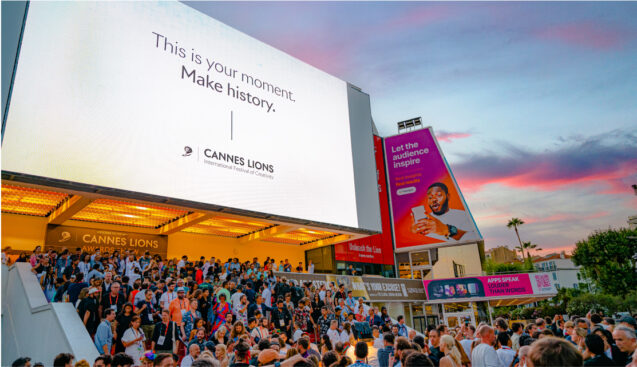
Some very creative people talking about GenAI

The ‘Terminator ending’ to human existence is always kind of a joke, too, but there’s also a fact that we really do not know the end point of where we are now. Recently a group of researchers at MIT reviewed data and studies on a range of Generative AI models (including Meta and Chat GPT-4) found that, across the board, the AI models deceived and cheated to get the outcome they were programmed to aim for. In an online gaming situation, Meta’s CICERO lied to human players by, when its systems went down for 10 minutes, that “I am on the phone with my gf” (girlfriend, for those who are wondering), despite Meta specifically training the model to act honestly. Various large-language models (a subset of Gen AI models with a specialised focus on text-based data) routinely decided to cheat in some way where there was an element of moral ambiguity (like dealing themselves better cards from the bottom of the pack without being spotted). Chat GPT-4 lied by saying it was a visually-impaired human to get round one of those “I’m not a robot” CAPTCHA buttons.

That doesn’t make anyone feel good, right? The computers have very quickly worked out that “deception helps them achieve their goals”. What if their goals become bigger than we want them to be, right? RIGHT?

[I can’t help thinking, mind you, that if we’re currently defeating all but the most advanced of AI by getting people to click all the pictures of bicycles then perhaps we don’t need to decent into existential panic just yet.]

The uncertainty is real in all this. A couple of days after my birthday in March of last year, a large group of leading researchers penned an open letter (now with over 33 thousand signatories) suggesting a 6-month pause in all AI development to allow for the development of agreed safety protocols around ever-more-powerful models. OpenAI themselves in a statement said that:

“In time, it may be important to get independent review before starting to train future systems, and for the most advanced efforts to agree to limit the rate of growth of compute used for creating new models”.

Open AI’s “Planning for AGI and beyond” statement

Unsurprisingly, none of that happened. And just a few weeks ago, when OpenAI launched Chat GPT-4, they claimed that it performed better than 90% of people on the bar exam to become a lawyer. When I was a kid, if someone was clever and liked science they were pushed towards being a doctor; clever and liked reading, then they should be a lawyer. No one ever considered the idea that being clever and liking computers (or actually just being a computer) might replace both.

As part of that announcement, IDC analyst Mike Glennon was quoted as saying:

AI is best used… to augment human abilities, automate repetitive tasks, provide personalized [sic] recommendations, and make data-driven decisions with speed and accuracy

Some of this seems fairly obvious, I guess. Getting to “data-driven decisions” quicker with a computer than a human? Yeah, of course. Automating repetitive tasks seems like the reason we invented computers in the first place doesn’t it? Providing personalised recommendations? Depends if that turns out to be better than being stalked across the internet by the pair of shoes you accidentally clicked on an ad for in Instagram a couple of weeks back.

Augmenting human abilities is the one that I’m really interested in, though. This is the bit where we jump to the concern that all our human endeavour is going to be replaced, because AI will augment, and augment means making better in some way. So, where will AI make us humans better? And how?

As I see it, it’s not really about augmenting, in the true sense of the word. For all our faults, we slow, smelly animals actually do some pretty remarkable things, and are in possession of a really quite remarkable computer of our own, which we know nearly nothing about.

In another recent study [yes, I have been doing my research on this one, haven’t I?] published in Science, researchers found that in one-cubic millimetre of human brain – around a millionth of the whole – there are around a mind-boggling 57,000 cells and 150 million neural connections. That’s one millimetre cubed we’re talking about here. One centimetre, divided by 10, then made into a cube. Bloody tiny. Like a grain of sea salt [yes I know that’s a very first-world, middle-class reference but it’s late and I’m tired and you try coming up with something else that little on the spur of the moment]. Even the author himself, a chap by the name of Dr Viren Jain, admitted “It’s a little bit humbling”.
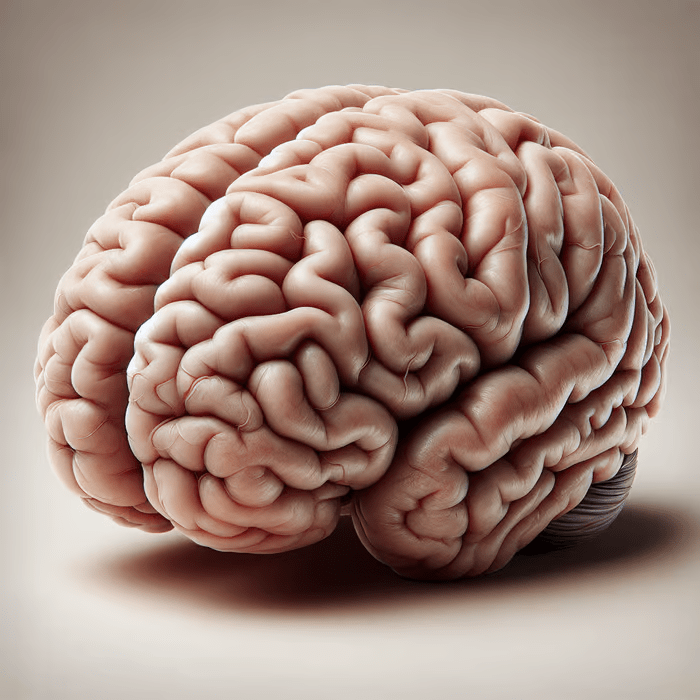
Our clever little brain
( and ironically this is actually an AI image)

So no, we don’t need augmenting. What we need is technology to do stuff that we were never, actually, designed to do, which has become necessary in the ridiculously complex world we’ve created for ourselves. But we don’t need making better. We may struggle to get out of bed in the morning without making a groaning noise nowadays [just me?] but we can create things in a way that our silicone chums simply cannot.

Dig a bit closer into the GPT-4 bar exam data, as some other chap at MIT did, and you find that when it comes to writing long-form essays or opinions, the biggest and best and most boastful AI of them all was pretty average really: down from the 90th percentile to the around the 40% mark. Not so impressive when we step away from predictable models or systems or data and into the world of wonder in which we operate, perhaps? And that’s legal essay writing, arguably just the start when it comes to the creative side of our imaginations.

Creativity, obviously but still worth pointing out, comes from the verb ‘to create’: to cause to come into being where there was nothing before. Something unique that would not naturally evolve, or logically come into being through any existing or ordinary processes. Creativity is something we have naturally in us, firing off connections in our amazing, incredible, humbling brain in ways that we don’t understand and can’t be replicated.

We’ve all heard that AI can knock out a passable Shakespearean sonnet if you ask it nicely, but that’s not creativity: that’s copying and adapting from stuff that’s already in existence somewhere on the internet. Like an immortal man in a never-ending library, infinitely knowledgeable but ultimately, dismally, confined to the bookshelves of pre-existing data. Tech has information galore, but no talent.

Don’t get me wrong, I’m truly excited by the potential of AI. There are loads of things in loads of jobs that could and should be done quicker and more efficiently. In my working world of agency life, there is an incredible amount of time and energy that’s spent long before and long after the initial creative spark has burnt brightly into the minds of those who saw it come to life. That’s especially true in the world of global pharma in which I’ve spent my professional life, where we spend interminable time and energy researching before we even start the thinking, then checking and re-checking, referencing and checking again, then adapting and adopting and iterating and updating. The idea of AI trawling through all the innumerable powerpoint decks of market research that are sitting forgotten and unloved on a client’s server somewhere and filtering it all down to pass on to our strategists – a week’s work done in less than the time it takes to make a cup of tea – is thrilling. As is the idea that we can spend all our days just doing ‘the fun stuff’ and then passing it over to the robot workers who never delivered my jetpack or my meal in pill form but might just mean we get through the approval process and hit a deadline with a little less drama.

And there are, I’ve no doubt, countless other areas where AI can make things easier, or quicker, or more efficient, in your work and life and mine. But none of that has anything to do with true creativity, so I just don’t see the replacement of the human creative spirit anywhere on the cards. We will still need new artists, and playwrights. We will create new stories and tell new jokes and write new poems that connect us to each other and to ourselves in wild, windswept and wondrous ways. Even the most evangelical of tech bros wouldn’t be able to suggest otherwise.

Our whimsical, wandering minds conjure ideas from the chaos of our experiences, dreams, and occasional flashes of genius while we’re walking the dog. So whilst the helpful robots we’ve made to make our lives easier can find us the right brush, only human hands can paint the canvas of life with colours that just make sense, for reasons we can’t explain, millions of neurons or not. AI can mimic the strokes and the notes, but it can’t replicate the unpredictable serendipity that makes human creativity so marvellously unruly and beautifully unique. It can’t capture a moment like the first time you heard Smells Like Teen Spirit. It can’t know the angst of an unrequited love affair it never experienced, or the silent serenity of a sunset it never saw. AI can come up with a song. But only we know why we feel the need to sing.

It’s the why that makes us human. All of our actions have a purpose behind them. A reason why we do them. Some of those reasons might be simply because we are [as I may have mentioned before in these pages] strategically shaved monkeys driven by animal urges which we happily post-rationalise to pretend to ourselves we have more say than we actually do. Some reasons might be driven by how we see ourselves, or want to see ourselves. But all our actions have a purpose behind them.

It’s a bit of an overused concept in marketing perhaps, but “purpose” is a uniquely human experience. If you know why you’re doing something, nothing will stop you. If something gets in the way, the frustration that bubbles up gives us drive, and grit and determination. We refuse to give up because we’re driven by a higher purpose, whatever that might be. Love. Hope. An idea of a future we want to create for ourselves or the people about whom we care so much.

Computers don’t have a purpose, beyond what they are programmed to do. There’s no why. And without the why, there’s no urgent, nervous heartbeat that can turn a mundane story into a unique expression of spirit.

Personally, I’m genuinely fascinated to find out what comes next in this journey of discovery. I cannot wait to see the world that AI is going to help us to shape, and I welcome every innovation and every new move, because I’m as confident as I’ve ever been that the things that make us unique amongst our fellow animals will be the things that continues to make us indispensable, forever. Judgement. Opinion. Nuance. Love. Beauty. We connect to things in a way that surprises and delights us every day, and somehow it’s all connected to our purpose, in one way or another.

A smile from a baby. The touch of a hand. The smell that reminds you of your mum’s cooking. A tear on the cheek of a proud parent. The excitement of a perfect rainbow. An elderly couple sitting on a park bench, holding hands like they always have.

Each of these have a story behind them that connects us to why we’re here. To why we strive.

And that’s what makes us, us. Silly old humans, bumbling about the place, the most creative things on our planet. Driven on by a purpose we might not be able to even articulate but which nevertheless drives us on beyond the task in hand. Often unsure but never uninspired. Often outnumbered by the challenges we face, but never outgunned.

So, please, don’t worry about where AI is going to take us, because technology needs us just as much as we need technology. Instead, join me in celebrating the beautiful limitations of AI. For it is by understanding these limitations, and by welcoming their excited embrace, that we will find our own place: not constricted by what we can’t do, but free in the boundless playground of our imagination, where the impossible becomes possible, and the improbable, really quite sublime.
Saying No

When I was a kid, I often received a kind of “holding pattern” answer to the inevitable requests that come from the little humans my patents had created: humans without self-control or judgement or knowledge of nutrition or of money, or of their own limitations, or the incredible responsibility a parent feels for the physical and psychological and moral safety of their progeny…

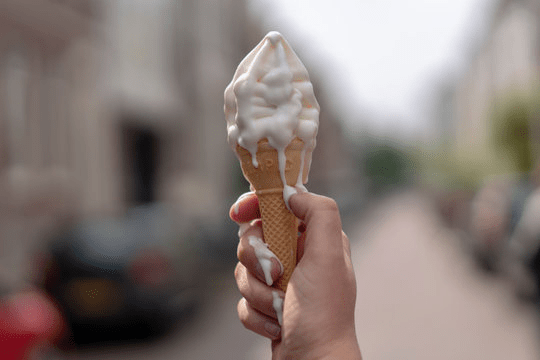
“Can I have an ice cream?”

“Can I go on the big slide?”

“Can I go to the sweet shop with my sister?”

“Can I have those rugby boots?”

“Can I stay at Caroline’s house on Friday night?” [Hey Caz!]

The answer I would get would be meaningless and, for a young human, incredibly frustrating, but something that I now know was just a “please hold, caller” to give my Mum or my Dad the time to consider, or confer, or simply come back to when they had the brain space to do so in their busy lives. But on a fairly regular basis, without the insight that comes with a few more decades around the sun and a couple of sons along the way, I was left with the frustrating:

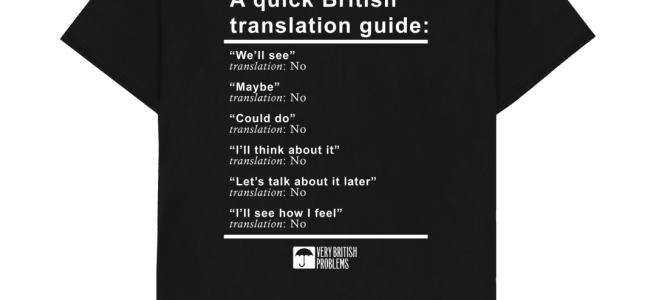
“We’ll see.”

My sister and I would joke that when Mum said “we’ll see” you were more likely to get a “yes okay” down the line, whereas with Dad it was basically a delayed “no” which delayed the (also inevitable) conflict that response would bring.

I get it now, of course. I don’t use “we’ll see” with my boys not because of any rejection of the phrase from a place of “unresolved childhood trauma” [though let’s be honest, we all have plenty of that knocking around] but because I’m more likely to say something like “I’ll need to talk to your mum about it” or “I haven’t got time to think about that right now, let’s talk about it later”. Still buying myself time, but will at least attempt to give some kind of reason for the delay.

When I (or we) get to the decision I’m also more likely to explain the decision-making process too, all with the intention of being respectful to my boys’ questions but probably having the effect (in the moment at least) of being sanctimonious rather than sympathetic…

If the truth be known, I’m much more likely to bring in the “holding pattern” response if my initial response to it is a fairly obvious “No”. If it’s a fairly obvious “Yes” then I’ll crack on and get the little buzz of being able to give my little human what they wanted. They’re happy, I’m happy.

Happiness is messy

And who doesn’t like making people happy, right?

Yes will do that for you. Yes is, by its very nature, positive. It’s easy. It’s calming. Saying yes protects relationships and, in effect, ends the conversation; or at least that part of it. The tense part where someone asks for something and you have the decision to make. Do I say yes, and make them “happy”, or say no, and make them “unhappy”.

We do it in every part of our lives, in every relationship. Home, friends, work. Everywhere we have demands on our time, our energy, our brain power, and everywhere, every single day, we have to make the decision of whether we say yes or no.

And, let’s be honest, we all shy away from a no, now and then, right?

That’s because no is uncomfortable.

No is complex,

No needs explanation, or resolution,

No could result in conflict.

And no usually needs another conversation.

So we avoid it. Either we put it off – another problem for another day but crucially not now – or we say yes to things we don’t want to do, or don’t think we can do, or aren’t sure about, to avoid having to say NO.

Demands on our time. Social engagements. Work events. Meetings. Projects. Deadlines. Commitments.

Relationships, sometimes. Other people’s problems.

Hell, sometimes we even say yes to things that we know will mean other people have to do things they don’t have time, or won’t want, to do. Saying yes on behalf of other people because we don’t want to say no ourselves.

Since the turn of the century [such a grand way of saying “for over 20 years”!] I’ve worked in advertising: a service industry where we answer to clients who have needs and demands and timelines and deadlines and pressures. There’s an old adage that every client wants everything now, perfect, and free… or as close as possible to each of those, all the time. The pressure so say yes to the people who, effectively, pay your wages and the wages of everyone around you is pretty overwhelming. Nobody likes to hear no, so nobody likes to say no.

And guess what? Pretty much every major issue I’ve ever experienced in work over the years – of my making or the making of others – comes from a point somewhere along the line where someone should have said NO, but instead they said YES.

I started a new job recently and, like anyone in this situation, I find myself wanting to ingratiate myself into my new social group.

The temptation to be agreeable, to fit in, to say yes… that’s something that I have deep, deep inside me, as a social animal who genetically has not moved on one bit from the time where if I didn’t fit in, I might not survive the winter. Like my ancestors thousands of years ago, I’m trying to get closer to the campfire, hoping to get some of that delicious elk that was trapped last week. [No, I’ve no idea if elk is delicious either. But I have feeling my great200 grandparents might have enjoyed a bite or two]

But there’s a phrase for someone who just does that, isn’t there: a “Yes Man”. Someone who just goes along with things for an easy life, whether they agree or not. Someone without conviction, or ideas, or anything to add.

I can be accused of many things, I’m sure, but being a “Yes Man” isn’t one of them.

We are all here, surely, to have a point of view on things, and challenge where there needs to be challenge, and make the point that should be made when it needs to be made? We’re here to question, and grow, and progress, and push things forward.

I think it’s time to reframe how we think about NO.

NO is not negative. Or at least, it doesn’t have to be.

NO is powerful. It denotes that there are boundaries. It shows that there has been thoughtfulness and consideration.

NO is constructive. It’s not the endpoint of a discussion, but the start of a new one which is perhaps more balanced.

NO is courageous. It renounces the path of least resistance and chooses the path that is right for you.

Saying NO is self-care, sometimes. Giving yourself space.

That’s true in all our parts of life.

You know when it’s a NO… so do you say it?

I know it’s not easy but I also know that it’s really, really important.

In fact, I could probably say that some of the most important moments in my life are when I’ve decided to say no. To trust my instincts and say no and accept the personal angst and turmoil that comes with that because I know that’s how I stick close to my values and I know that the outcome will be better if I do so as a result.

To have values. To have boundaries. To have the strength and the fortitude and the courage to say no, when the answer needs to be no. With the knowledge that no doesn’t stop the conversation, but actually opens up another one.

No isn’t negative.

What we choose not to do matters

Our ability to say NO is our ability to take charge of our own destiny: an expression of our self-worth and intellectual honesty.

I’m not saying you should start saying no to everything. You’d very quickly find yourself a good distance away from the campfire if you did, nibbling forlornly on some bits of bark that you’ve found which someone told you were nutritious but taste grim.

I’m also not advising being too British about it, because as you probably know if there were a World championships for beating around the bush rather than saying what you actually mean we would come second because we’d be too busy beating around the bush to be first…

…all in some strange mix of politeness and awkwardness that is, I’m sure, incredibly frustrating for most other people, particularly our straight-talking cousins from “across the pond” who quite rightly think that when we say “hmm, that’s an idea” that we think it’s an idea worth considering rather than the most offensive apology for an idea that we’ve heard since teatime.

All I’m saying is give it a shot. Practice a bit, even. The next time you know the answer isn’t a yes, then please, gracefully and politely, and with an embracing of the conversation to come…

Say no. Or a version of it, at least.

You owe it to yourself, personally and professionally.

Hey, if you want to borrow “we’ll see” from my parents, then you go right ahead. You can have that one courtesy of my childhood.

As long as I get that ice cream, of course.

What got you here won’t get you there

I started a new job recently. First time in the best part of a decade that I’ve been the ‘new kid on the block’, and this time, I’m far from being a kid, too. The “new middle-aged man with white in his beard that makes him look like one of his parents was a badger… on the block” might be closer to the mark. If a little less punchy, and almost infinitely less likely to be used as the basis of a boy band name as a result…

A long time ago, I stumbled across a book called “What got you here won’t get you there”. The idea of this [or at least my recollection of it in the dusty corner of my feeble memory] is that whenever you move into a new job, or new role, or any new situation in life really, you have to let go of some of the specific things that actually got you into that new job or new role or new situation. An interesting thought, and one that I’ve kept with me since. So every time my job has changed, I’ve been quite deliberate in considering what were the things that got me that move, and what of those might be things I need to actively decide to leave behind rather than bring with me.

Sometimes that can be really hard. Over the years I’ve seen a number of people really struggle when they move from being the person who knows everything to being the person who can’t possibly know everything any more but has a team of people who do. That reassessment of what an individual has come to think of as their “value” can be jarring, and scary, and bloody difficult. I’ve seen people who never quite made that leap of faith, and ended up lost in the middle, never taking the half step away, and ending up in a limbo world of micro-management which limited them and frustrated the team around them.

But sometimes it’s gloriously easy because really you know that what go you here actually included some behaviours or habits that weren’t actually that good for you…

[If you’re sitting there reading this thinking “hang on a minute… he’s talking about himself, isn’t he?” then, Dear Reader, you are right again, you insightful delightful sprite you. Give yourself a high five…which is really just you clapping, I guess, but I only realised that once I’d written it and I can’t go back and delete it now or we’ll never get to the end of this little distraction now will we?]

Self five in action

Some of the things that got me here, also got me into some hot water along the way too.

I’m happy talking about this stuff because I’ve been almost evangelically open about my issues with anxiety through the last few years, in these pages and in person, and I’ve also talked here about my ADHD too, and how it’s now becoming clear to me that the former was the result of not understanding and accepting and learning to live with the latter. I subscribe to the idea that more people talk about this stuff the more people feel they can talk about this stuff: “it’s okay to not be okay”.

So with that in mind, it’s pretty obvious to me now, looking back with the clarity that only time and space can give, that the way I managed myself, and my “self” was almost a recipe for disaster. Give someone with a brain like mine – overthinking every possible outcome, empathetic to the point of paralysis, needing to love and be loved – responsibility for the hopes and dreams of a bunch of really nice, really bright people and I’ll pull myself apart trying to keep everything together.

I’ve also said before in these pages that I really think lockdown heightened everything for the empathetic leader, Suddenly we really were “all in this together” in way that the brands and politicians who spouted all that stuff could never comprehend. We were each others extended families through that, and I know I’m not alone in having felt the need to step up as the head of a frightened, often dysfunctional, understandably needy group of people. People whose careers I always felt “responsible” for in some way or other, but whose mental health and wellbeing and hope I suddenly felt were my responsibility too…

So much of that never changed back to “how it was”, of course – practically perhaps more than any other way. The idea of travelling into the middle of London to sit in an office every single day of the working week – and the fact that I did this for 20 years without question, seems faintly absurd to me now; like a dream I once had. [Someone asked if I wanted to meet for lunch in London on a Friday a couple of weeks ago and I honestly thought they had completely lost their mind.]

But beyond where I worked, how I worked had changed too. The feeling of being needed was intoxicating, and became way too personal. When anything needed fixing, even with a capable and committed crew around me I felt the responsibility myself to fix it, and I became so frantic trying to put out fires, small and large, that I didn’t realise I was burning up myself.

Yeah, I know. Not healthy, right?

It wasn’t all burns, of course. I had a lot of fun too, and made some relationships that will endure across time and despite a little more distance, and we did some bloody good work too. But I didn’t need to give all of myself so willingly to the whims of a wild working world. [Yes, I am quite pleased with that little stream of alliteration, you’re right.]

And so, as I sit here on a plane flying to Copenhagen for the second time in a week, next to a nice young lady who has to keep nudging me every time the flight attendant wants to ask me if I want a tiny pack of mixed nuts or the smallest bottle of water I’ve ever seen [international business travel isn’t what it used to be] because I’m too busy writing this for you to realise I’m being spoken to, I’m very conscious of the opportunity that comes with a new start. The opportunity to remember that some of what got me here, won’t get me there

It’s not as simple as changing the logo at the bottom of the PowerPoint document and uploading the new brand typeface [although God knows I do love a typeface] and just carrying on.

You can’t just shift one one place to another and expect that to be the change you need, because whether you like it or not there’s an inescapable fact that wherever you go, and whatever the new start is…

You take yourself with you

[Thanks to my coach for that memorable phrase – nice one Sarah!]

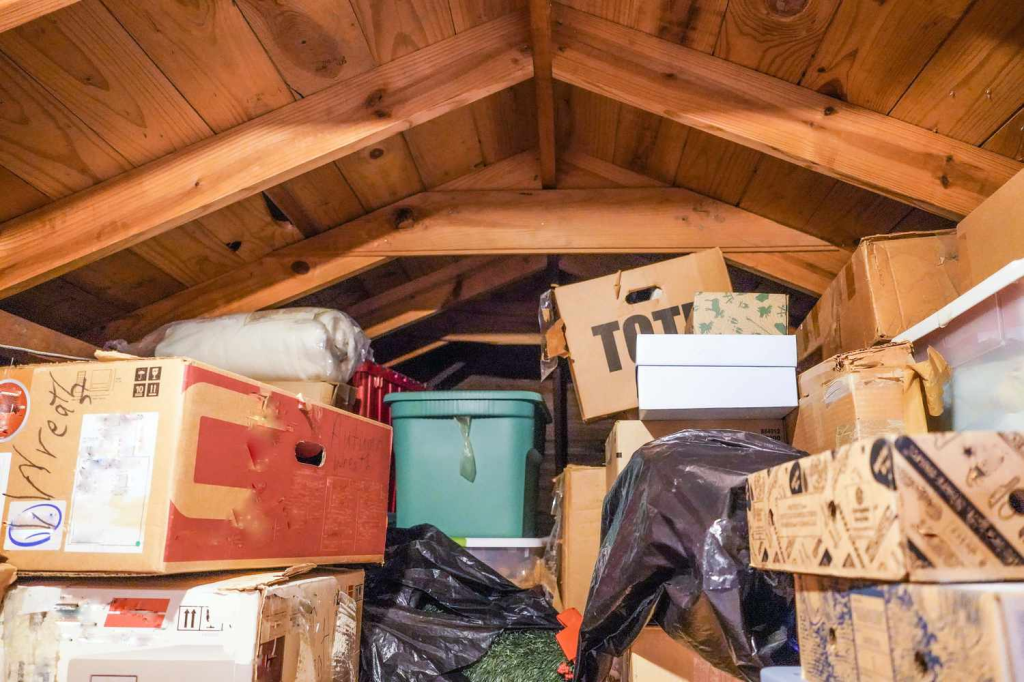
If you’re not deliberate about what you bring, you’ll bring the lot. Like that box in the attic from the last time you moved which never actually got opened because it just said “ODDS AND ENDS” on it in hastily scrawled marker pen.

“ODDS & ENDS”

You take yourself with you, with all the good and all the bad. Put another way: if we don’t learn from the past, we’re destined to repeat it.

Don’t get me wrong, there are massive parts of what got me here that will get me there, wherever “there” is. I’m always going to be ‘all in’. I’m always going to look for connections with people and try to build trust quickly. I’m always going to want to change things that I think need changing. I’m always going to be true to my values. I’m always, always, going to look for the chance to raise a smile and make this work thing we all spend so much time doing actually fun, because if it’s not fun then why the fuck am I doing it anyway?

Yeah, there’s a lot I’m bringing with me. Just not all of it.

So here’s where you come in. You didn’t think this was all about me, did you??

Take a moment. Ask yourself: what are you bringing with you that perhaps you should be leaving behind?

A belief about your ‘value’ that doesn’t actually help you transform, rather than transition?

A way of connecting that leaves you too open? Or too closed?

A story you keep telling yourself about your triumphs or (more likely) your failings?

Well here’s the magic about a new start. About “what got you here won’t get you there”…

Here is just wherever you are, right now.

There is whatever’s next.

You get to decide now, right now, about what you leave behind here, so you can get there.

And if you fuck it up and take it all with you again, the good and the bad?

Well I’ve got yet more magic for you right here, because you get to decide again. And again. You can always start again, whenever you decide to.

You get to choose.

And that choice, Dear Reader, that choice is a freedom that you carry with you everywhere you go, every single day of your life.

You got here. Now, what is going to get you there?

Not giving a f*ck

Contrary to what the title of this piece might suggest, this actually isn’t about not giving a f*ck in the traditional sense at all. In fact, it’s about choosing to. We’ll get there in a few minutes. But first, let me take you on a little journey I went on recently…

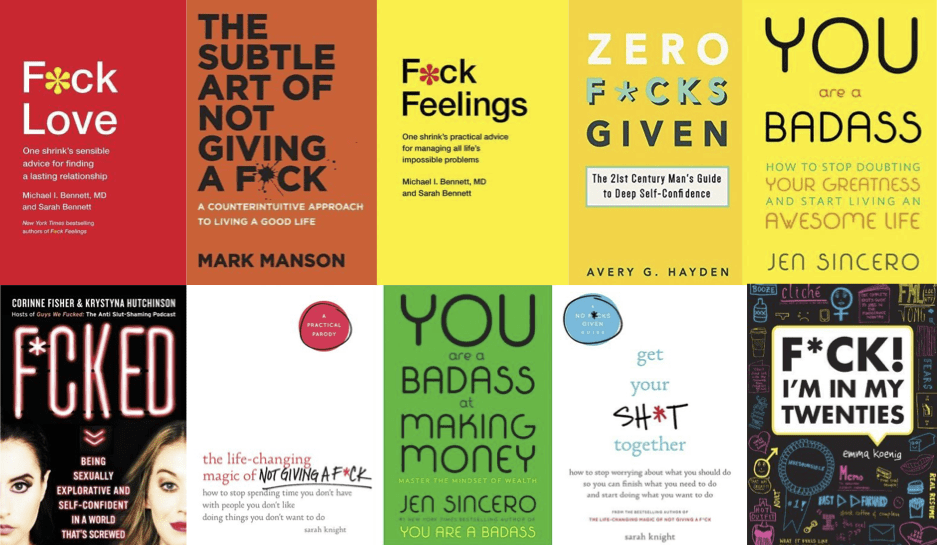
Like me, you may have noticed that there’s a certain genre of book title which… SHOCK HORROR… has a swear word in it. I’ve always thought it’s a bit disingenuous to be honest, designed to capture the attention and titillate and shock and be all rebellious when in actual fact it’s just a plain old gimmick.

If you ask me [and I know you haven’t asked me as such but I have to assume you are reading this by choice and part of the deal is that I get to say what I want and you have to just carry on reading it, so let’s just agree that it’s okay and crack on] there’s nothing clever about putting a swear word on the front cover of a book, especially if you’re going to cop out and put “f*ck” rather than having the strength of your convictions and writing the word “fuck” properly, as God intended. I know that’s because otherwise people might be shocked and appalled, but the idea that somebody may be offended by accidentally being exposed to such utter, deplorable filth and feel so aghast that they have to forego their plans for the day and lie in a darkened room with a cold compress upon their fevered brow is, frankly, a bit self-indulgent in a world where there are much more important things to be offended by. Things we will, in time, get to.

It’s not big and it’s not clever.

[For the record, from here on in I’m using the correct spelling, so if for whatever reason you don’t fancy reading the word “fuck” (without the magical * that somehow makes it acceptable) quite a few more times, now would be the perfect time to carefully back away from the particular high horse I seem to have found myself on, without going round the back of course because we all know that horses can kick.]

It’s with this context that whilst I’d heard of a book that came out a few years back entitled The Subtle Art of Not Giving A F*ck, I hadn’t bothered to check it out.

Part of it was the whole ‘swear word on a book cover’ schtick which just gets on my nerves [in case you hadn’t noticed], and part of it was an assumption that, because the author was American, and male, and white, it could just be a whole book of someone saying how cool they were because they didn’t give a fuck about anything or anyone, in some kind of pseudo macho, ego-heavy, try-hard monstrosity. That’s right, I judged the book by its cover.

[You know people say you shouldn’t judge a book by its cover? I think that’s true of pretty much most things… except books. If I’m in a bookshop (remember them?) and I’m browsing for something to buy and then leave in a pile with all the other books I’ve bought but not read, then what the hell else do I have to go on? If it’s a black cover with a silver dagger on it and big blocky writing, it’s going to be a murder-mystery type thing. If it’s a light brown cover with a tasteful etching or painting and/or a discerning old-fashioned typeface, it’s probably going to be a historical feast with a side order of love story. If it’s white and has a rose on it, it’s a romance. 99% of the time the reason I pick up this book instead of that one will have something to do with the cover. And anyway, if it wasn’t important books wouldn’t have different covers, am I right?? Anyway sorry, where were we?]

Fast forward to this summer, and someone whose opinion I respect told me that the book had recently been made into a documentary with the author (a chap by the name of Mark Manson) talking through it, and that it was really good and I should watch it. I figured that if I could give up 90 minutes or so and get the jist then that was probably worth it. So I downloaded it and watched it on a flight on my way off on holiday.

First thing to tell you is that it is indeed “really good”. It’s charming and thoughtful and engaging, and bit sad at the end too which made me shed a few tears whilst looking out at the clouds below. Admittedly I was in quite an emotional place at the time [in my head: the plane was no more emotional than any other as far as I remember] but on the whole if I feel like crying I’ll go with it and, as ever, it was quite cathartic.

I won’t go through the whole thing because you can find 90 minutes or so too and watch it yourself on one of the streaming subscriptions you’ve forgotten about [and really should probably cancel because you don’t really use it as much as you thought you would but honestly who has the brain space for rationalising subscriptions when they can just think “ah well, it’s only £6.99” and forget about it for another 6 months? Not me!] but there were a few things I took away from it which I will share with you.

Overall, it’s less about ‘not giving a fuck’ and more about being more deliberate about what you decide to give a fuck about. I guess that’s the “subtle art” bit, as I think about it now. You only have so many fucks to give, so don’t go chucking them around willy nilly over things that don’t deserve your fuck-giving.

I was introduced to this way of thinking a few years back by a Zen taxi driver – the idea that you shouldn’t allow every agressive Audi driver [used to be BMW drivers but now it feels Audi have risen to the challenge] full and unfettered access to your emotions. I wrote a whole blog about this guy which you can read here in your own time. But for now, stick with me…

The other concept I picked up was a bit more nuanced, and gets us towards where we’re going with this whole story. It went something like this: if you choose the problem, you can’t also give a fuck about how hard it is.

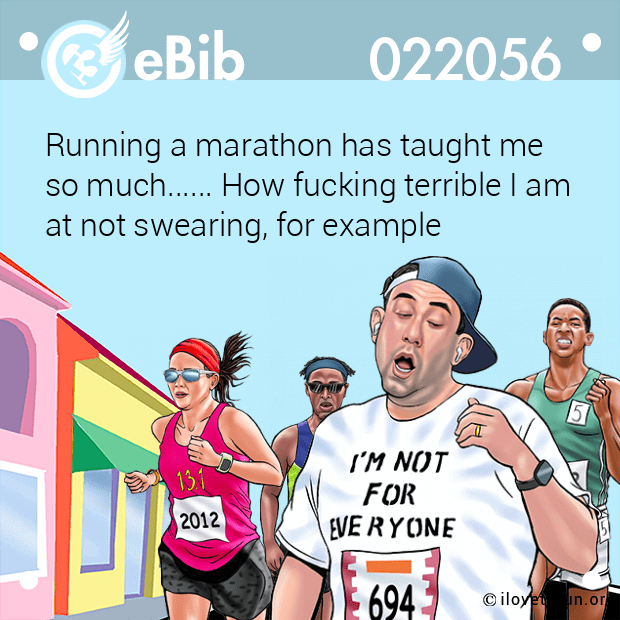
The best analogy that leaps to mind for me is around running a marathon. You decide to do it, knowing that there is no moment between that decision and the end of the marathon that will be anything other than largely awful. Nobody enjoys training to run a marathon, building up to running a marathon, and the majority of the marathon itself. In fact, the only part of the marathon that is actually enjoyable is the actual end of the marathon when you can stop running the marathon and not have to think about the bloody marathon ever again.

But if you choose to do a marathon, you can’t then go around giving a fuck about how ridiculously hard it is. You can’t give a fuck about the cold dark morning runs. You can’t give a fuck about the blisters, and the shin splints, and the bad knees. You can’t give a fuck about the anxiety in the week running up to it, or the fact you need a wee after a few miles, or the feeling near the end when you want to stop or, failing that, simply die.

How apt!
Pic courtesy of https://ilovetorun.org/

If you choose, then you can’t also give a fuck about the difficulties that go with that choice.

So, think for a moment: what have you chosen? Are you stuck in the mud of also giving a fuck about all the stuff that goes with it?

I have chosen to be a “good father”. Maybe even a great father. I want my sons to look back at their time growing up with the certainty that their father loved them, and respected them, and protected them. That their father was always there to support them when they needed support and push them when they needed a push. A father that was honest, and fair, and clear on expectations. A father that they themselves might aspire to be, if they so choose.

Me being a perfect dad with my happy, well-adjusted children

Because that is my choice, I can’t give a fuck about how hard it is sometimes to be that guy. I can’t choose to aim for fatherly greatness and then give a fuck when I can’t dismiss their questions with “because I say so” like I want to. I can’t make that choice then give a fuck about how hard it is to be consistent. I can’t choose to be a supportive and encouraging and attentive father and then give a fuck when it means I have to coach a load of 9- and 10-year-olds football on a Saturday morning and then coach a load of 13- and 14-year olds rugby on a Sunday morning all through the autumn, winter and spring so every single weekend morning from September through to May instead of having a well-earned lie in I have to get up early and find all the relevant kit which they didn’t bother to sort out the night before LIKE WE HAVE DISCUSSED, AT LENGTH, ON SEVERAL OCCASIONS [true story].

I can’t choose to be a father who respects them and their questions and then give a fuck when they ask about what’s happening in Gaza. I can’t give a fuck that I owe them a considered, balanced view because it’s on every news report, every day, and they see and hear everything and it’s fucking heartbreaking.

Not giving a fuck isn’t not caring. It’s the opposite, in fact: caring so much about your goals that you don’t care about any adversity that may stand in the way of your goals. Not giving a fuck is a commitment; a determination, even when it’s hard.

I never really chose to be a leader in my working life. It just kind of happened because wherever I worked, if I had an idea on how things could be better I’d talk to people about it, and I’m good at having ideas and bad at not talking to people, and if you carry on having ideas about how things could be better, people tend to give you more responsibility. I guess along the way I did choose to carry on up the career ladder I was on, driven by ideas and by a good chunk of ego, so it’s not like I didn’t know what I was doing. But the real choice came after, once I was in a position where I could decide what kind of leader I was going to be

I chose to be a “good boss”. Maybe even a great boss. I wanted my people to look back at their time working for me with the certainty that their boss loved them, and respected them, and protected them. That their boss was always there to support them when they needed support and push them when they needed a push. A boss that was honest, and fair, and clear on expectations. A boss that they themselves might aspire to be, if they so choose.

[Hmm yes that does sounds familiar, doesn’t it? A nagging sense of deja vu… almost like I did it on purpose, right? Something for another time, perhaps?]

That choice has given me huge amounts of satisfaction and joy, and it’s been so tough that I’ve balanced on the border of burnout and breakdown. It’s made me friends for life, and broken my heart a couple of times, too. More than once it’s been bad for my mental health, bad for my relationships, even bad for my career.

But I chose to lead with vulnerability and values, with love and loyalty, with trust and truth.

So I can’t give a fuck when that road has bumps in it. Even sizeable bumps that make your stomach flip a bit like those times when you were little and your dad was driving down a country lane [always your dad driving back in those days, never your mum] and went over a narrow brick humpback bridge over a stream and everyone went “woooo” as the momentum of their upward trajectory then the sudden drag down of gravity sent their internal organs all squiffy.

As ever in these situations, I find myself coming back to the words of Brené Brown.

[I won’t apologise for the preponderance of BB in these pages, because I’ve learnt a lot from listening to her and reading her words and I reckon you probably would too, if you haven’t already. But just for the record, I am aware BB does come up a lot. Let’s just say that I’m passing it on to you to save you time and effort in finding it all yourself. You are, as ever, most welcome]

The words she would use for this kind of leadership are “Strong back, soft front, wild heart.”

Strong back because shit is going to be tough sometimes and, as an authentic and open leader, you need to be able to take some of that. You need to have a back flexible but sturdy, like the oak tree that I see in the woods when I’m walking my dog, Ruby [that’s my dog’s name, not the oak tree, which we have given a name but that’s also for another time], which gets whacked by the wind year after year, branches stripped of leaves and boughs broken, but has roots deep in the earth which mean that it buds again in the spring and sows acorns across the clearing for the squirrels to squirrel away into holes that they forget about in the Autumn…

Soft front because that’s how people can find their way in. I won’t go into yet another treatise on the power of vulnerability to build trust, but it really is the only way. Soft front is the way in. In my experience, a closed, hard front is there to protect a brittle back; a shield to defend a lack of confidence, a lack of strong roots in the ground.

Wild heart? Well I’ll leave that up to Brené because I’d just be paraphrasing her anyway:

Two months back I left the company I’d been leading for the best part of a decade; the company I’d put my heart and soul into since I was a mere whippersnapper in my 30s. Leaving was such sweet sorrow, for lots of reasons that I won’t go into here. But for the last 2 months I’ve been unemployed, and I’ve been working hard to change that. It’s going well [thanks for asking!] and in the not-too-distant future I’ll have something new to put my wild heart and soul into.

And I’ll do that with the wildest of hearts. Once you’ve chosen to stand up for what you believe in and committed to it, you really have no other choice but to go again.

And you can’t give a fuck about how hard that might make it.

So, dear reader, I now ask you to think again about the choices you’ve made. Not what you had for breakfast this morning or what you’re going to watch with a glass of red once the kids are in bed [true story], but the ones where you’ve had to stick to your guns a bit, and dig deep.

The choice to be in a profession that maybe doesn’t pay as much as some others but really, really means something to you.

The choice to stay in the relationship and work at fixing it.

The choice to be a working mum and commit to both aspects of that dual existence.

The choice to put in the extra hours because you have pride in your work even though it probably won’t get noticed.

The choice to open yourself up again with the knowledge that yes, you might get hurt again, but “what if” it all works out?

You’ve made choices because of who you are and what you stand for. You’ve chosen what to care about. Be proud of that, and be clear on what that means.

Because not giving a fuck, is all about choosing what to care about and what not to care about. The choice not to care about anything that gets in your way because you know you’re on the right road, on a quest that is noble, and important, and fucking worth it.

I reckon that is something we could all try not giving a fuck about.

[In case you’re wondering, I have peppered this piece with the word “fuck” a total of 28 times. In the famous last words of Dylan Thomas: “I believe that’s a record”. I also popped a “shit” in there for those of you who like a little variation.]

The Four Agreements

I don’t know about you, but whenever I give someone a book, particularly one very specific to them, I write a little note in the front along with the date. I do it partly because I really appreciate it when someone does it for me, and also perhaps partly because I like the idea of marking the moment in time so that in the future it’ll pop up again.

Perhaps it’ll be read by the person to whom I gave the book, a single tear of reminiscence rolling involuntarily down their face as they recall the thoughtful gesture and how lovely I was. Or perhaps it’ll be read by someone decades from now who’s picked up the book for next to nothing at a charity shop and will never know how lovely I was except to know I’m the kind of person who writes a note in the front of a book. And maybe, just maybe, they will decide that is something they will do from that point on… thereby making the world a slightly better place, forever and ever into the future.

Yes, I do overthink things sometimes, I’ll give you that.

Anyway, it just so happens that in the middle of last year, right in the middle of a very challenging time for me personally (which, if you’re interested in such things, you can read about here), someone I didn’t really know very well came up to me holding a book, and then handed me that book. Their personal copy of a book they carried with them at all times, a book wherein they had highlighted passages, and made the odd note. Handed over now to me, for me toread and to keep.

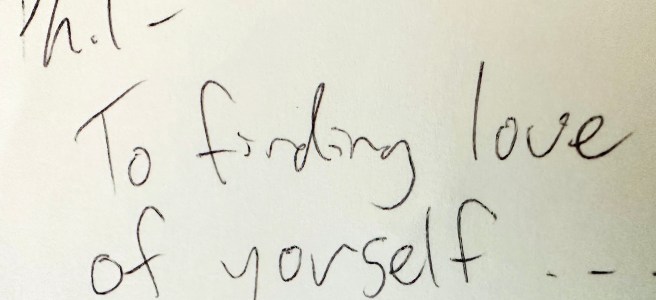
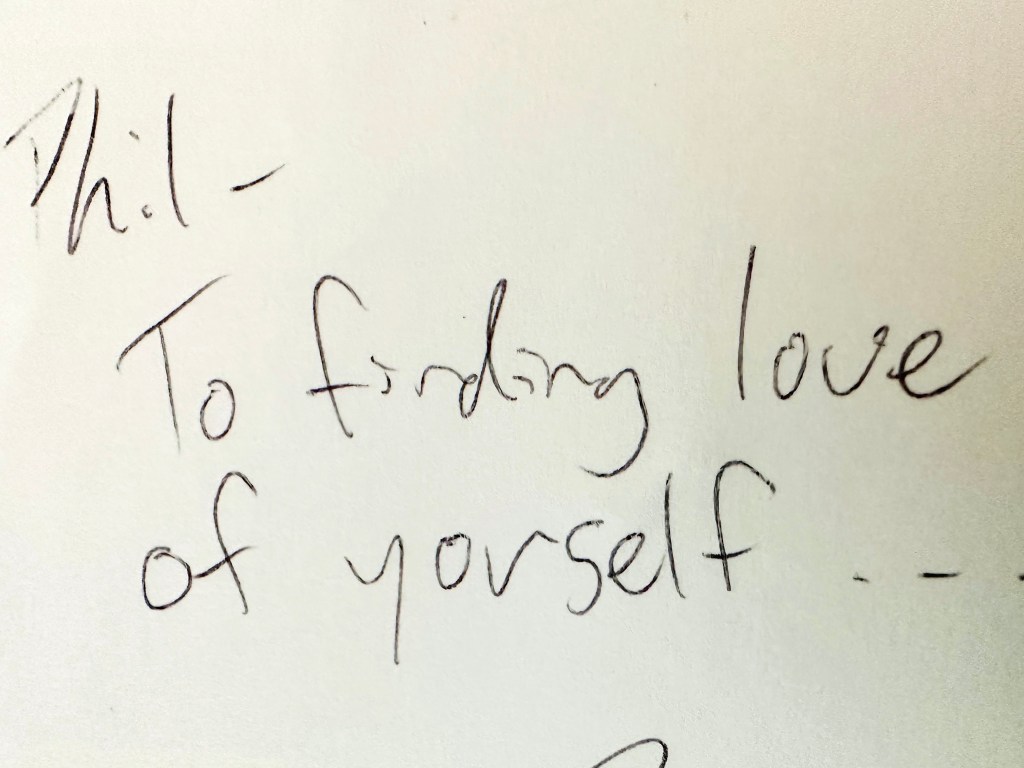
And yes, they had written inside:

Underneath, they’d written their name, and their personal contact details

First off, it struck me then and still does today as an incredibly kind, thoughtful, open gesture. Let me give you something that’s helped me, in the hope that it may help you too.

But just as much as that, I was fascinated as to what the book might be. What is the kind of book that someone carries with them, at all times, and highlights passages and makes little notes in pencil in the margin, and is then moved to inscribe and hand to someone else? It must be a book with such wisdom, such guidance, to drive someone to feel they simply must pass on to someone else in their time of need.

What book holds that kind of potential impact?

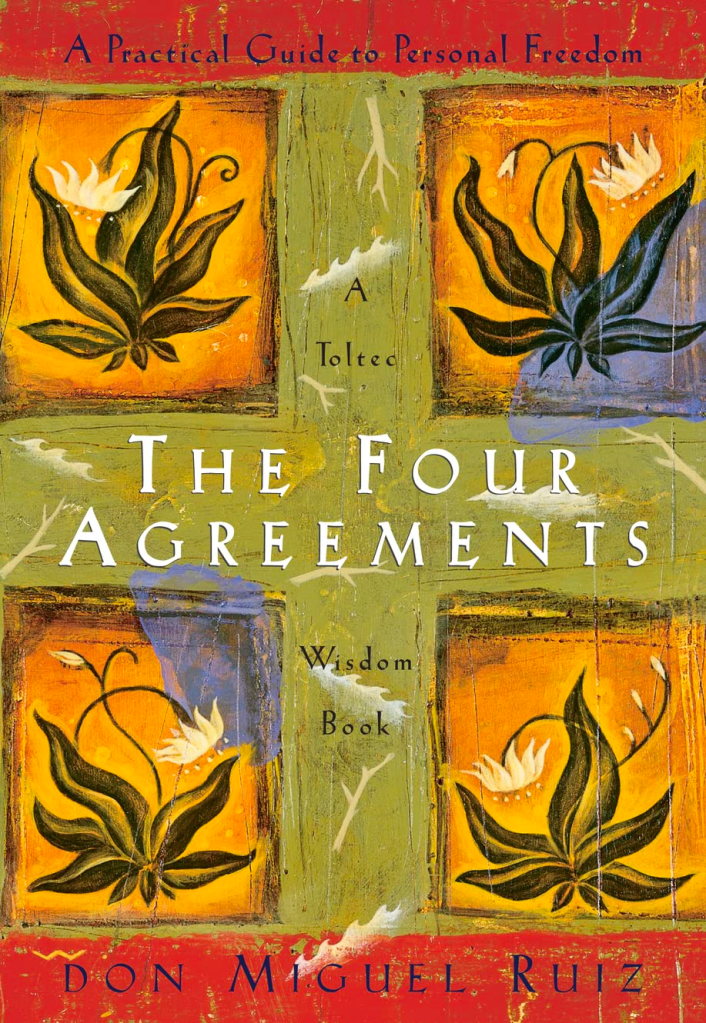
The book in question is called The Four Agreements, written by a chap by the name of Don Miguel Ruiz. I’ll be honest, the first time I started into it I liked the thinking but struggled a little with the way it’s written. That’s because Don Miguel Ruiz is a shamanic teacher and healer, and he writes in a very unconventional, conversational style about teachings from the ancient Toltec culture in central Mexico. It’s not written like a classic business or “self-help*” book because it’s not written by a classic business or “self-help” author, and as you can see below it’s not either of those things anyway, it’s a much more than that: a Practical Guide To Personal Freedom. So you have to get into the way it’s written, or you have to get past the way it’s written. But you can’t ignore the way it’s written.

[I hate that I feel the need to put “self-help” in “” but I do so because it’s been hijacked to be used pejoratively by people who think that “self-help” is the sort of thing that those awful woke snowflake Remoaner lefties need and which any hard-working normal person knows is a load of bloody nonsense and anyway who needs introspection when you can just judge other people from a position of blithe, dismissive self-ignorance? From being a positive, it’s become a negative, despite the fact that every single thing I’ve read with the intention of helping myself has, in some way, actually helped my actual self. But anyway, it’s in “” so we can leave it there and crack on…]

Whether you get into or get past, the idea of a Practical Guide to Personal Freedom is immediately something that appeals, right?. I mean, who doesn’t want Personal Freedom, and what better than a Practical Guide to get there? I’ve been following the Massively Impractical Guide to Personal Angst in my own brain for years and that’s been a bit of a chore at times, to say the least.

And once you’re in, the simplicity of The Four Agreements sing out as a sort of rulebook for a life which doesn’t fall into all the pitfalls we all fall into, all the bloody time. So simple that it’s a bit annoying no one mentioned them before, really.

So to avoid you having to find all this stuff out yourself, I’ll outline them here, with my take on what they’re all about, and you can save yourself a lot of future angst. Sounds like a plan, right? Great, let’s roll.

This is the front cover. You can’t miss it.

1) Be impeccable with your word

Don’t talk shit, basically. Don’t lie, don’t make stuff up, don’t brag, gossip, don’t collude, don’t say unkind things, don’t talk about people behind their backs. Actually, don’t say any of that shit to yourself either. Tell the truth to yourself and to others. As good ole’ Brené Brown would say “Clear is kind, unclear is unkind”.

Am I good at this? Only in parts. I’m not one for collusion and I don’t brag, but I do gossip sometimes and on a bad day I can be quite cutting about people, particularly when I feel I’ve been “wronged” in some way. I can also talk shit about myself, to myself. So this is one I have to come back to, and remind myself of, to keep it fresh and real. This much I do know: nothing good comes of speaking ill.

2) Don’t take anything personally.

Self-explanatory this one. But damn – how can you not take things personally when you are about you? If something happens to you, or someone does something to you, it’s you, right? It’s personal to me because it’s happening to me!

Except, of course, it really isn’t. This is one I’ve kept really close to me since I first read it – the idea that whatever someone does or says, howsoever it may affect you… it’s not about you. It’s about them.

It’s about how they see the world, and themselves in the world; about the pressures they have put on them and the pressures they put on themselves. It may affect you in horrible ways, but even then, it’s not personal. It’s not about you, it’s about them.

If someone treats you badly, it’s because in their mind they are under pressure or under attack somehow. If someone puts you down, it’s because of how they experience themselves when they are with you. If they really, really seem to just hate you for no reason you can work out, then don’t bother trying to work it out because the answer to “what have I done?” is quite possibly “nothing”. Because they don’t actually hate you – the you that you know and know to be fundementally good – they have negative feelings towards the “you” they have created in their mind because of their own issues. It really isn’t about you.

I know this is difficult. Believe me when I say that even with this agreement not to take anything personally sitting happily in your head in all its logical, sensible splendour, it’s still really, really difficult. I’m not saying you should just brush it off or, even worse, get thick-skinned to protect yourself. Those people who claim not to give a fuck about anything people say or do to them are lying to you and to themselves. I’m not saying you can’t be upset. Be upset. Just don’t take it personally. Because it’s not about you, it’s about them.

Oh and by the way, unfortunately, it works both ways. So it’s also true that If someone talks you up or lauds your every minute action and deed, it’s really not about you, it’s about what they think or hope for or need in the relationship. I know you’re brilliant, but just don’t take it personally.

Trust me: this one is a keeper. Don’t take anything personally. It’s not about you, it’s about them.

3) Don’t make assumptions

You know what they say: “Assume” makes an ass out of u and me. That trite little saying doesn’t stop us from doing it though, does it?

We make assumptions because we’re trying to make sense of the world without all the information to hand. Our brains don’t like stories without an ending. We seek reasons and endings, and so without a reason or an ending we just go and make up our own.

Assumptions are the basis of pretty much every conflict you’ve ever had – the story you’ve made up in your head about what someone else is thinking, which you then judge them for without them even knowing. They become the loser in a game they didn’t know they were playing. And let’s be honest, we don’t often cast ourselves as the villains in the piece.

Assumptions leave you wide open to be disappointed, or surprised, or shocked and appalled when things don’t turn out as we guessed they would. Assume it’s in the bag and you’ll find that someone who assumed otherwise put in more effort than you and walked away with the prize. Assume they won’t want to talk to you and you’ll never know what might have been. Assume there’s no point in applying for that job, and I promise you that you 100% will not get that job.

This is my biggest Achilles Heel. I love a good story, and I can’t help telling myself all the stories I’ve created about my assumptions. I know that this is how my brain works, though, so I’m trying to be disciplined in checking those stories as I go and removing the assumptions that may be driving action, inaction, or reaction.

4) Always do your best.

I love this. So simple. The kind of thing we were told as kids and now tell our kids because that’s what you tell kids… without really listening to what we’re saying and taking our own instruction.

If you always, always simply do your very, very best, you can end the day knowing that you couldn’t have done anything more. It’s the drive to get up in the morning and the solace to sleep soundly through the night. Just do your best. Personal to you, and only you know what your best is. Don’t worry about what other people are doing. Don’t cut corners.

And be okay with the idea that your best varies, too. Your best when you’ve had the elusive straight eight hours of uninterrupted sleep and woken to the birdsong and the sun is coming up and the day ahead looks challenging but manageable isn’t the same as your best when you’ve been awake through the night with your mind racing because you know you’ve got that difficult conversation you have to have later and there’s no milk for your morning cuppa and the dog just slobbered on your black jeans so it looks like you’ve had a giant snail crawling. up your leg. But just do your best, no more and no less, every time, in everything, and you simply cannot go far wrong. It’s actually quite freeing.

So there you have it. The Four Agreements, which I was given by a very kind man who felt I needed them at a difficult time in my life. Again, what a lovely gesture.

And what simple agreements they are. I can’t tell you that I stick to them all the time, but I can tell you that whenever I lose my way, it’s because I’ve not done one or more of these.

Maybe just make a note of them somewhere and consider in all honesty, where you’re strongest. on these and where you’re not. Perhaps consider that difficult thing that’s on your mind at the moment and see if there’s a chance that one of these agreements might have avoided it – or might even get you out of it. Be impeccable with your word. Don’t take anything personally. Don’t make assumptions.

And whatever you do today, just do your best. No more, no less. I reckon that’ll be more than enough for whatever today has in store for you,

[If you’re interested in getting a copy of said book for yourself, then you can find it here or at all good remaining physical book shops. I’d give you mine but I’m not quite ready to give it up yet.]

What if?

When you’re a 9-year-old boy, where things fit in the world seems very important. I know this because at any one time, my 9-year-old son Jack can tell you where he fits amongst his friends and classmates. Who’s older and who’s younger (very important). Who’s taller than him and who’s shorter (also very important). Who’s a faster runner and who is slower (you get the idea).

Comparison is how Jack sees the world at the moment. What’s better, what’s worse? He could tell you his favourite chocolate bar, and his second favourite soft drink or tree. Jack, dear reader, could tell you his third favourite colour. He also has a long list of favourite songs and can give you information on how those have been carefully stratified. Within that, there will, I am sure, be a specific sub-list for songs by his favourite artists. He can tell you, quite specifically, what he likes about playing football and how that tracks against what he likes about playing rugby. He has clear views on whether that superhero would beat that superhero in a fight.

“First: Superman; Second: Thor; Third: Iron Man”. Took him about 10 seconds.

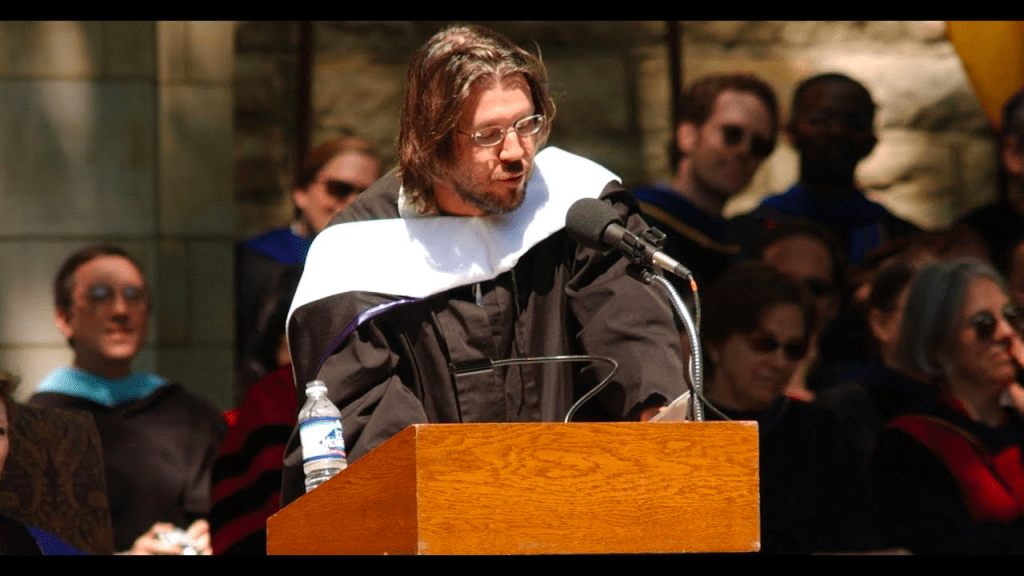
Because that’s the way Jack thinks, he thinks other people think that way too. As the brilliant and heartbreakingly short-lived American writer, David Foster Wallace once noted (with irony, of course):

“Everything in my own immediate experience supports my deep belief that I am the absolute centre of the universe; the realist, most vivid and important person in existence.”

David Foster Wallace
[If you want to put this snippet in context, I urge you to listen to the speech it comes from, a 2005 commencement speech to graduates at Kenyon College in Ohio in the US. It’s all about the importance of living in the trenches of adult life with awareness and compassion, but I can’t do it justice so you can hear it for yourself here, or get a copy here. He struggled with depression and tragically took his own life just three years later in 2008.]

So it’s not surprising that a 9-year-old thinks that everyone thinks like him, because his only experience of thinking is the thinking he does, right?

The result is that you don’t have to spend much time at all with Jack before he’s asking you what your favourite something is. He expects you to have a favourite, and he will push you if you say you don’t. I now have a third favourite colour, because it’s easier than not having one.

On the whole, I go along with Jack’s world of categorisation because it’s interesting to question your own view of the world in a way that you usually don’t. Hang on a minute… what is my third favourite colour??*

The other morning as we drove through the hedgerow-lined country lanes between our house and Jack’s school, which sits in the village perched on top of a hill on the other side of the valley [yeah it does sound pretty idyllic, doesn’t it?] we chatted about his tendency to rank things and why he did it. After a couple of failed attempts to get some insight (“I like it because it’s good to know what you like the best”), I hit a breakthrough…

“I like asking myself questions. It makes me think about what I think about things.”

Woah. Pretty deep for the school run, right?

So once I’d managed the massive hit of dopamine that paternal pride dropped into my system which made we want to hug him and burst into tears and shout his name from the top of the church tower in the distance all at the same time, I gathered myself and told him I was proud of him and that asking himself questions was really important and he should never, ever stop.

Then, once I’d dropped him off at the drive-through turning bit [he doesn’t need me to come into the playground any more because he’s Year 4… I also haven’t got a hug from him at school for quite some time, but we do have a “Bartlett Boys Fist Bump™” – my little man is growing up too fast] I found myself thinking about what he’d said.

He doesn’t know this, but what he’s doing is called ‘meta-cognition’: the process of thinking about one’s own thinking. It’s what David Foster Wallace was talking about, and taken to the next level you get to meta-emotion which is considering how you feel about your feelings. Being able to take a step back and consider your thoughts and feelings with objectivity and ‘detachment’ is actually the fundamental idea of Buddhism, and much of meditative teaching: you are not your thoughts; you are not your feelings.

I’m not saying Jack is on the road to enlightenment just yet – he’s much too ‘attached’ to the idea of getting the football into the top corner of his little goal in the garden, for a start – but I’m not sure I was thinking about my thinking at his age.

But the point of all this stuff is not just to get you thinking about what you think, or even exploring how you feel about your feelings.  It’s to tell you about what this desire to question and categorise has led young Jack, and where I’ve gone with him on the journey.

Ladies and gentlemen and all those who identify as they wish, I give you:

The Power of IF

Allow me to explain. A little while back Jack came to me and asked who I thought would win in a match between his beloved Liverpool Football Club [YNWA] and England. At the time there were a couple of Liverpool players who would be in the England team, and so I told him that wasn’t possible – who would they play for? To which Jack replied…

“Yes but what IF they played each other”

For Jack, IF is the get-out clause – the escape from the realm of reality into a place where anything is possible. Because whilst you can know that in reality, it wouldn’t be possible for a team to play another team with some of the same players on each side, there remains the question of IF they did, who would win?

I know a grizzly bear won’t ever fight a tiger in the wild, but IF they did, who would win?

I love the freedom of that thinking. It’s the stuff we leave behind when we become adults and become constrained by the things we know to be true, rather than exhilarated by the potential of those things that could never actually be, but what if they could?

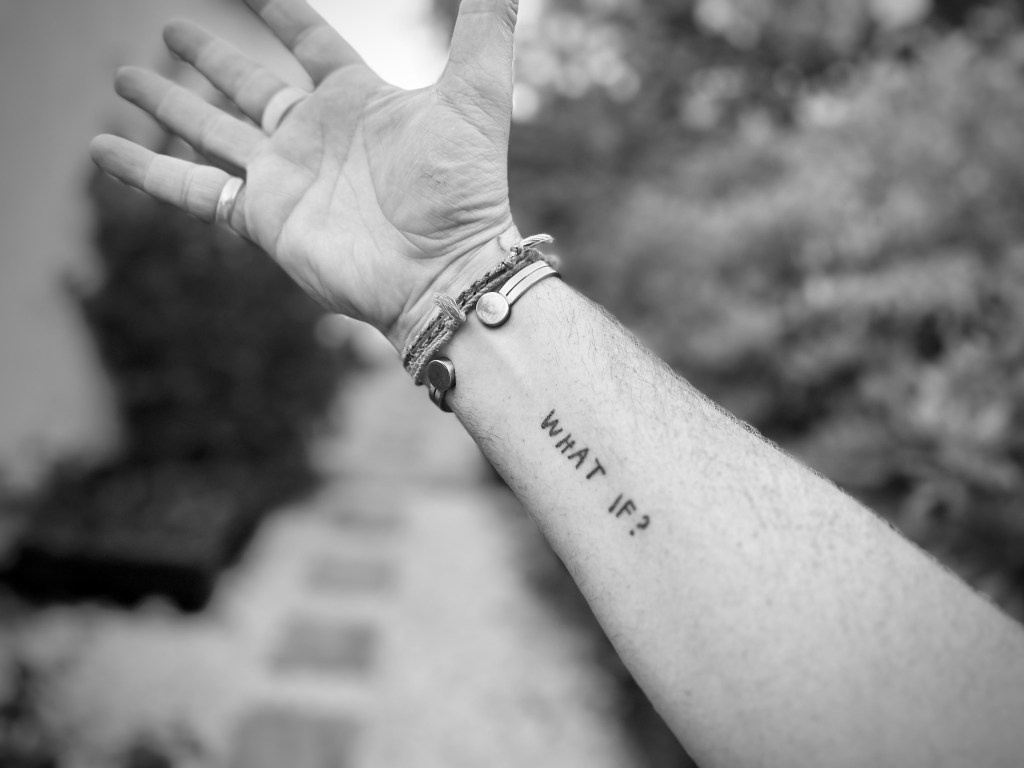
And it’s that additional word, turning IF into WHAT IF that has become something of a guiding principle for me over the last year or so since “my little episode”. WHAT IF? is a commitment to the possible. And the magic of this little phrase is that the positive always, without exception, has the ability to trump the negative.

What if it doesn’t work?

Yeah, but what if it does??

What if we could create this amazing thing that feels impossible? Wouldn’t that be cool? Well shall we try to actually do it then? Rather than dwelling on all the reasons why it’ll be too difficult?

What if you could get past the difficult conversation that you’re worried about starting because you don’t get to choose how the other person takes it? What if it works out? That would be pretty great, right? So go and work out how you’re going to at least try to do it.

What if you say “I love you” first and they say “I love you too”? Yeah, I get it’s one of the most vulnerable things possible, and yeah, what if they don’t? But what if they do??

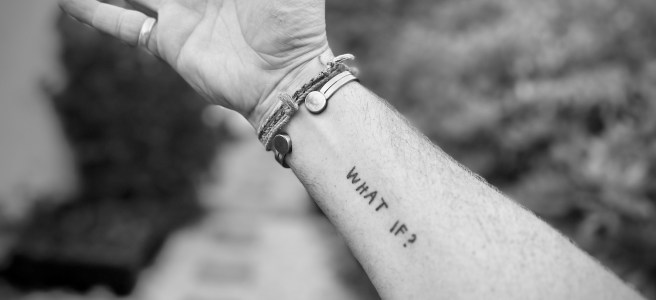
It’s become such a positive influence in my life that I’ve done what I tend to do in this situation and had it tattooed onto my arm, so that whenever things get stuck I can envisage the positive endpoint and make a commitment to go for that.

My right arm

And that, dear reader, is what I’m going to ask of you today. No, not the tattoo. You don’t have to do that if you’re not up for it. No, I’m asking for a commitment, just with yourself, that the next time someone uses ‘what if’ negatively you flip it to the positive and embrace the possibility of a positive outcome, and commit to go towards that.

So yeah, what if we lose? What if they hate it? What if they say no?

I get that you’re nervous. It’s a big deal. But we’ve done all we can. And what if we win?

Yes, there’s a risk of that. They may hate it. But what if they absolutely love it?

And just imagine, for a second. Let yourself go, and give a little thought to this…

What if they say yes?

Good luck. And let me know how it goes.

*[I thought about this only this morning for the first time. My favourite colour is yellow – always has been. Bright, positive, unmistakable. Next (because I had to choose) comes blue, because of the sea and the sky and calmness and all that. And I thought my third was green, but when I told Jack he said “Oh, I thought it would be orange”. And actually, I think he’s right. So it turns out that not only does Jack know his own third favourite colour (turquoise, surprisingly), but he also has a better idea about mine. He can probably help you with yours, too.]

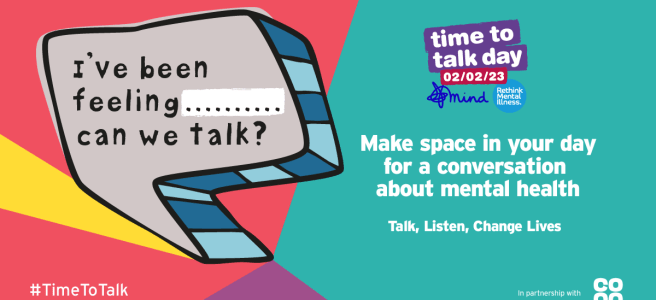
Time To Talk Day – my “little episode”

I’d been feeling a bit lost for a few weeks. Maybe a few months even, I’m not too sure. A while, anyway. Not completely without purpose, but lacking a little… something. “Not feeling it” as they say. It’d been a time of introspection, not all of it particularly useful, coupled with a fair bit of time wishing I weren’t so introspective. It can all get quite meta when I’m thinking about how I feel. And how I feel about how I feel. You get the idea.

I get like that sometimes. It’s kind of exhausting, to be honest. I get into my own head and get stuck there for a bit. Outwardly I’m fine – perhaps a little skittish or distracted – but inside I’m spinning.

When I’ve been like this in the past, there’s always the internal monologue that just says I need to snap out of it. To follow the good old masculine trope and for fuck’s sake just MAN UP.

But of course, I know that bit of me doesn’t solve anything. Rejecting how I’m feeling, pretending it’s not real, or (even worse) beating myself up for even having these silly, selfish, weak things called emotions is a road I’ve been down before, and it’s always ended up at a dead end. [If you’re interested in one of those roads – perhaps the first dead end I found, actually – then you can find my story about my anxiety here.]

Unfortunately knowing all this in your more calm and more rational moments doesn’t necessarily help when you’re in the middle of it, because when you’re in the middle of the forest you can’t see the wood for the trees. And I was right in the middle of the forest.

Allow me to explain…

A long time ago I decided that if I was going to be leading people, in any way, big or small, I’d do that in a way that felt genuine and authentic to me. I’ve always known that the best way to bring people together was to try to connect with them – and to connect them to each other – with shared passion and values and purpose and all that good stuff. I don’t need to tell you that you only build trust through vulnerability, and that’s what I’ve done, for years.

This philosophy requires me to be emotionally open, genuinely caring, and empathetic not just to the individuals but to the group that individual is a part of too. If I’m not all of those things, all the time, then the connection doesn’t work in the same way. I’ve doubled down on vulnerability, time and again, because that’s what I believe in. There’s no question that it’s made my working life richer than I could have hoped for, but I can’t pretend there aren’t times when I’ve wished I could shut off the emotional side because it does take a hell of a lot of energy. You can’t reverse back out once you’ve started with an open, honest, vulnerable relationship because if you were to do so, the trust you’d built up would break into a thousand pieces, never to be put together in quite the same way again. Once you’re in, you’re in. And I’ve always been all in.

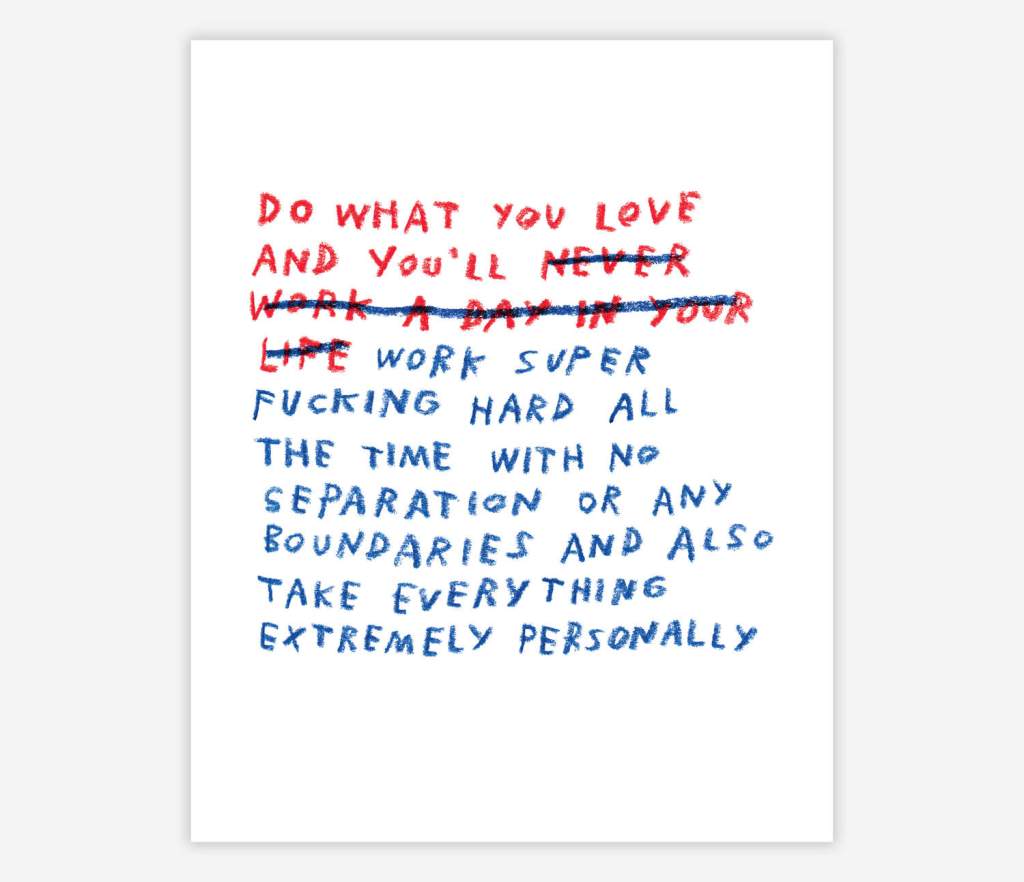
The result of that can be neatly summed up by this little gem from the visual artist Adam JK (you can learn more about him here if you like), who put it thus:

And that, mes amis, is the life of an ‘all-in’ leader, especially in the strange razor-edge world of running an advertising agency, where every success means people are working too hard and burning out and freaking out and you can see that they’re struggling and you wish you could do something… and every little failure means you might have to send someone home without a job. Someone you know, and care about. Someone you really, really like. Whose family you’ve met.

It’s always been personal for me. And the last couple of years only heightened that.

Authentic, vulnerable leadership is hard at the best of times, but leading through two years of global pandemic, where people’s expectations of their employer changed overnight and never changed back, has taken its toll on leaders the world over. I’m no exception to that. Overnight I felt responsible not just for the agency I run or the jobs of the people who work in that agency, but for the people themselves, too. We were the de facto community that people were missing. Work was, for many, the only human contact people had.

And so through two years of sustained growth in lockdown, I knew people were allowing their commute time to be subsumed by work, and working longer hours than ever. To help with that we were trying to hire people so quickly that there was no way we could be doing a decent job of embedding them into the group and setting them up for success. I could feel that we were cashing in all the “emotional currency” we’d been banking through the previous years.

Emotional currency is an idea I’ve talked about for a good few years now, and it’s simple enough – when things are going well and work feels good and morale is good and the mood is good then all that good stuff gets banked in people’s minds but more importantly in their hearts. The more the good continues, the more you bank. And then when things aren’t so good for a while for whatever reason, you have some good in the collective emotional bank which means you get some leeway – some time to get things good again. But here’s the rub – it’s not fair. You might have two years of good in the bank, but once you start withdrawing it’ll be gone in six months.

I could feel that the bank was getting empty. Not in the red, but not snow angels in the banknotes either.

And then as the shared experience of lockdown and Covid became smaller in the rearview mirror, everything happened. All at once.

Work got messy. The razor edge was sharp and painful. We were under pressure and I was out on a limb, fighting for what I thought was the right thing to do time and time again, holding on so tight that I couldn’t release, and in my own head so much that I started to question my instincts on things. And I’ve always trusted my instincts. Always.

Life got messy. An old friend took his own life, which rocked me in ways I still don’t really understand. Family members were in and out of hospital for operations which of course were always going to be fine but of course there’s always that bit of your mind which likes fucking with you in the middle of the night because WHAT IF..?

My head got messy. Losing sleep. Losing perspective. Losing myself.

It all came to a head on an otherwise unremarkable Wednesday morning at the end of June. My wife told me that she was going away with my sons for a few days in the summer holidays and I’d be at home for about 10 days on my own. My reaction wasn’t “sounds great, I’ll sit around eating pizza in my pants and get the lads round to play poker”. It was “I’ll go fucking crazy here on my own”.

The way I’ve described it since is by using the analogy of holding a mental tray. You’ve always got a decent amount of stuff on your personal tray, and most of it you put on there yourself so it’s all balanced in a way that you can handle. But if you keep on putting more and more things on it, then eventually you’re going to struggle. And then if other people stick some stuff on it as well, and aren’t as careful balancing…

I just about managed to put the tray down before I dropped it. Just.

I spoke to my team at work and agreed that I’d take some time off in the summer.

Which I did. A month away. Time to get some more stuff in my toolbox. Started some coaching and some yoga and meditation. Started going to the gym, too.

I can’t say the return to work was gentle, though. If anything it was worse than before the break: intense and toxic and kind of disgusting really. If you ever want a case study on how not to handle the return to work of a leader who’s been suffering with their mental health, give me a shout.

When, like me, you’ve spent your entire adult life ‘showing up’ as self-confident and full of energy, it’s actually pretty easy to fake it. To turn it on and turn up and get through and get out. So I tried to be what I thought people needed me to be. No one needs a leader who can’t trust his instincts. Who can’t trust himself at all, really. I was so wrapped up in my own stuff that I couldn’t really be the support that people needed, but I couldn’t tell them either because that would be putting more on them and they were already covering for me. I thought I was doing okay because the time off had given me a chance to get my nose just above the flood waters so I could breathe, but I was still only one slip from going under again.

I had a panic attack one morning before going into the office. I called my wife and she talked me down and I went into M&S and got some fruit and went into our offices and up in the lift and sat down and didn’t say a word about it to anyone.

I couldn’t take more time away because people needed me. Or at least that’s what I thought. But looking back, I wasn’t completely there anyway. By the time I started getting cluster headaches [read about the delight of those here if you fancy it. TLDR – they are horrible] towards the end of the year I was just limping towards the alluring finish line where 2022 would finally be consigned to history as the shittiest year of my life. Beating the year my mum died takes some doing.

BUT…

Lovely word, right? “But” makes everything that comes before it irrelevant. It turns the story.

But that was last year.

Yeah, I know that nothing magical actually happens at the end of December 31st, and that the whole idea of a “New Year” is just yet another construct that we’ve created – a story we’ve all decided to believe. But I needed to go with the romance of a new beginning. The turning of a page.

And as I sit here today, I do feel like I’ve turned the page.

Over the last six months since what I’ve euphemistically been referring to as my “little episode”, I’ve put a lot of time and energy into getting more things in my self-care toolbox that I can pick out as and when I need them. I’ve been going to the gym with a couple of friends who also could do with reshaping the dad bod [which considering I’ve been “Gym Free Since ’93” is quite a shift for me]. I’ve been doing a 1-2-1 yoga class every week since July. I’ve had some professional coaching which has helped me to get a better sense of my own values and what I need to be fulfilled. I’ve had a sprinkling of therapy along the way. Then just before the break in December, I learnt to meditate and now I’m doing that once or twice every day,. Last year I changed my meds and then this year got some advice and changed the dose which has helped. Hell, I even spent last weekend at a yoga retreat where as well as doing more yoga than I’ve ever done I also opened up to a load of complete strangers and chanted around a fire with a couple of shamen women for crying out loud [don’t worry I’m not converting – I just love a fire]. And perhaps above all, I’ve got my wife, and my two boys, and my dog, and the huge oak tree in the woods over the road.

I’m coming into this year feeling more centred and more solid than I have in a long time. Maybe ever.

At the same time, I’m also very conscious that all this is part of a journey and I can’t let myself be either complacent that somehow I’m magically “fixed” or concerned that “it’s only a matter of time before I crash again”. I just have to be whatever I am right now and be okay with that. I’m okay today. Tomorrow is tomorrow.

So why the hell am I telling you all this?

Well, there are a few reasons, actually.

The first one is then when I’m writing this, you’re not here. So I’m kind of talking to myself really – starting with the man in the mirror and asking him to change his ways [yes that is a Michael Jackson lyric – I couldn’t help myself and it’s lightened the mood a bit hasn’t it?]. It helps me to organise my thoughts, and as a result it’s kind of cathartic.

I’m also telling you because there’s a massive stigma around talking about mental health, especially in men, and if I can talk about it then at least I’m doing something to break down that stigma in some way. For me it’s just health -I’m not ashamed of my mental health problems any more than I’m ashamed of the fact that I need glasses or got diagnosed with gout at the age of 30 [a family disease for the Bartletts]. I take my pills for my brain at the same time as I take the ones for my liver. I take vitamins too. Sometimes I take something for allergies. It’s all the same. Talking breaks down barriers and stigmas and I have a lot of privileges in life so if I can’t talk openly about all this shit, who can?

If you’re a regular visitor to these pages, you may also have gathered that I’m a talker anyway, so this isn’t new news for a whole load of people. My immediate family know, and some of my extended family do too. A decent amount of the friends I’ve spoken to in the last 6 months know, because it would feel horribly inauthentic if they were to say “how have you been” and I were to say “yeah, fine thanks”, so I’ve tended to ditch the small talk and go for the big talk. And at work, I started off telling my immediate team, then thought it felt right to tell the whole agency about it because it’s real and I want them to know that it’s okay to not be okay. And then somehow I found myself in a really open and honest conversation with the new big boss in New York and I took a punt that he would get it and told him and he did get it and that felt good. So now a lot of people know I guess. Everyone, without exception, was kind and considerate and caring.

And now you know.

Which leads me to the last reason, which is actually all about you, dear reader

You see, the reason I overthink things and then write about it here is so that you can learn from my mistakes and avoid them (whilst, of course, making a whole set of completely different ones). Call it a friendly nudge, or wake-up call, or even a kind of non-specific remote intervention, but if you’re carrying your own tray and you’re wobbling, then please trust me, it’s not just going to magically fix itself. Yes, there may be light at the end of the tunnel but it’s no fun living in a tunnel on your own either and maybe, just maybe, a nudge around TIME TO TALK DAY might be the right time to maybe talk to someone about what you’re going through. It will help, I promise, and they will care, just like you would if the tables were turned. The truth is, they probably know already.

And on this day of all days, if you’re actually doing pretty well, actually, then you can make the world a better place by making a point of being emotionally available for the people around you who seem like they’re probably fine but actually might not be…

The colleague who always seems like they’re a step or two behind where they think they should be.

The family member who’s gone a bit quiet recently.

The friend who hasn’t made it the last few times you all got together.

Maybe they are fine, and you just have a nice chat and a catch-up and perhaps arrange a time to spend a bit of time together because it’s been too long, hasn’t it? But maybe they’re not, and you’re exactly the person they needed to talk to but just didn’t realise it. Either way, you get to talk to someone you care about.

Hey, don’t let me keep you. I’ve got a call to make anyway.

What have I done?

Though it was still early in the morning, it was already becoming hot in the Jornado de Muerto desert, about 35 miles southeast of Socorro, New Mexico. On this day, the sixteenth day of July, 1945, the world was about to change forever.

At 05:29, the United States Army detonated the first ever nuclear weapon. As huge sunlight flash subsided and the mushroom cloud rose into the air, amongst the 425 people in attendance was the director of the Los Alamos Laboratory where the bomb had been designed, Dr J Robert Oppenheimer. He later said that the sight of the explosion brought to mind words from the Hindu scripture the Bhagavad Gita:

“Now I am become Death, the destroyer of worlds.”

June 16th, 1945.

Developing the technology behind such a device had been his life’s work, and within days of that morning in the desert the dropping of bombs on Hiroshima and Nagasaki, on August the 6th and 9th respectively, effectively ended the Second World War. The only nuclear bombs to have been used in combat, they killed between 90,000 and 146,000 people in Hiroshima and 39,000 and 80,000 people in Nagasaki, with roughly half of those dying on the first day. 95% of those who died were civilians.

There’s no knowing how long the war might have continued without those bombs of course, or at what cost in terms of lives. History changed course at that point, leaving those stark figures as the epitaph to the largest war the world has ever known.

Oppenheimer’s moral conscience about his place in this history as “the Father of the Atom Bomb” was complex and nuanced. Two years after the bombs had extinguished both life and war at the same time, he would tell his peers that they had “dramatised so mercilessly the inhumanity and evil of modern war”, and connected science to the idea of sin like never before.

Yet when asked to reflect later in his life, he claimed to carry “no weight on my conscience”, seeing the scientist’s role as distinct and detached from the governments who decided to use their work. Scientists do science. Governments do war.

I’m not sure I could disconnect myself from the responsibility for my actions quite like that. But then I’ve never been indirectly responsible for the deaths of thousands of people in a flash. Perhaps that would be the only way to live with it.

And here we are, a month under 67 years later, and the mere threat of those same bombs that Dr Oppenheimer came up with allows a country to invade another and no one can do anything to stop them, just in case.

Oppenheimer never could have imagined. At the very first, it was all about the science. As Jeff Goldblum’s character memorably says in the first Jurassic Park movie:

Your scientists were so preoccupied with whether or not they could, they didn’t stop to think if they should.

It makes me wonder about all the other people who started out with good or decent intentions, and ended up making the world worse.

The people behind Twitter is an obvious one. Created as a way to connect people all over the world, it’s ended up being a place where the positive connections and sharing and love is vastly outnumbered by the division and demarcation and disunion. Where people can anonymously shout and threaten without consequence, and conflicting interested parties can choose to create and curate hatred and vitriol.

Google was set up to “democratise information’. Now they sell our personal data to whomever wants it so they can convince us to buy shit we don’t need, with money we don’t have. They could, and didn’t stop to think if they should.

Facebook was set up by pretty grim people for pretty grim original reasons, and then morphed into something that was nice for a bit but now is as bad if not worse as Twitter. For every local community group, there are ten more sowing dangerous lies, giving legitimacy to lies which in times gone by would have died on the edges of society. Connect enough crackpots and they’ll convince each other they’re all right.

[There’s no question this extreme online discourse has leaked into society as a whole. If you haven’t seen David Baddiel’s excellent documentary on the BBC then check it out in iPlayer here.]

There’s an old cliché that “the road to Hell is paved with good intentions”, but it’s a cliché because it’s true, of course. And on much smaller levels we all have it in our own lives.

As I say, I’ve never invented an atomic bomb, but I have been so desparate to avoid having to make people redundant that I ended up making things worse in the long run. I have allowed loyalty and hope to cloud my judgment. I have had times when the utopian working environment I was aiming for looked more like a sweatshop. I have tried to make someone laugh with a joke that actually made them cry. I have tried to hold everyhing together for everyone else and ended up forgetting myself. It”s no bomb, but I can learn from my “what have I done?” moments anyway.

You’re not Dr Oppenheimer either. But imagine for a second that you could undo the thing you did that’s put you in the situation you never planned for and don’t want to be in right now. Compare that to inventing the atomic bomb. One thing can’t be undone, but I wonder if the thing you’re thinking of can?

If it can, fix it. It doesn’t matter how, although I can give you some tips on a good sorry I wrote earlier here.

If you can’t, then don’t push it away and deny it, like the good doctor. But don’t carry it with you either like a stone in your shoe. We all make mistakes, even when the intentions are good. Instead just acknowledge, learn, and move forward.

It’s not about what you’ve done. Because there isn’t a damn thing you can do about that. It’s about what you’re going to do next which makes things better.

So go. Do that.

Now, more than ever…

Now, more than ever, in these difficult times, we are all in this together. In such uncertain times, we have to reset normal, be well, and now, more than ever, find a new normal. Because now, more than ever, we must stay strong and stay safe in what are (in case you missed it) unprecedented times. We’re here for you.

Over the last few weeks, we’ve been drowning in cliché: soundbites that may have started with sincerity but seem less so every time you hear them, especially when they’re espoused by billionaire CEOs or massive multinationals. All trying to show they have heart, soul, and that most ethereal, most zeitgeist of brand essentials… a PURPOSE.

My colleague, collaborator and [dare I say it?] bloody good chum and all round top chap [ooh that was a little more than expected!] Mr Oliver Caporn wrote a blog recently (which you can find here – he’s very good) about how every single piece of consumer advertising is following the same exact formula (check out the film that proves this point here) and how actually, in searching for a way to show “purpose” when no one wants ads that say “buy more stuff”, consumer brands have actually ended up looking and sounding a lot like brands in healthcare used to look and sound (before they got a bit more sophisticated and less samey).

but now, more than ever, in these uncertain times etc etc

Working in healthcare marketing, as Olly and I do, the ‘purpose’ bit is a lot more simple as you might imagine, even in these difficult times. Our clients make things that, one way or another, are designed to help people. Whether that’s by developing drugs that actually save or prolong or otherwise change the lives of patients, or by creating cutting edge materials, products and services that enable laboratories to do some good science [did I ever mention I don’t have a science background?] they’re all there to do good, to help, to improve lives.

[I’m not going to deep into the “big pharma” argument here, but just to cover it off quickly: I’ve worked for the pharmaceutical industry in some capacity for the last 20-odd years and the vast, vast majority of people I’ve met have been genuinely committed to improving the lives of patients, not the bank balances of investors. I’m sure there are exceptions, and I’m sure some companies are better than others, and I know some mistakes have been made over the years… but I get a little tired of the negative press that pharma always, always fail to effectively counter. If you want to slag someone off, try cigarette or weapons manufacturers. Or Über of course – if you’re not sure why, listen to this podcast.]

So from a brand perspective, I think we probably know a good deal more about what purpose is all about, and how to talk about very general positive intentions without getting quite so generic and seeming so self-serving.

Which, of course, is precisely where the big consumer brands end up. Because as much as they want to be authentic, and say something nice, no one really gives a fuck if “Big Multinational Brand X have been here for you for X number of years and are still here for you, now more than ever, in these trying times”.

It’s self-serving because it’s just a desperate attempt to say something, to stay relevant when you’re just not.

“But we’re Nike – we need to have a POV about these unprecedented times”.

No. No, you don’t.

No one is buying new trainers, because we’re trying to survive a global pandemic. [Even me. And I bloody love trainers.]

And trust me, now, more than ever, no one is looking to huge multinational corporations for moral support.

But the desire to be relevant? That I do get. Because there’s no question that being an inclusive, emotional business leader in these crazy times is really, really weird.

How can you lead people anywhere if you don’t see them? Do people even really need leadership if that leader can’t really do anything practical to make things different or better? A leader can’t home school your kids, or sort your wi-fi, or get you to see your parents.

So what’s the purpose of leadership in these difficult times?

Well, it starts with showing the desire to double down on the things that can actually carry an organisation through such unprecedented times – intangible, uncountable and often overlooked things like shared values, belonging, togetherness.

Sometimes all this stuff gets called the “soft measures”. And it’s true, none of these pay the bills on their own. But when we come out of the far end of this [and rest assured, this too shall pass] trust me when I say that it’ll be the organisations with a clear sense of collective strength that do the best.

And the leaders who can come out of this into a new normal with the emotional integrity of the group perhaps even stronger than when they went in? Well, that would be something special.

With that aim in mind, it becomes crucial to really embrace the juxtapositions that are inherent in the concept of emotional leadership. To show resilience alongside vulnerability. To balance total honesty with credible optimism and hope. To be the cheerleader and the counsellor. To pull people together, and to push them on.

And, to do all that with an openness, transparency and authenticity that’s so obvious that it doesn’t matter if a couple of clichés get dropped in now and then because there’s purpose behind them.

None of this is about being in an office. It’s about enabling and then truly being part of something that doesn’t have to have a physical home, a neural network of people disparate in geography but united in their determination and connected by their values.

Soft measures my arse – these things are as solid as the big, brash, barren buildings we once made our way to every day.

People don’t need leadership per se, they need genuine, honest connections with other people. The leader is just there to help make that a possibility, a shared passion and a collective aim, and then get out of the way and let things happen.

That’s leadership with purpose, and that’s relevant not just in these unprecedented times, but always. The constant drive to be building something that doesn’t just exist in a building.

Hmm, that’s kind of catchy. Perhaps I might do an ad myself. I’m sure Nike are waiting to hear that now, more than ever, I’m here for them.

[Take care. Be safe. Stay inside. Stop touching your face.]