
We like things that end cleanly, right? A launch, a decision. a delivery. Something we can point at and say, “that’s done”. Clean endings give us a sense of control. They make the effort feel justified. They let us compress weeks or months of work into a sentence or two, maybe starting with “well, what we did was…”
But most of the time, that’s not where we actually spend the vast majority of our time. Most of the time, we’re somewhere else entirely: right slap bang in the middle. And as I’m sure you don’t need me to tell you, the middle is where things stop behaving
Where the brief seemed pretty clear at first but as soon as you start to pull it apart it disintegrates, like a cartoon character pulling at a thread on their adversary’s jumper and leaving them standing there just in their nik naks.
Where the plan that looked optimistic now looks, with the benefit of lived experience and a deadline hurtling down the tracks towards you, really quite spectacularly so.
It’s the phase where you’re not sure whether the discomfort you’re feeling is creative tension doing its job, or something quietly going wrong.
[Annoyingly, it can be a bit of both. In fact, it’s usually a bit of both.]
The middle is emotionally untidy. Where you feel deeply confident on Monday morning and quietly less so by Thursday. Where you oscillate wildly between “this is coming together nicely” and “I have ruined everything I have ever touched”. Sometimes before lunch.
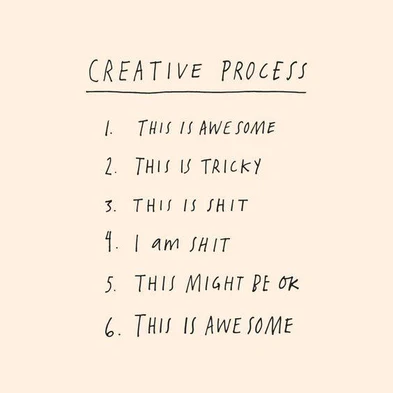
It’s also the bit we’re least likely to talk about.
Because the middle doesn’t come with a neat story. It doesn’t make for a good Instagram post, let alone a LinkedIn pic of the happy team. It doesn’t reduce easily to a lesson or a takeaway. It’s unresolved, slightly awkward, and often still in motion.
And sometimes it never resolves at all.
The project doesn’t land.
The idea gets diluted into something nobody quite owns.
The conversation you built up to in your head doesn’t change anything in the way you hoped it would.
[The imagined conversation is always better than the real one, don’t you find? The other person is always calm, and receptive, and says just what you want them to say…]
When things don’t land, there’s a temptation to treat the whole experience as disposable; to tidy it away so there’s no evidence, and move on [all too] quickly. To tell ourselves, “Well, you win some, you lose some.”
Which is true. But also incomplete.
Because even when there isn’t a visible outcome, something has still been happening, right?
The middle leaves an indelible mark on those who were there. The shared crucible of the middle shapes relationships. How it went defines how it goes: with a human bond of endeavour and vulnerability and trust… or not.
If people spoke up and got shut down, guess what will happen next time. The inevitable disagreement that you need to get to alignment either felt safe or they felt combative (or both of those. How did decisions actually get made when there wasn’t a clear right answer?
None of that shows up on a project plan. None of it gets its own slide. But it accumulates anyway, quietly influencing what becomes possible down the line.
A team that has spent time in genuine uncertainty together is not the same team that walked in at the start… even if the project itself never sees daylight. And neither is the person who led the way when they didn’t really know the way.
We tend to judge leadership at the moment of delivery. Who stood up. Who signed it off. Who got the credit. Leadership is much easier when things are going well. The harder test comes earlier, when the path isn’t obvious and the pressure is rising and there’s no guarantee waiting at the end to justify the effort.
What do you do then?
Do you project certainty you don’t feel, because uncertainty feels like weakness?
Do you shut down disagreement to keep things moving?
Do you prioritise speed because slowness feels uncomfortable?
Or do you name what you don’t yet know, invite better thinking than your own, and stay present when it would be far easier to retreat into control?
[For what it’s worth, I’ve covered all of those approaches in my time. Sometimes in quick succession. I try my best to land on the last one nowadays but, like you, I slip up still too.]
I’ve noticed something about myself over time: I’m often better when things are unclear than when they’re polished. When the shape isn’t obvious yet, and the work still needs holding rather than presenting, I tend to be able to work out what to do when I don’t know what to do.

Which is helpful, because that turns out to be most of the job.
One reason I think we struggle to value the middle properly is that it’s hard to measure. Outcomes have metrics. The middle has judgement, learning, and capability, all frustratingly qualitative.
Another reason is that it exposes us. The middle shows doubt and missteps. Endings let us pretend it was all intentional.
There’s also a quieter fear: that talking about the messiness of the middle sounds like making excuses. As if acknowledging the work that happened without a clean result somehow lowers the bar.
Personally I think it raises it.
Because instead of only asking “Did this succeed?” we start asking better questions. Things like:
What did this show us about how we work together?
What would we now do differently, having lived through it?
What did this strengthen, even if it didn’t stick?
Those aren’t consolation prizes: sometimes they’re the real trophy. But you only get the glory of those insights if you’re willing to look back honestly, without rewriting history to protect your ego.
Of course, this isn’t just about work. Much of life is process-heavy and outcome-light. You can do everything right and still not get the ending you hoped for. We’ve all been there, right?
That doesn’t mean nothing happened. It means you were right there in it.
I’m not suggesting we stop caring about results. Results matter. They keep things moving. They justify the investment and if there were no results at all I think we’d probably need to challenge the “unlucky this time” story and sweat the technique a little. [Additional brownie points to anyone who gets the reference there. If you know, you know.]
But perhaps we could play with the idea that delivery isn’t the only proof that something was worthwhile?
Maybe we get better at noticing what’s being built while we’re waiting for something to finish. Or talk more openly about the messy middle, rather than only sharing the “humbled and proud to announce…” highlight reel.
Maybe we stop wiping the slate spotlessly and antibacterially clean every time something doesn’t deliver, as if the time spent there somehow didn’t count.
And if you’re in the middle of something right now that may never quite land, it might be worth asking yourself a new question:
What is this shaping in you, or in the people around you, while it’s still unfinished?
And are you paying enough attention to notice?

 The Bartlett Bubble
I would write a longer comment but I’m in the middle of something.
LikeLike