Ah, the joys of a good old British summer. A chance to talk about the weather, complain about the weather, and wonder aloud about whether we might actually get more than three days of sunshine in a row, ever again. I’ve seen the mysterious ball of fire in the sky a couple of times in recent weeks and I quite liked it. I look forward to feeling its warm embrace perhaps a couple more times before the nights close in…
And as Summer starts to drift towards Autumn [for my trans-Atlantic cousins, “Autumn” (or the translation thereof) is what the entire rest of the world calls what you have decided to call “Fall”. You’re welcome 😉], the sky beginning to bruise earlier and earlier day by day, we all find ourselves in “BACK TO SCHOOL” mode.
Whether you have kids or not, it’s the same feeling: summer is kind of finished, your holiday is in the rear view mirror, and it’s back to the ‘real world’. Kids go back to school with new rulers and pencil cases and shiny shoes, whilst the workers of the world get back into full work mode, without the updated stationery but perhaps with a bit more battery life after something of a break over the summer months.
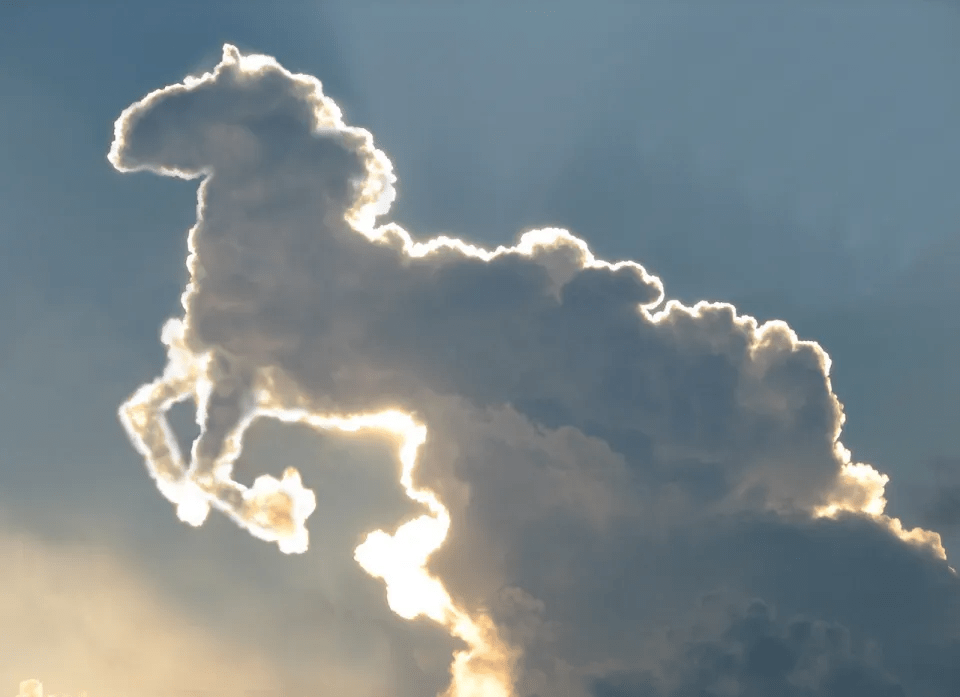
Whilst I’ve been thinking about thinking about this “Back To School” time, waiting with fevered anticipation for the deluge of ‘First day of school’ pics of wide-eyed, excited kids from friends and family to swarm over my socials, I’ve been considering that, actually, whilst we hard-working folks may have had a couple of weeks off somewhere nice, we certainly didn’t have the big break that we used to have back in our school days. No giddy high of “school’s out for summer”; none of the drifting days of those seemingly never-ending summers picking daisies and looking for animals in the clouds.
No, we take a week or two and then crack on. In practical terms, pretty much every day is a school day. And with that simple phrase, we open up another train of thought…
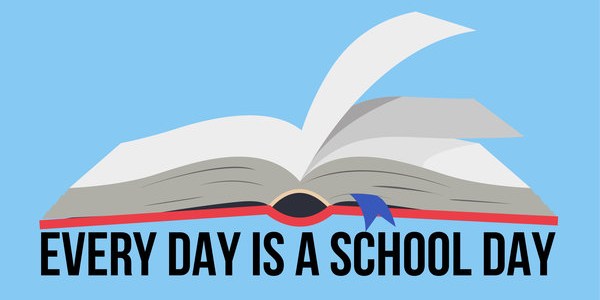
You’ve probably heard the saying “every day is a school day”: the idea that, no matter what stage of life in which you may find yourself, there’s always something new to experience, learn or understand. For some people that might be empowering but more often than not it’s a phrase that’s used when someone has been forced into learning something that really they could have done without; an eye-roll of a comment etched with resignation at one of the realities of life.
And a reality it is. Because whether you like it or not, in that sense school never actually ends.
Part of that deserves an eye-roll, right? The idea that I have to learn, all the time, even though I haven’t been in formal education since the year that Radiohead released OK Computer/Clinton started his second term as US president/Princess Diana died/the UK last won the Eurovision Song Contest/Labour last came to power in the UK [please choose your cultural reference as appropriate]. Surely there’s a point where I’ve done all the learning and can just apply it all?
And yet here I am, nearly 3 decades on from the last time I walked into an exam hall of empty desks and full brains, and I’ve probably learnt more in the last few months than I have in the previous few years. Exciting and exhausting in equal measure.
As regular readers may have picked up, I started a new job at the beginning of the year. Every single day since has indeed been a school day. Not simply because of what I’ve had to learn to be a part of a new agency within a larger organisation of nearly three-quarters of a million people* around the world, but also what I’ve had to un-learn too.
[*That number of people really is quite unfathomably huge, isn’t it? A quick internet search tells me that around 85,000 people could fit, side-by-side and standing upright, on a football pitch. I can kind of visualise that. But nearly 10 times that number? I’m kind of lost. Apparently the original Woodstock festival had between 400,000 and 500,000 people and that looked like this:
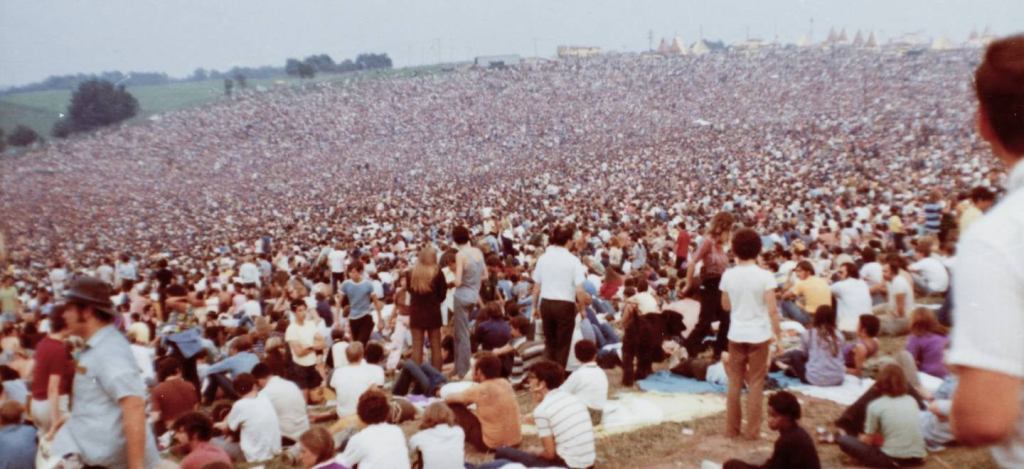
So 50% more than that huge, never ending crowd of human flesh is how many colleagues I now have. No wonder I don’t know everyone’s name yet. Anyway sorry I’ve gone off on a tangent haven’t I – where was I? Oh yes, that’s right…]
What I’ve discovered is that the learning bit is a relatively straightforward and familiar process. You don’t know something… someone tells you or you find out yourself… you remember it. Done.
But the un-learning bit is more complicated. Because that means shifting entrenched beliefs and behaviours, some of which have been part of my working life for as long as I can remember. And because it’s new to me. I’m not sure that I’ve had to un-learn to such a degree before.
Un-learning is about challenging my own preconceptions. Questioning my own well-established wisdom about the working world through which I wind my winsome way.
It’s a funny feeling, actually. Personally I really like the idea of starting with a blank sheet of paper: the freedom that everything is possible; everything up for grabs. It’s part of how my funny old brain works. It’s always exciting to me: never daunting.
But… really? Like, everything is up for grabs? If there are things that I’ve always thought are bullshit, I don’t have to bring them with me? No one is going to say “but this is how we’ve always done things”? We get to say what we actually think about our work and our industry, all the time… as long as we can back it up and write something new on that blank sheet of paper?
Woah. That’s different. That demands a different kind of me to go with it. At least a different way of approaching things, that’s for sure.
For me, it means dialling up the conviction. Dropping some of the very British, very deferential, very hierarchy-conscious, very “polite” language that’s been part of my working world since day dot.
No more: “I feel like maybe it might be worth thinking about whether there might be another way of how we could approach things…”
More “There’s a better way of doing this. We need to change things.”
There’s freedom to that too: freedom to say what you think, rather than having to think first about what you think other people might think about what you think [feel free to read that sentence back a couple of times to work through it if you need to – I certainly did]. Over the years I’ve often found myself tied up in knots with that meta-cognition of thinking too much about my thoughts, and the anxiety of worrying too much about what other people think about my thoughts, and it’s exhausting and really, really not good for me. The idea that I can let some of that go? That’s good for me, in loads of ways.
But if you’re going to have a point of view, you better be able to back it up. Feel free to challenge the status quo, as long as you can replace it with an idea that you can explain, and champion, and bring other people into.
That’s a different kind of pressure, of course. But it’s something I can influence. All I need to do is “trust my own wisdom”. Trust that there are some things I do know enough about, after all this time, that I’m allowed to have a point of view on. [Such funny language – being “allowed” to have a point of view. Who ever really stopped any of us having a point of view, except ourselves and our worries about how other people might take that point of view?]
I know, without any doubt in my mind, that there’s something in your life – work or otherwise – that you think is total bullshit. A process. A habit. A hangover from a previous life. A way of doing something that never really made sense to you but you do it because that’s what you do and that’s what we do and that’s what they do and it’s always been like that.
And if you think about it, I bet there are also things that you’ve learnt along the way about “how things are” or “how things work” or “how it’s done” that are so ingrained that they’ve almost part of you. Less about what you know and more about what you’ve come to believe. Some of these things even drift over into articles of faith: so strong and so solid that they become walls that close us in and keep out any possibility of challenge.
Perhaps there’s a process that’s been around for ever and ever and is just there, despite the fact that people know it’s not really fit for purpose (or was then, but might not be now or for the future). Perhaps it’s a structure that made sense when the team was all in one office all the time, but now you’re more digital and dynamic and dispersed than any workers in the history of work it just doesn’t… well… work. Perhaps it’s as simple as the kind of work that you do and the way that you do it versus the how you might need to adapt in a changing world? [No points for guessing what I’m talking about here, so if you missed my cautiously optimistic musings on AI you can catch up via this handy link. Don’t mention it!]
Perhaps it’s about the person you’re expected to be. At work or at home. And how that fits, or doesn’t fit, actually, with the person you want to be. Or the person you know, deep down, you truly are.
So who, actually, is stopping you from questioning some of these things? Maybe, just maybe, the answer to that question is the most uncomfortable one…
I’ll let you answer for yourself. But I know for me, it’s opening up to the idea of un-learning that is firing my imagination.
So I offer you this, dear reader: perhaps the first thing you might want to consider un-learning is the notion that nothing can change… or that you aren’t the one to do it.
If not you, who?
And if not now… when?
Wait, did you hear that? Yeah, the school bell just rang.
Have a good day, and happy un-learning.

 The Bartlett Bubble