
Someone once said that grief is just love with nowhere to go. I like that idea. But it does leave me wondering: if someone has died, do you continue to love them as much, forever, or even add to that love in the same way as you do with someone who you’re still with? After all, I have new experiences with my wife and kids and friends where the love I have for them is topped up all the time because of something they say or do, an experience we share. Another warm glow of dopamine connection that comes from connection – a smile, a hug, a burst of laughter. Whereas all my moments of connection with my mum happened almost a decade ago…
Oh shit, he’s going to talk about his mum dying, isn’t he?
Well yes, sort of. I am going to talk a bit about death. I’m not going to go into details but, you can take this as your ”trigger warning”: this contains bad language (probably), flashing images (unlikely actually but just in case), alcohol use (I might have a beer at some point during the writing of this so I’ll check that in too) and yes, I am going to acknowledge the existence (or non-existence??) of death.
In my experience, we’re crap about talking about death, or indeed the dead. I don’t think that’s because of the platitude that it “reminds us of our own mortality”: it’s more basic than that. From an evolutionary psychology perspective, it’s simply that we are hard-wired to fear awkwardness – ours, or other people’s on our account – because in evolutionary terms we’re simple, social animals who want to be accepted by the tribe so we can get close enough to the campfire to keep warm and perhaps get some food, and if we’re the awkward one (or worse, the one who makes others feel awkward) we’ll find ourselves cast adrift in the deep, dark forest to fend for ourselves.
But those instincts that were designed to protect us back then, leave us feeling all alone now. Despite the fact that “in this world, nothing is certain except death and taxes” (you can thank Benjamin Franklin for that blunt assessment of our fragile existence), we just don’t have the societal structure to handle it. Our language allows us to talk in euphemisms of people having “passed away”, or having been “lost”, or “left us”. And because no one talks about death… well, no one knows how to talk about death. A cycle of avoidance, which leaves those feeling the loss of death also feeling ever more isolated.
It just seems like poor planning to me. All of our neurological and psycho-social development over hundreds of thousands of years has been painstakingly designed by the trial and error of natural selection to give us the very best chance of staying alive long enough to get our genetic information into the next generation. And yet the inevitability of that we will, without any doubt, experience death and grief doesn’t stop us from getting hit like a bloody train.
[By the way, sorry to boil it down but if you ever have one of those “why am I here” moments in an existential mist, “to get your genes into the next generation” is pretty much it same as every single living thing there has ever been and will ever be. But don’t you dare feel in any way disillusioned or depressed about that. The fact that you are here at all shows that you are the ultimate organism your personal gene pool could have produced. The chances of you being alive at all, let alone at a time when I can write this sitting on a boat on holiday and you can read it wherever you are on a little computer in your hand are so infinitesimally small as to be close to zero.
So, sincerely, congratulations. From an evolutionary perspective, you are absolutely rocking it. The fact that you put on a jacket this morning when you left the house and now you probably won’t need it does not negate the achievements of all your various ancestors in surviving wars, famine, disease, the Dark Ages generally, subjugation, invasion, starvation, attack by bears or, possibly, the odd sabre-toothed tiger. Let’s face it, if your 8-times great grandfather had fallen off that cocoa-trading ship rather than banging his head and falling on the deck, you wouldn’t be here. I’m not saying “be grateful to be alive” because that’s trite and dismissive, and you’re allowed to feel shitty if you’ve got a headache or had an argument or didn’t get the call back you were hoping for. But you are unique, and you are very, very special. Unfortunately, this doesn’t mean you are actually entitled to anything without a starter of skill or talent, a big chunk of hard graft as a main and a side order of good fortune. Oh, and bread and olives “for the table” of course.]
One of the reasons we don’t talk about it is because we think that other people don’t want us to. Only a matter of weeks after my mum died, the idea of mentioning her or the fact she had died or (even more ridiculous) that I still felt sad about that, seemed almost absurd. I mean, nobody wants to hear someone banging on about their dead relative for weeks on end, right? I mean, booooring!
I thought like that, as many do. Until someone pointed out to me a little inconsistency, which I will now pass on to you, dear reader…
If someone you cared about came to you a couple of months after someone close to them had died, and wanted to talk about it, or at least not not talk about it and pretend it hadn’t happened, what would you do?
Of course, you’d be open and empathetic and kind and thoughtful and show them that you cared about them and you’d probably tell them that if they wanted to talk in the future they knew where you were, and you’d probably go away from the conversation feeling pleased that you were able to support them, and actually perhaps a little proud that they felt they could open up to you like that.
So if you would do this, what would make you think they wouldn’t too? It’s not like you’re way nicer than other people, right?
[Don’t worry, I know you’re actually nicer than other people because you’re reading this and I have used AI to ensure that this is exclusively to be read by really, really nice people. But you get the point.]
From this point on, I started mentioning my mum when she popped into my mind. In fact, whenever I talked about the values of the agency I was leading, when I got to “Grace” I’d often say “This was the one my mum liked”… the past tense hanging there, making the point. It brought her into the room with me, and that felt nice.
I don’t mean “into the room” in any ghost kind of way. Although for someone who’s not at all religious, I happily dance along the knife edge of spirituality quite happily, picking and choosing what I believe and what I don’t to create my own unique little belief system. Personally, I don’t believe that there’s some all-knowing, all-seeing something up somewhere looking over us, or that there’s a place we go after we die. I don’t believe in reincarnation, or ghosts, or fate.
But I do believe that, in a certain way, we all live forever. Not in the sense of reincarnation, but in the way that our memory endures, in the people whom we’ve known and loved and who know and love us in return, and then by extension by the people they know and love and so on. We pass through the generations like our own genetic fingerprint, a little piece of us all traveling on into a time we will never know.
As time moves inexorably on, of course, the memory of us will be diluted by every passing day, until there are only homeopathic levels of us still around. But just as a single drop of water doesn’t change the sea, it’s still part of the sea.
That’s how I feel like my mum is still around, I guess. My memory of her is dimming over time – sometimes I can’t quite remember her face anymore and rely on more recent memories of pictures we have around when I envisage her. [Interesting (to me at least) that “envisage” contains comes from the French en- meaning in, and -visage meaning face. Perhaps envisage originally came from the idea of imagining a face? I can’t find anything to confirm or deny that, so please enlighten me if you happen to know].
I can hear her voice, though, very clearly. I was always able to do a decent impression of her, largely to wind her up when she was with me – a favourite being whenever I gave her a bearhug and she would exclaim “my glasses” in her slightly annoyed but amused way because she thought they would get squashed and I’d repeat it back to her to tease her. So now whenever someone says ‘my glasses’ (with the long ‘a’ of “well-spoken” English, of course, making it rhyme with “arses” rather than “asses”) I repeat it to myself in my head, saying it just as Mum would have,.
And in a much more concrete way, I can actually hear her actual voice whenever I want. Because I’ve got a recording of her actual voice.
That might be an obvious thing to say now in a time where we all have a thousand videos of everyone we know on our phones all the time. But filming everything wasn’t quite such a thing 10 years back, and in any case, I wonder how many vids you have of your mum or your dad? They don’t tend to be the people. we capture on video really, do they? So whilst I think I might have a couple of vids in which my mum is in the background, this is pretty much the only place where I’ve got her actual voice.
It was the last answerphone message she left me, and I was so paranoid about losing it I’ve now got it saved all over the place, in various clouds and on laptops and memory sticks. It’s not long, and it’s not that enlightening, but it’s still her voice and because we’re not designed to understand death really, every time I hear it it’s like she’s saying it right now. Like she’s just left it a few minutes ago. Like she’s still alive, I guess.
In the message, she says:
Phil, it’s Mum calling. I’m on my mobile, and it is important that you phone me back, soon as you can. Erm, I’m at Christie’s here, and I need to speak to you. Erm, so… and I guess just be somewhere where perhaps you’re a bit private, darling. Okay, speak when we can. Bye.
There’s a lot to unpack in there. You can’t read the tone of voice, but she’s quiet, and subdued. Doesn’t sound like good news, right?
But before we get there, I’d like to unpack some of the different elements, because in that 31-second recording you can get at least a small sense of my mum, actually.
First of all, I know it’s you calling, Mum, because I saw your number as a missed call. And even if I hadn’t seen your number, I’d know it’s you because I’ve known your voice for my entire life. And let’s be honest, I don’t think the word “calling” is really necessary at all. So from that, you can get that my mum was frustratingly just like your mum and every mum really. Endearingly crap at anything to do with tech, and never really got the hang of mobile communication.
Oh, and by the way, the next phrase: “I’m on my mobile” is also completely unnecessary. You could argue that the instruction to “phone me back” is perhaps a little extraneous, but I’ll give her that. “Soon as you can”, particularly in the tone of voice I mentioned, makes the stomach drop a bit.
And then we get to “I’m at Christie’s”. If you’re unlucky enough to know much about the Christie hospital in Manchester, you’ll know it’s a specialist cancer hospital. Brilliant place, but not somewhere you want to spend as much time as I or my sister have. Ugh.
And then “I need to speak to you” which, let’s be honest, is pretty obvious because that’s why you called me in the first place isn’t it Mum? No one calls because they don’t need to speak to someone. But where were we…?
Oh yeah. “Be somewhere where perhaps you’re a bit private”. Fuck. That’s the bit that gets me, even now. That and the addition of “darling”. A thoughtful, considerate woman, full of love, even at the most difficult of times.
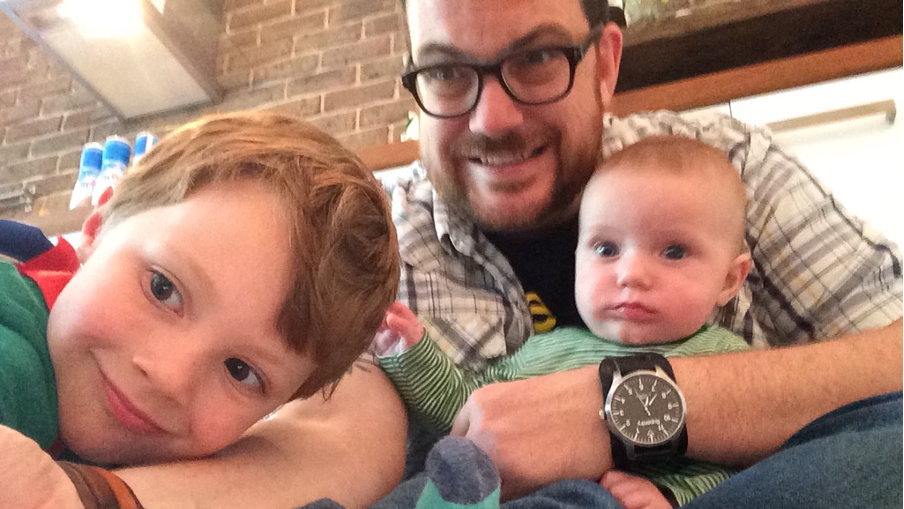
That message was left at 11:31 on the 24th of April, 2014. 4 days after my elder son Ben’s fourth birthday, on Easter Sunday that year. To raise the mood a little, here’s a pointless pic that I took of him and his little brother on his birthday.
I’m not sure why I didn’t answer her call at the time. I’d started about a month earlier at the advertising agency I’ve been running since, and so I was probably in a meeting with my old Finance Director, the inimitable Manoj, where he was telling me about how we were losing money every month and it was now my problem to solve. I do remember a lot of those kind of conversations at that time.
I don’t remember the specifics of the call when I phoned her back either really, but I do know it was the call when she told me the doctors weren’t giving her any more treatment, because it wouldn’t make any difference. From her first round of chemo on April 5th (my sixth wedding anniversary, as it happens), my mum died just 10 days after she left that message, on May 4th, 2014. What started slowly with a cough around the turn of the year accelerated fast and then it was just bad news every time.
I read somewhere that we have societal and social coping mechanisms for death, built into our emotions, but that these only really work for the sudden, unexpected but immediate death (the “massive heart attack” or “tragic car accident”) and the long, prolonged death from a terminal illness. Whether or not that theory holds water [what an odd phrase that one it – sounds like someone who needs to go to the loo] or not I’m not sure, but the fact is that the situation with my mum fell between these two – not so quick as to be in a state of shock; not slow enough to come to terms with things. Just bad news every time.
Your experience of death will be different from mine, of course. Where you were, who you were with. Who told you, if you weren’t there, yourself, and how you reacted. But whilst those moments are right there with you as they are with me, and were so, so visceral at the time, I’ve found that those aren’t the times I remember when I think of Mum, because really those are about me, and my feelings, and my reactions, not actually about her. How I think of her has changed as the time between now and then has grown, so that now I miss her in a much more general way: less about specifics of experiences we shared, or about her absence at those key dates around the calendar, but more the idea of Mum, in all her “Mumness”, that I often think about. Let me explain…
Mum would quite often come down to visit my wife and me in South Eash London, and use us as a base for going to galleries or museums in the city centre. She was on her own in her little terrace in Nantwich, Cheshire, and so she’d get the train down from Crewe to Euston and then, as a confident user of London’s public transport system (she was brought up in Richmond in London’s leafy South West) would make her way to The National Gallery (most likely) before heading on down to us in Crystal Palace where she’d just turn up on the doorstep. Without any real idea of when to expect her, the doorbell would ring, and I’d say “That’ll be Mum” and go to answer the door and she’d be standing there with her little wheelie suitcase wearing that dark purple coat that I bought for her one Christmas (I think??). Just “Mum”. All hugs and smiles and stories of the exhibition and her journey.
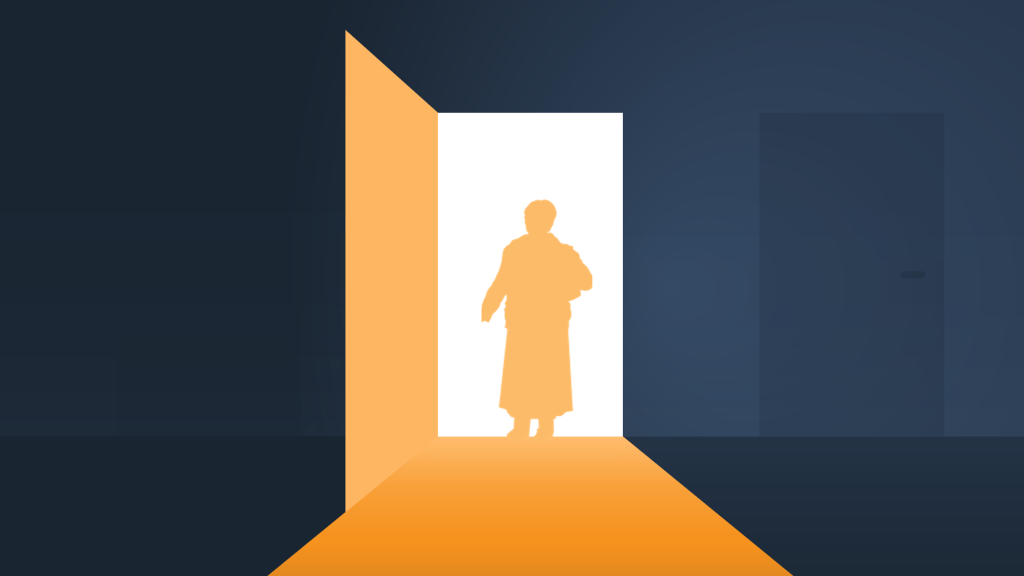
The feeling of opening the door and seeing her there is one that I miss with all my heart, but also one that I can feel today as strongly as I ever could. And one that always brings a thoughtful smile because that’s what keeps her with me. Not the pictures, or the voicemail, or the recipe for marmalade she wrote out for me because she could never remember that I hate marmalade. It’s the feeling of “Mum”. Still with me, whenever I want it.
The person you’re thinking of now, that you miss so dearly… they’re with you, too, in whatever way you choose to believe or experience that. They’re part of your experience and, by extension, they’re part of how people experience you. Celebrate them. Miss them. Raise a smile for them too.
We’ve all experienced grief in some way. A grandparent, a friend, a parent, a sibling, a colleague. Even a relationship. The end of something we didn’t want to end. It’s all the same feeling, really, and we’ve all felt it. So don’t push it away, and please don’t worry about talking about it. I promise you that you’ll find that the vulnerability of grief can actually be a wonderful way of connecting with someone who already cares about you.
I’ve just found the slightly longer quote from which I’ve taken the title of this piece, and it’s worth sharing…
Grief, I’ve learned, is really just love. It’s all the love you want to give, but cannot. All that unspent love gathers up in the corners of your eyes, the lump in your throat, and in that hollow part of your chest. Grief is just love with no place to go.
Except, of course, love always has somewhere to go, doesn’t it? Love that was for someone else, but now goes into the people who are still with you.
Thanks for sticking with me today, I really appreciate it. Love to you and yours.

 The Bartlett Bubble
Nobody writes with such a stream of vulnerability and honesty like Phil. A therapy session on a page. I started thinking of my mum, my childhood best friend and even an old work colleague, who all passed too soon and I will try to ‘celebrate and raise a smile for them’. And I hope, if we are lucky, that some day (way in the future) we all will be missed like Phil misses his Mum.
LikeLike
Bloody hell Olly – you got me there! What a lovely comment. Thank you x
LikeLike