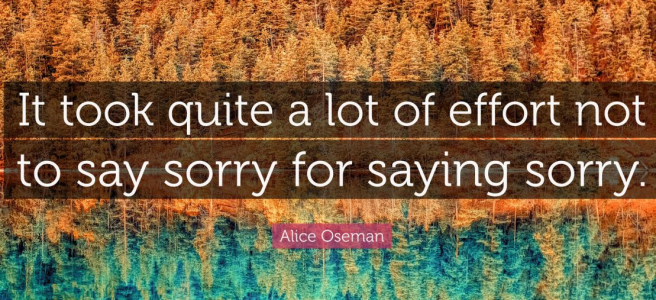
A little while ago I wrote some words around the idea of saying sorry; or more specifically the incredible power that the word “sorry” has to take the wind out of the sails of indignation, and deflate the balloon of conflict. Used judiciously it can be the one and only perfect word right at the best possible time. Over the years I’ve learnt the fact that actually saying “I’m sorry” (whether verbally or in writing) can be all that’s needed. It’s a chance to move on.
But I’ve got some bad news for you, I’m afraid. I haven’t been judicious with my use of this most valuable of words. No, I’ve been scattering sweet sorry around like popcorn in a cinema, not minding if it drops on the floor or hits the mark or just sticks to my jumper like a limpet on an old boat, waiting to be spotted as I walk out into the brighter light of the foyer, and only then being popped into my mouth as though nothing more normal could have happened.
[Is popcorn the only food you happily eat off your own clothing? I reckon it is. If you can think of anything else please send me a postcard about it…]
Sometimes a week at work can sound like an endless stream of apology, regret and self-flaggelation.
Sorry.
Sorry I don’t understand.
Sorry I have to jump to my next meeting.
Sorry I’m late, my last meeting ran over.
Sorry I didn’t see your message.
Sorry I didn’t reply to your message.
Sorry I didn’t have a chance to reply to your message sooner.
Sorry I can’t make that time, I’ve got a conflict.
Sorry I don’t have that information.
I am so utterly and completely sorry I’m not sure I deserve the gracious response you’re going to give. I have let you down, and I have let myself down. I am bereft.
A couple of weeks ago I caught myself saying sorry for not having been able to watch the recording of a meeting that I’d already said sorry for not having been able to make because I was already in another meeting.
[Who decided this was okay, by the way? “Can’t make a meeting because you’re too busy? Don’t worry, you can catch up with everything (without being able to input, of course) by watching the video of the meeting in your own time”. Time, remember, that you didn’t have to attend in the first place. A meeting, remember, for which you were deemed relevant enough to be asked, but not so relevant that the meeting gets rescheduled to get your input. I guess if the meeting can go on without your input… you actually weren’t really all that needed in the first place? Anyway, I digress. Sorry]
My excuse for such horror? Such abject degradation? Why, pray tell, had I failed so completey?
Because I had taken a couple of days off to spend time with my family over school holidays. At the time at which the meeting had been scheduled, I was probably on a beach in West Wales, hand-in-hand with my beloved wife, lazily kicking a football back to one of my incredible sons, throwing sticks into the surf for the amazing Ruby [Ruby is a dog, in case you’re wondering].
And yet I’m sorry. Really?
In the midst of a busy life within, let’s be honest, a pretty busy world right now, it’s not just my working week which is awash with woe: it’s my personal life too.
Sorry I missed your call.
Sorry I haven’t got back to you.
Sorry I can’t do that date.
Sorry I can’t make the gym tomorrow.
Sorry for the radio silence.
Sorry I’ve not been a bit grumpy recently.
Sorry.
Ring any bells?
I wonder how many times a day you say sorry? I bet if you counted it you’d be shocked.
And the most shocking thing about all of these?
Very few of the times we say sorry is there anything we could possibly have done to avoid the situation. Saying sorry, time and again, for things that aren’t actually our fault,
I get that some of this is politeness and manners. We’re showing that someone else might, in some way, have been inconvenienced, or worse for those who love us and whom we love, might have been concerned in some ways: for our wellbeing, or even worse for the health of the relationship.
And, of course there’s the added social anxiety of simply being British: us Brits already say sorry if someone bumps into us, for crying out loud; now we’re sorry for not having had a chance to read the pre-read before the prep meeting before the actual meeting…

So yes, there’s an element of awareness of the situation and potential impact it may have had on others.
But I wonder, in vast majority of these situations does anyone actually need a full blown “sorry“?
As I’ve mentioned before in these pages, on a Friday morning before work I try to go for a walk in the woods just over the road from my front door, accompanied by my good friend Joe from down the road [Hello Dr B!] and the aforementioned Ruby.
We try [a broad brushstroke of a word, with wide-reaching edges from active to passive, insincere to heartfelt] to do this every week, but we’re both busy boys and so it doesn’t happen as often as we’d both like it to. And for a couple of months this year, it dropped off completely. Every time, one or other of us would say sorry we couldn’t make it for some reason or other.
When next we met, we set off on one of the many routes we can take, and started to talk as we usually do.
And as we walked and talked, we both found ourselves apologising for not having done this sooner.
Which caught my friend’s attention. He pointed out that the things that had meant we couldn’t go on a walk together – something we both enjoy and look forward to – weren’t actually our fault at all. It had been because of the demands of working life, or the responsibilities of home life, or actually because one of us had been ill. Apologising on behalf of a bloody virus. Sorry but that’s ridiculous isn’t it? [See what I did there? Another pernicious little sorry, this time with the magic “but” which actually means you’re not sorry at all, yet still it pops out almost as a reflex…]
So we pledged that we wouldn’t say sorry to each other for not being able to walk together any more. Neither of us were to blame, and we both recognised it.
That communal commitment has stuck with me, And damn it if it hasn’t actually made it from a theoretical “that would be a good thing to do” into the more intentional, and more definite “I am doing this.”
[That’s actually quite an important shift; particularly, perhaps, for someone with a brain like mine. Someone like me. Me, basically. Part of the discipline I’m trying to bring into my life is acting on my ideas and instinct and ideology, and training myself to actually do what I say. So instead of “I’m thinking of writing a book about how someone can hack ADHD to fulfill their leadership potential”, I’ve switched to saying “I’m writing a book on Hacking ADHD for Leadership”. True story, Bit scary to make that shift, but it’s almost like that itself is a little hack. Oh, I’m writing a book am I? Best crack on with it. Don’t worry I’ll make sure you get a mention in the acknowledgements.]
And so I’ve stopped saying sorry as a default, for things that aren’t my fault. To to bring sorry back from the brink of being totally meaningless.
Sorry needs to mean something, or it means nothing.
And most of the time we say “sorry”, we’re actually not sorry at all really.
I read something recently that suggested replacing “sorry” with “thank you” in the work instances…
Thanks for waiting.
Thank you for your patience.
Thanks for the reminder.
I reckon those would do nicely for a whole load of those times when you overuse “sorry” in work, right? Not a massive shift in politeness, but a shift in energy for sure.
Okay, it might not be as as appropriate with friends you’ve not been in touch with [“thanks for your patience, I would now like to go for that aforementioned coffee”], but if you just tell them the reason you dropped off the radar a bit is because you’ve been been totally overwhelmed recently so the idea of making contact hasn’t managed to move from a vague idea to something more active, despite the fact that speaking to them might have been the best possible thing [true story], I’m pretty sure they’ll get it. They don’t need a “sorry” from you.
Why don’t you try to do the same? Reserve “sorry”, with all its truth and power, for the moments when you need its truth and power? For when it was your fault, and you want to make amends?
Because when it’s not your fault, it’s not really your place to be sorry, and it’s so desperately draining to be sorry all the time, right? Politeness be damned: a world of contrition is no place to live.
For what it’s worth, I think you’re actually doing bloody well under the circumstances, with that deadline and that target and those responsibilities and that tricky relationship and those thoughts you have sometimes and these difficult times and that bloody orange bloke back again.
You’re showing up as you need to, and being who you need to be for whomever’s in front of you.
You’re making the right decisions based on the information you have at the time, as you always have.
You’ve given the love you can to the people who deserve it.
So please, don’t go around being sorry for the little things that weren’t your fault. Be proud of the important little things you’re doing, every day,
And as I leave you here, I will simply say sorry that this was perhaps a little long, and sorry I didn’t finish writing it last week when I planned to, and sorry that I didn’t put my clothes away before I had to leave to take Jack to his football match this morning like I promised I would.
This last one is really only relevant for one specific reader to be honest, and I’m not sure she always reads this. Sorry to have wasted your time reading it.
Until next time. Thanks for your patience.

 The Bartlett Bubble